Upgraded Ariane 6 Lofts Thirteenth Group of Amazon Leo Satellites

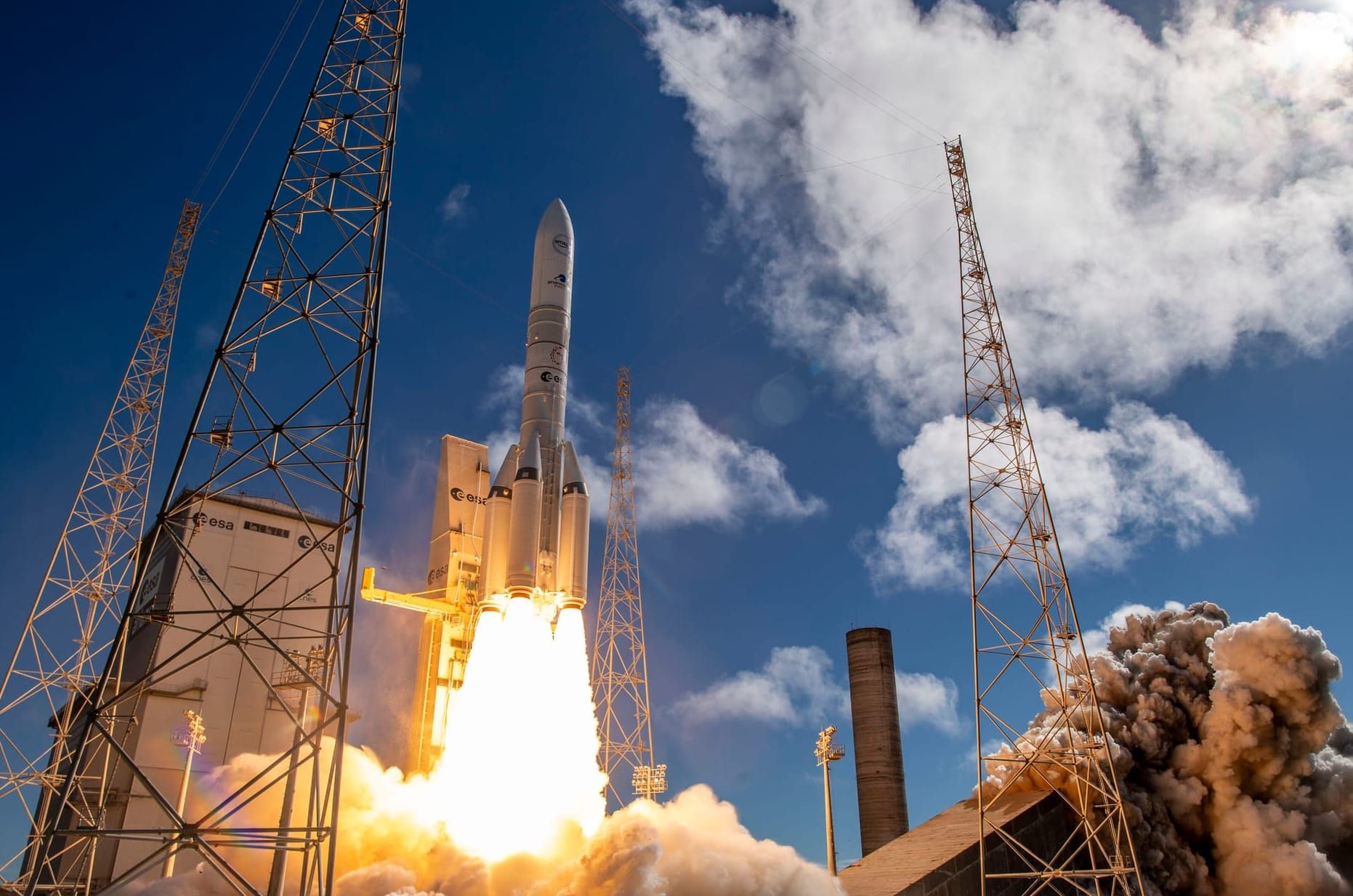
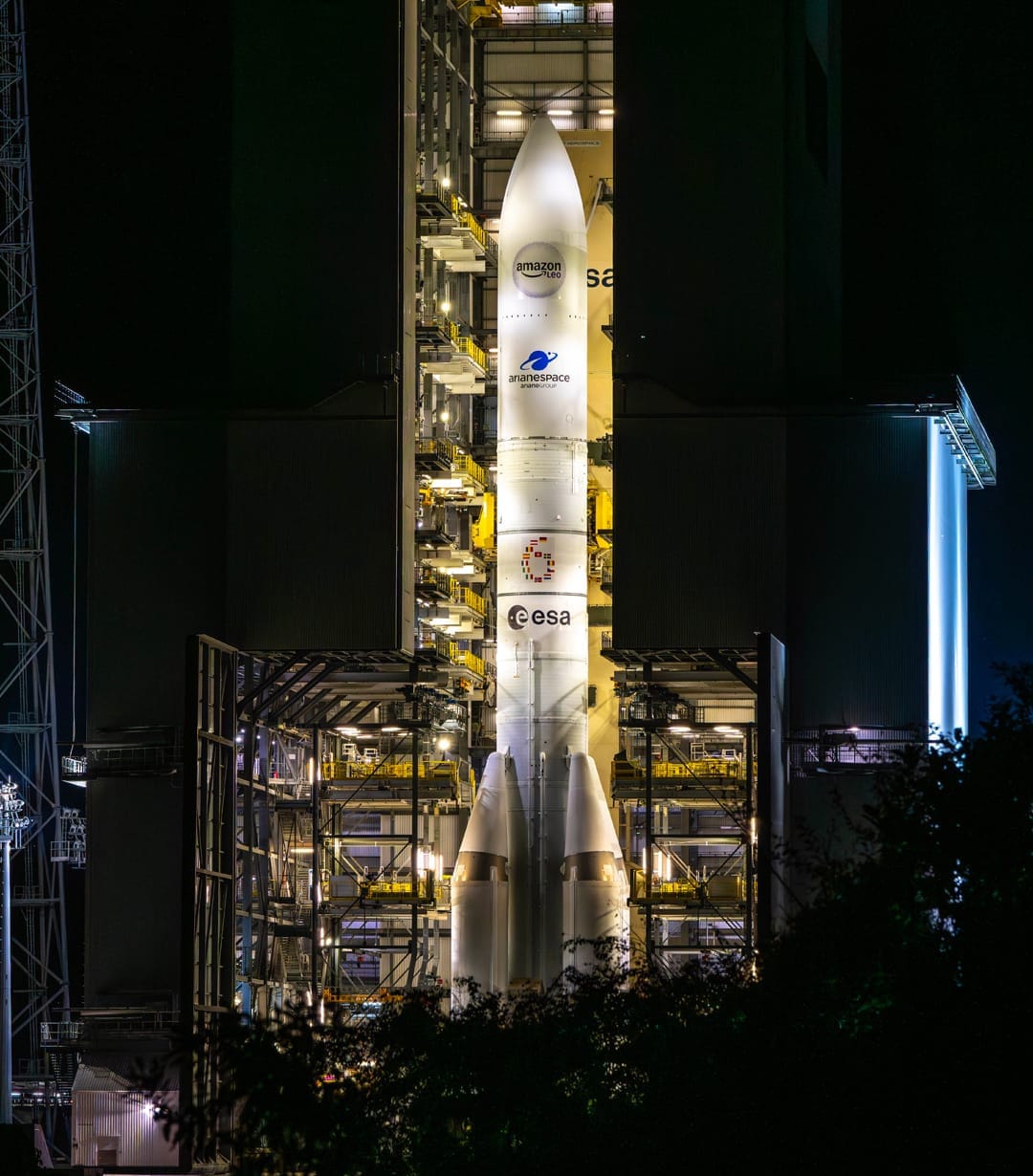
Out of the Guiana Space Centre at 12:21 pm Universal Coordinated Time on June 17th, the most performant Ariane 6 to date carried 36 satellites into low Earth orbit, its largest group so far, for Amazon's space-based internet constellation.
With the increased power of its four solid rocket boosters and its single Vulcain 2.1 engine, Europe's Ariane 6 soared at great speed from French Guiana and towards low Earth orbit. The boosters propelled the flight for a little over two minutes, with Vulcain 2.1 continuing to do so for another five and a half minutes. Orbit would be achieved a few minutes later thanks to the second-stages Vinci engine.
At eighty-six minutes after liftoff, the 36 satellites began the steady process of being released from Ariane 6, taking place over the course of twenty-five minutes. Compared to previous Leo deliveries via the rocket, an additional four satellites were onboard thanks to the performance added by the new P160C solid rocket boosters, replacing the slightly shorter P120C.
LIFTOFF! 🚀 Ariane 6 #VA269, in its most powerful configuration yet, launching 36 Amazon Leo satellites. @transport.esa.int
— European Space Agency (@esa.int) 17 June 2026 at 13:25
[image or embed]
Impressive real footage of the four P160C boosters separating from the rocket.
— ESA Space Transport (@transport.esa.int) 17 June 2026 at 13:33
[image or embed]
Today's and previous groups are heading toward, or operating in, an orbital altitude of around 630 kilometers to prepare to provide internet services to customers. Following the deployment of further satellites, services from Leo are planned to be available later this year at speeds of up to one gigabit per second, something already demonstrated.
Thanks to this deployment, Amazon has 367 satellites in orbit through thirteen launches, via three providers. Arianespace has now conducted three of those, United Launch Alliance has performed the bulk of those with seven previous missions, while SpaceX has performed three dedicated launches.
Speaking on Ariane 6's capabilities in support of Leo, David Cavaillolès, Chief Executive Officer of Arianespace, shared:
"With 100 satellites now placed in orbit by Arianespace for Amazon Leo and the launch of 4 more satellites than the first two missions, we are setting records with an increasingly powerful and versatile launcher. This further demonstrates our ability to address new markets, and especially constellation deployment."
Christophe Bruneau, Chief Executive Officer of ArianeGroup, meanwhile boasted about upgrades to the rocket:
"Today, we witnessed a particularly pivotal launch for Ariane 6 with the first successful flight of the P160C boosters. This success demonstrates ArianeGroup's ability to make evolve the launcher in less than 2 years after its inaugural launch, maximizing its performance. All the teams from ArianeGroup and its partners can be proud of this result, it is an outstanding achievement."
A few weeks from now, no earlier than July 3rd, Amazon will have its final launch atop United Launch Alliance's Atlas V, to deliver 29 satellites.
Amazon gets deployment waiver
Having informed the U.S. Federal Communications Commission in January that they would not be able to have a cumulative 1,616 satellites deployed, half of the Leo constellation, by the end of July 2026, Amazon requested an extension or waiver for their regulatory deployment deadlines. Followed by a brief spat from the Commission's chairman and SpaceX, the company got a waiver on June 5th.
That waiver details that the requirement to have 1,616 satellites in orbit has been delayed two years, to July 2028, but with reduced priority for Commission frequency approval until March 2028. The reduced priority can be shifted to November 2027 if Amazon proves that they have built enough satellites to reach the halfway milestone and procured suitable launch solutions, which they have.
A regulatory requirement to have all 3,232 satellites in orbit by the end of July 2029 remains in place. Customer services will not need all of the satellites, with Amazon hinting that they may be available in the coming months.
What is Ariane 6?
Ariane 6 is ArianeGroup's latest launch vehicle in the Ariane family of rockets. ArianeGroup has been manufacturing and marketing the Ariane launch vehicles on behalf of the European Space Agency since Ariane 4. Two versions of the Ariane 6 rocket are available, Ariane 62 and Ariane 64.
These two versions share the first and second stages. The first stage of Ariane 6 burns liquid hydrogen and liquid oxygen in a single Vulcain 2.1 engine, producing 139 tons of thrust. The second stage of Ariane 6 also burns liquid hydrogen and oxygen, but in a single Vinci engine that generates 18 tons of thrust.
Each of the solid rocket boosters burns a mixture of aluminum and hydroxyl-terminated polybutadiene to produce 474 tons of thrust each. This allows Ariane 62 to generate 1088 tons of thrust at liftoff, while Ariane 64 can generate 2036 tons of thrust.
Ariane 62
Ariane 62 is the cheaper of the two configurations because it opts to use two solid rocket boosters. The lift capacity of Ariane 62 is as follows: 10,350 kilograms to low Earth orbit, 7,200 kilograms to a sun-synchronous orbit, 4,500 kilograms to geostationary transfer orbit, or 3,500 kilograms to a lunar transfer orbit.
On the launch pad, Ariane 62 weighs approximately 530,000 kilograms with a first-stage, second-stage, and faring diameter of 5.4 meters. Ariane 62 stands 56 meters tall ahead of launch.
Ariane 64
Ariane 64 is the more capable of the two configurations due to its utilization of four solid rocket boosters. The lift Capacity of Ariane 64 is as follows: 22,000 kilograms to low Earth orbit, 15,500 kilograms to a sun-synchronous orbit, 11,500 kilograms to geostationary transfer orbit, 8,600 kilograms to a lunar transfer orbit, or 5,000 kilograms to geostationary orbit.
On the launch pad, Ariane 62 weighs approximately 860,000 kilograms with a first-stage, second-stage, and faring diameter of 5.4 meters, exactly the same as Ariane 62. Ariane 64 is eight meters taller than Ariane 62 and is 62 meters tall ahead of launch.