Starship 'Block 3' Flights Begin With a Bumpy Start

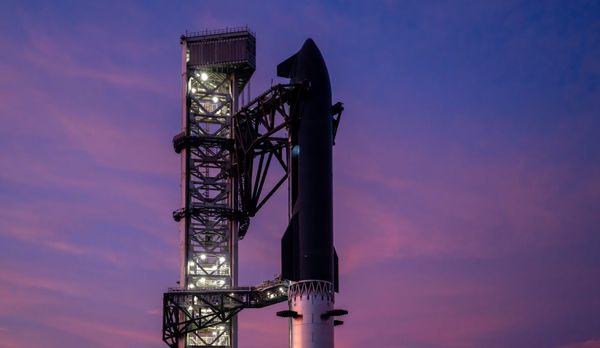
Having spent the first part of the year commissioning a new launch pad and vehicle upgrades, Starship's twelfth flight test took place on May 22nd, utilizing Super Heavy Booster 19 and Starship upper-stage Ship 39.
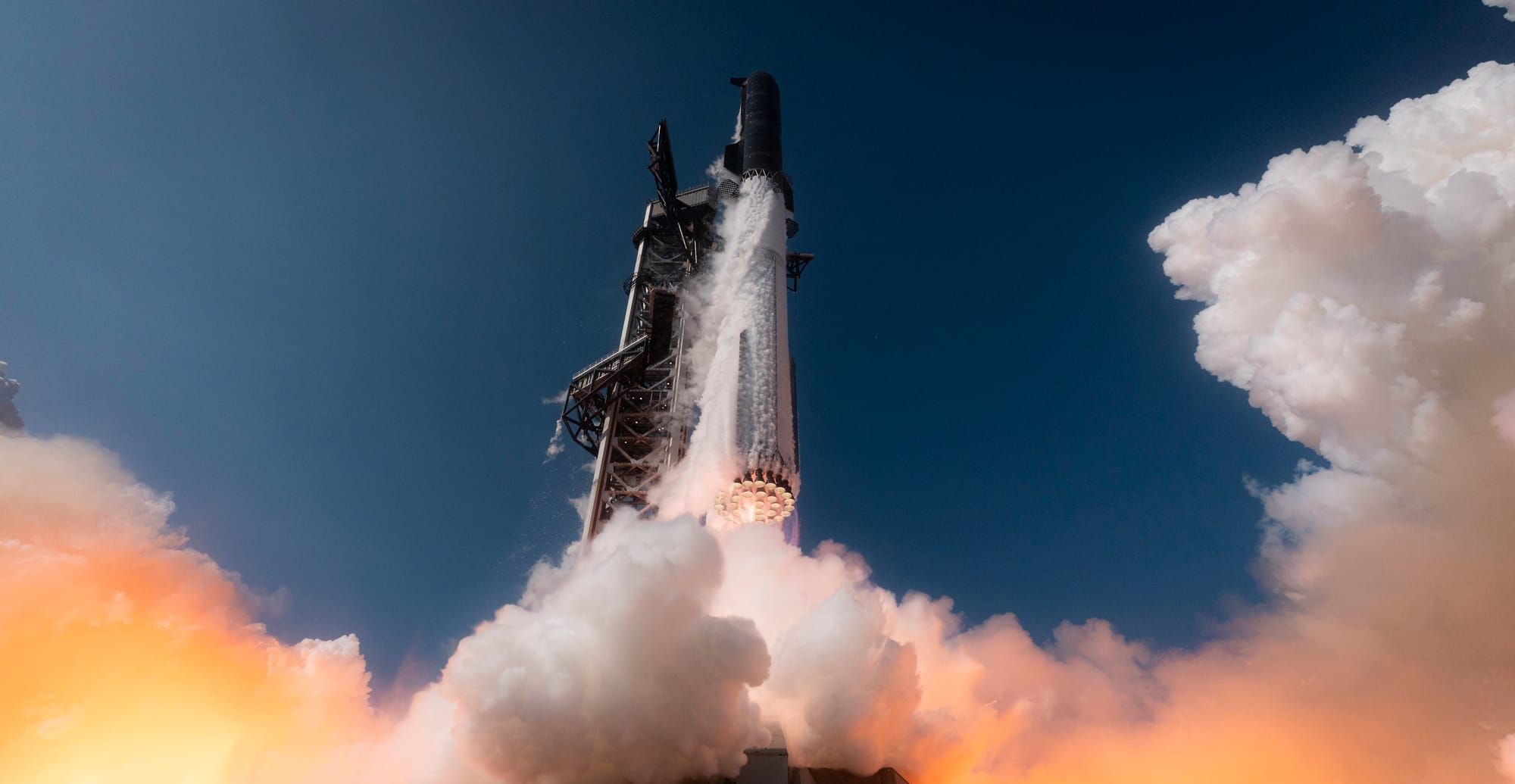
For the first time with an integrated 'Block 3' Starship-Super Heavy launch vehicle, thirty-three 'Raptor 3' engines ignited at SpaceX's second launch pad at Starbase, carrying Booster 19 and Ship 39 skyward. Behind the vehicles was a sizeable cloud of smoke, produced by the heat of the egines and the pads water deluge.
Liftoff of Starship! pic.twitter.com/LQLdjK5V6K
— SpaceX (@SpaceX) May 22, 2026
Ascent to staging proceeded perfectly with all enigines remaining lit, with an impressive over 180-degree spin to obtain flight attitude too. Ship 39's six 'Raptor 3' engines, three optimized for sea-level and three for vacuum, lit to perform hot-staging from Booster 19, which had five engines still firing.
Starship’s Raptor engines ignite during hot-staging separation pic.twitter.com/oNdU0Z4FQI
— SpaceX (@SpaceX) May 22, 2026
Hot-staging of the two stages went flawlessly. Not long afterwards Booster 19 attempted to relight most of its engines for a simulated boost-back burn, but that was aborted shortly into it. Additionally on Ship 39 one of its vacuum engines cut off early, leaving the remaining five to compensate.
Booster 19 managed to regain some control as it fell back to Earth, further away from Starbase and faster than planned, however its enginges failed to properly reignite for a landing burn attempt. The first-stage slammed into the Gulf of Mexico at several hundred miles per hour.
Fair play, Booster 19. Sporty all the way. Well done to SpaceX for showing it too. pic.twitter.com/b3NGnV589n
— NSF - NASASpaceflight.com (@NASASpaceflight) May 22, 2026
Remaining engines on the upper-stage did manage to compensate, bringing Ship 39 onto its targeted trajectory over a minute behind schedule. Views from inside the engine skirt, shown briefly by SpaceX, showed damage around the outside an a gas leaking around one of the vacuum engines.
Starship has successfully deployed our modified @Starlink satellites and simulators pic.twitter.com/0ym9RJ0J6M
— SpaceX (@SpaceX) May 22, 2026
Floating in space after ascent, Ship 39 was planned to demonstrate an in-space 'Raptor 3' relight, but that was skipped following the engine failure. A payload deployment test was performed with the release of twenty dummy Starlink satellites and two modifed ones, known as 'Dodger Dogs'.
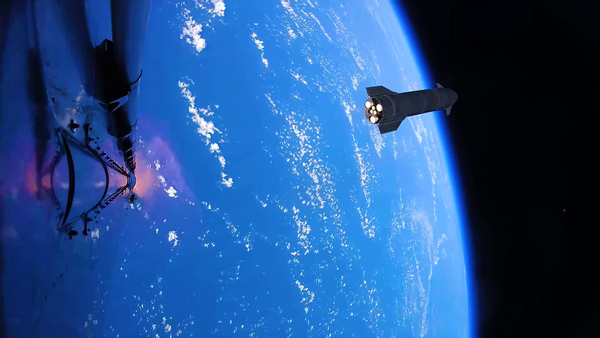
While floating towards atmospheric reentry, the two 'Dodger Dogs' zipped around Ship 39, inspecting its heat shield, flaps, and structure by a proper 'third-person' view for the first time. Those views will be used to examine how the Starship upper-stage handles ascent.
Views of Starship in space from a @Starlink satellite pic.twitter.com/5hfw1n8v1o
— SpaceX (@SpaceX) May 22, 2026
With part of the in-space demonstrations complete, Ship 39 prepared for atmospheric reentry by orienting itself nose-up into its flight path. Reentry lasted a dozen minutes and provided an amazing lightshow, with part of the breakup of the 'Dodger Dogs' seen.
Starship is executing a banking maneuver that mimics the final approach it would take while returning to Starbase for a catch on a future mission pic.twitter.com/3YQr8LKAaj
— SpaceX (@SpaceX) May 22, 2026
Following reentry, Ship 39 performed a series of maneuvers with its flaps during descent to simulate the path it would take when heading back to the launch site for a catch, also slowing it to sub-sonic speeds simultaneously. Once low enough above the Indian Ocean, two 'Raptor 3' engines relit for a landing burn, quickly bringing the upper-stage upright from its bellyflop, which successfully allowed for a splashdown.
Splashdown was shortly followed by Ship 39 falling on its side and exploding, concluding the flight test.
Splashdown confirmed! Congratulations to the entire SpaceX team on the twelfth flight test of Starship! pic.twitter.com/XXBAtryPpL
— SpaceX (@SpaceX) May 22, 2026
What's happening next?
Starship-Super Heavy's twelfth flight test proved that a 'Block 3' vehicle can ascent out of the atmosphere, release internal SpaceX payloads, and land the upper-stage in a controlled manner. With the loss of Booster 19, that makes this flight a mixture of the third (March 2024) and fifth flight (October 2024) tests in terms of what was proven.
Having skipped the in-space relight of a 'Raptor 3' engine, the next flight test will need to complete that objective before the first orbital flight test can go ahead, as leaving a massive multi-hundred-ton object in orbit would be massively irresponsible.
Consequently, in the remaining six months of the year, test flights to prove a Ship-to-Ship propellant transfer will be delayed. That capability is needed for a crewed lunar landing contracted by NASA in 2028, which itself may need fifteen flights of the vehicle and the Office of Inspector General believes SpaceX is repeatedly running behind schedules. Flights into orbit are also needed for 2027's Artemis III mission to test Starship's lunar lander variant with the Orion spacecraft and astronauts.
In 2025, SpaceX wrote off progress towards orbital flight with the loss of many vehicles before or during flight tests. Ship 33 was lost to a fire in its engine section in January 2025, another fire caused Ship 34 to be lost in March 2025, and Ship 35 was destroyed during atmospheric reentry following propellant leakages across the vehicle in May 2025. 'Block 2' only had two successful missions, coming in August with Ship 37 and in October with Ship 38. On the ground Ship 36 wiped out the only site able to perform test firings of the upper-stage for several months, while Super Heavy Booster 18 failed to hold pressure during a quality test, delaying the twelfth flight test.