Second Four Booster Ariane 6 Mission Delivers Eleventh Set of Amazon Leo Satellites

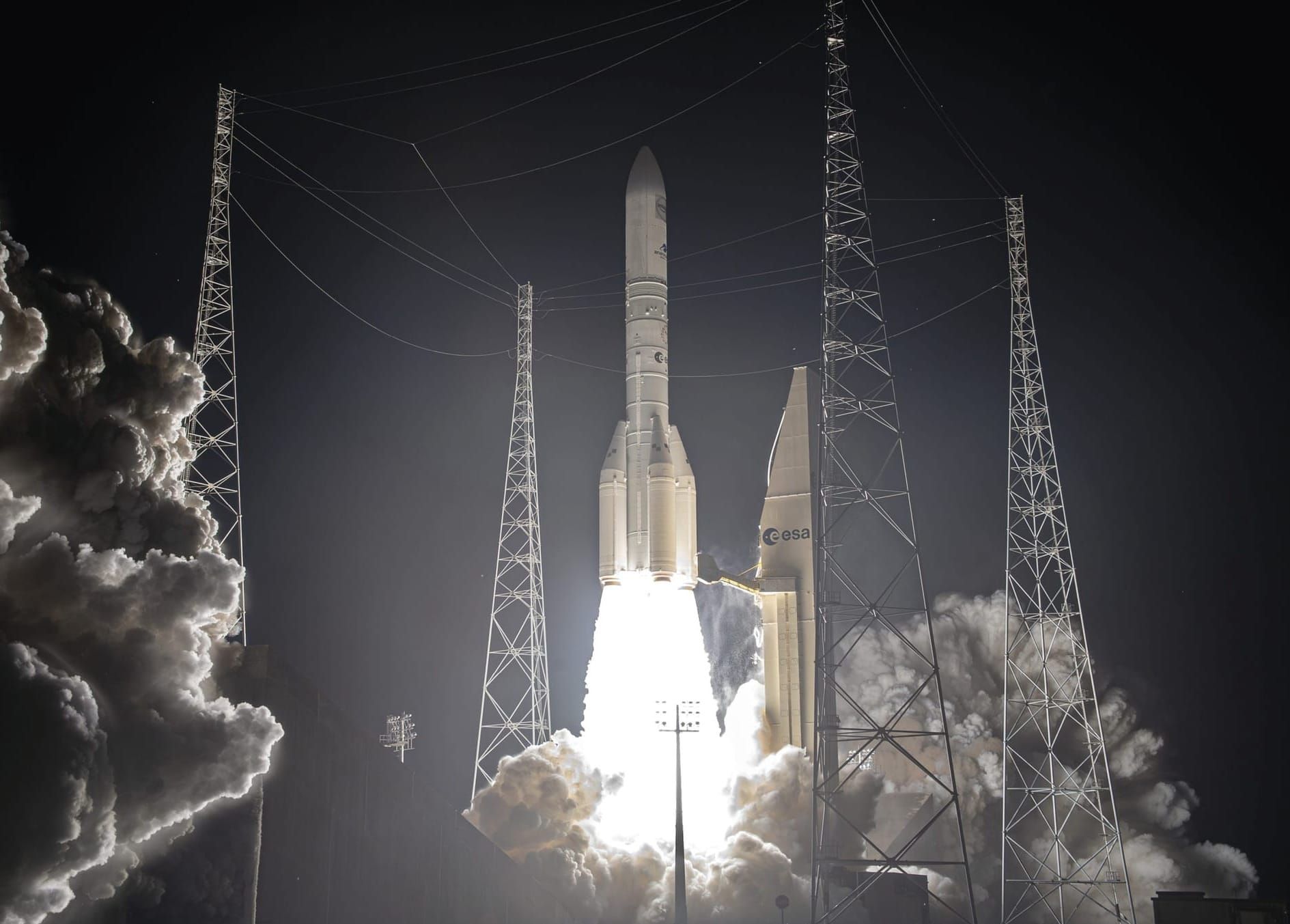
For the second time this week, Amazon's Leo internet connectivity satellites departed Earth, with a liftoff from the Guiana Space Centre at 08:57 am Universal Coordinated Time on April 30th.
Through the power of four solid rocket boosters and the Vulcain 2.1 engine, Ariane 6 lit up the night sky over French Guiana in its ascent into low Earth orbit, carrying 32 Leo satellites as part of its eleventh group. Initial orbit was achieved after a dozen minutes, before a series of precise burns with the Vinci engine perfected it.
Around ninety minutes after liftoff, the group of satellites were relased of the course of twenty-five minutes, in a process very similar to Europe's first delivery for Amazon.
There's been a rumble in the jungle! Ariane 6 is carrying another batch of 32 Amazon Leo satellites to Low Earth Orbit.
— Jay Keegan (@_jaykeegan_) April 30, 2026
Good ascent so far, good SRB sep.@NASASpaceflight pic.twitter.com/ZnulMj2133
Today's and previous groups are heading toward, or operating in, an orbital altitude of around 630 kilometers to prepare to provide internet services to customers. Following the deployment of further satellites, services from Leo are planned to be available later this year at speeds of up to one gigabit per second, something already demonstrated.
Following today's launch, Amazon now has 302 Leo satellites to provide space-based internet services in orbit through eleven launches. Back in early February, Arianespace joined SpaceX and United Launch Alliance in deploying satellite groups.
Speaking on this and sixteen further Leo launches, David Cavaillolès, Chief Executive Officer of Arianespace, shared:
"This second launch for Amazon Leo marks another milestone in Ariane 6's ramp-up, demonstrating our ability to meet the growing needs of the constellation market and to deliver reliable, competitive solutions to our customers. We thank Amazon for its trust and remain fully mobilised to ensure the success of this partnership."
As soon as May 22nd, 29 more Leo satellites will head for space via United Launch Alliance's Atlas V. Not too long after that, another Ariane 6 will be carrying over 32 satellites. Deployments via Falcon 9 may also occur soon.
Amazon bolsters Leo capabilities
In an effort to become more competitive against SpaceX's Starlink, Eutelsat's OneWeb, Shanghai's SpaceSail, and China's GuoWang, Amazon announced on April 14th that they intend to acquire Globalstar and its fleet of 88 satellites in Earth orbit as part of a move into mobile direct-to-device services. Amazon's rationale for the acquisition was, according to Senior Vice President of Devices and Services Panos Panay, as follows:
"There are billions of customers out there living, traveling, and operating in places beyond the reach of existing networks, and we started Amazon Leo to help bridge that divide. By combining Globalstar’s proven expertise and strong foundation with Amazon’s customer-obsession and innovation, customers can expect faster, more reliable service in more places—keeping them connected to the people and things that matter most."
The acquisition is valued at around 11.57 billion United States Dollars and is expected to be complete in 2027.
Looking a few years into the future after the acquisition, Amazon plans to include direct-to-device systems onboard Leo satellites with higher throughput and improved capabilities compared to those of Globalstar.
Alongside aiming for mobile services, airline users are also being sought. On April 13th, the company revealed Leo's 'Aviation Antenna' for use across several aircraft. That antenna is planned to provide 1 gigabit download and 400 megabit upload for airborne users. Two weeks before the announcement, Delta reached an agreement with Amazon to introduce Leo services to five hundred aircraft initially in 2028. Meanwhile, JetBlue plans to use the space-based internet for free in-flight connectivity starting in 2027.
What is Ariane 6?
Ariane 6 is ArianeGroup's latest launch vehicle in the Ariane family of rockets. ArianeGroup has been manufacturing and marketing the Ariane launch vehicles on behalf of the European Space Agency since Ariane 4. Two versions of the Ariane 6 rocket are available, Ariane 62 and Ariane 64.
These two versions share the first and second stages. The first stage of Ariane 6 burns liquid hydrogen and liquid oxygen in a single Vulcain 2.1 engine, producing 139 tons of thrust. The second stage of Ariane 6 also burns liquid hydrogen and oxygen, but in a single Vinci engine that generates 18 tons of thrust.
Each of the solid rocket boosters burns a mixture of aluminum and hydroxyl-terminated polybutadiene to produce 474 tons of thrust each. This allows Ariane 62 to generate 1088 tons of thrust at liftoff, while Ariane 64 can generate 2036 tons of thrust.
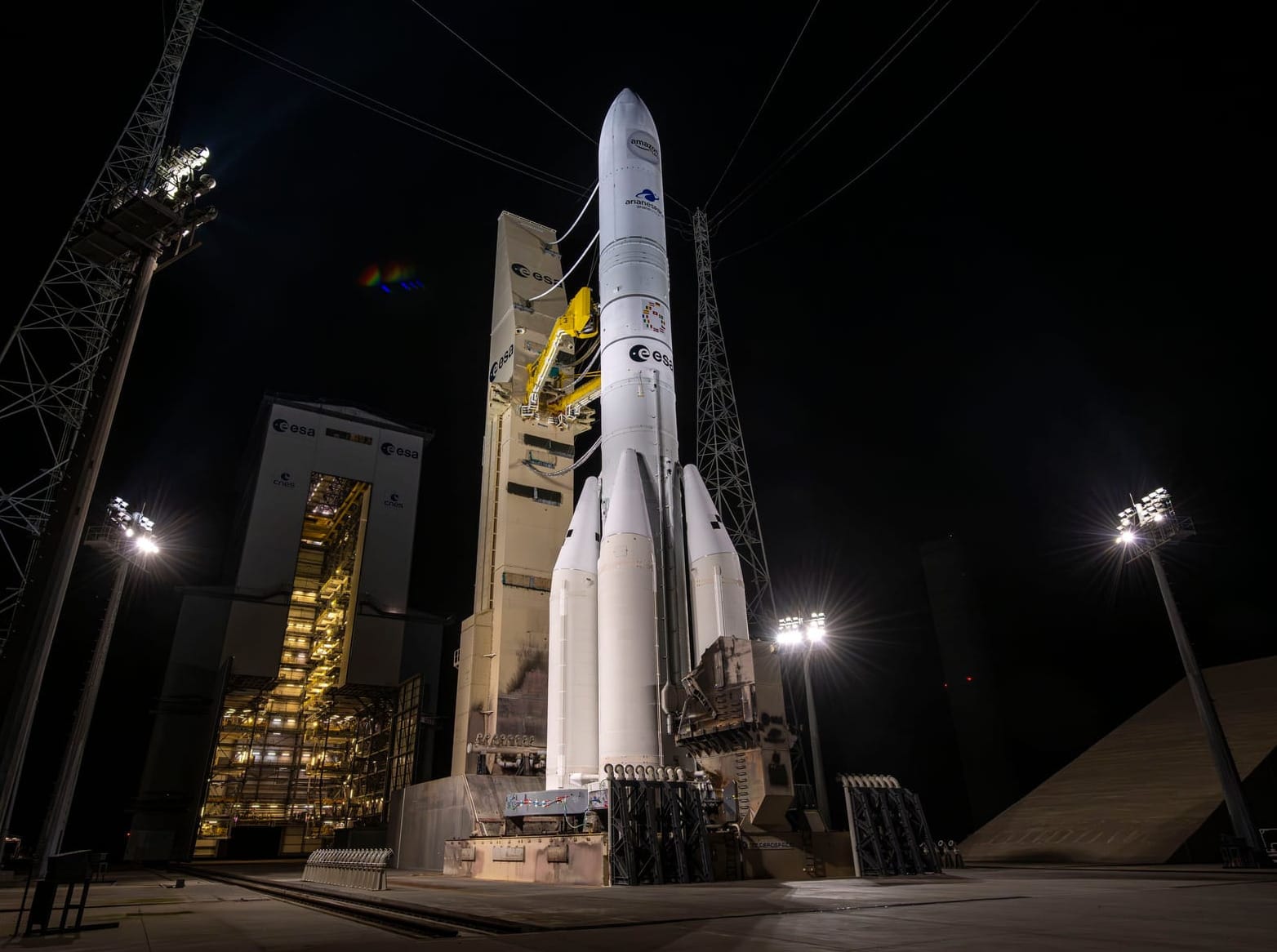
Ariane 62
Ariane 62 is the cheaper of the two configurations because it opts to use two solid rocket boosters. The lift capacity of Ariane 62 is as follows: 10,350 kilograms to low Earth orbit, 7,200 kilograms to a sun-synchronous orbit, 4,500 kilograms to geostationary transfer orbit, or 3,500 kilograms to a lunar transfer orbit.
On the launch pad, Ariane 62 weighs approximately 530,000 kilograms with a first-stage, second-stage, and faring diameter of 5.4 meters. Ariane 62 stands 56 meters tall ahead of launch.
Ariane 64
Ariane 64 is the more capable of the two configurations due to its utilization of four solid rocket boosters. The lift Capacity of Ariane 64 is as follows: 21,650 kilograms to low Earth orbit, 15,500 kilograms to a sun-synchronous orbit, 11,500 kilograms to geostationary transfer orbit, 8,600 kilograms to a lunar transfer orbit, or 5,000 kilograms to geostationary orbit.
On the launch pad, Ariane 62 weighs approximately 860,000 kilograms with a first-stage, second-stage, and faring diameter of 5.4 meters, exactly the same as Ariane 62. Ariane 64 is eight meters taller than Ariane 62 and is 62 meters tall ahead of launch.