
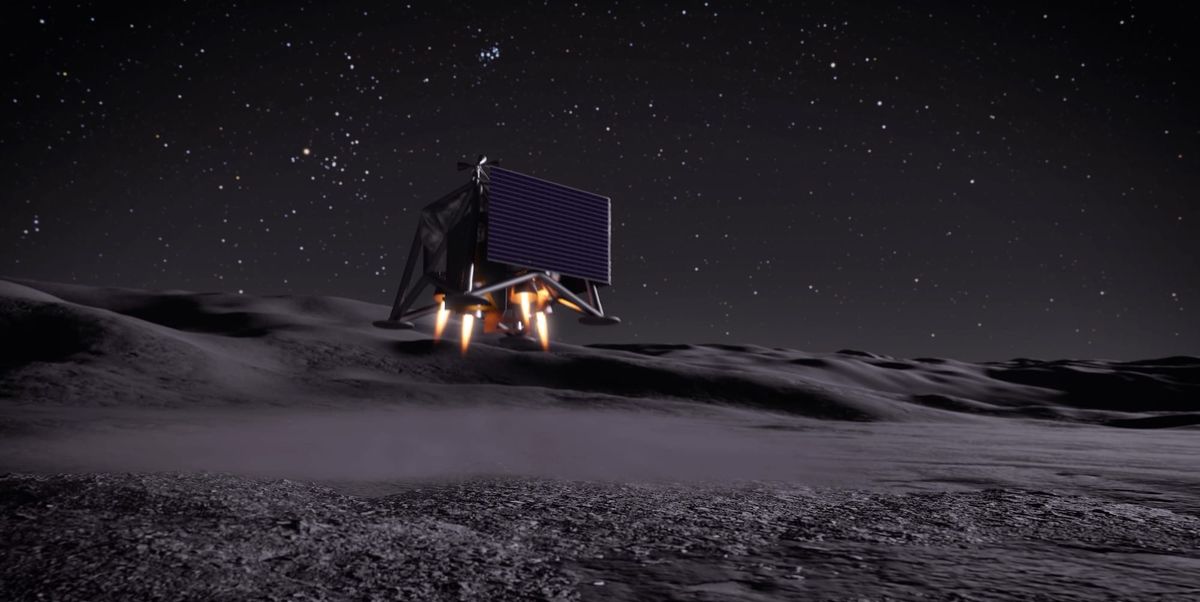
Having announced an intent to go all-in on a Moon base two months ago, NASA hosted another event about that effort on May 26th, sharing updates to existing missions, new contracts, and specifying some more details.
At the start, the space agency was keen to share that three missions currently set to head towards the Moon this year have been branded as 'Moon Base'. Those missions belong to commercial providers previously given contracts under the Commercial Lunar Payload Services (CLPS) program, with those as follows:
- 'Moon Base-1', originally Blue Moon Mk1 Pathfinder Mission from Blue Origin, is set to head to Shackleton Crater at the Moon's south pole, beginning no earlier than the fall of this year, carrying a handful of technology demonstrations and experiments.
- 'Moon Base-2', previously known as Griffin-1 from Astrobotic, will deliver a robotic rover to the surface to scout terrain and verify command systems toward the end of the year.
- 'Moon Base-3', also called IM-3 from Intuitive Machines’, is expected to occur sometime this year to place instruments to study lunar soil on the Moon's surface.
All three missions were said to be in support of 'sustained' operations.
Two of those landers, those of Blue Origin and Astrobotic, are aiming for the Moon for the first time, while IM-3 will be Intuitive Machine's third attempt at a successful landing on the surface. Astrobotic has previously tried to go to the Moon's surface before, but that missions failed not long after launch. Oddly not mentioned in the 'Moon Base' trio of missions was something for Firefly Aerospace's next Blue Ghost, which has CLPS' only success to date out of four attempts, but a new mission type was (more on that later).
The CLPS program has lunar delivery missions booked further into the remainder of this decade, currently not renamed to the new scheme. NASA's recent event did say that a 'dozen' future missions are set to be announced this year, presumably being dubbed 'Moon Base-#' and re-sharing already bought services. About seventy such missions are supposedly planned between now and the early 2030s.
In rebranding and reannouncing CLPS missions as those for a surface base, the space agency may be hoping to gain a better success rate and look more productive out of a purely cosmetic change, which would not be a surprise under the second Trump Administration. If a 'Moon Base' mission fails, however, it may look far worse than a CLPS failure to the general public, as the new naming scheme carries an undertone of involving human crews, while the previous one does not.
In addition to the existing missions, the space agency shared that it has awarded a cumulative 439 million United States Dollars to Astrolab and Lunar Outpost for a single Lunar Terrain Vehicle from each, which are still in development. Those vehicles are contracted to be on the surface by 2028 with the ability to explore both crewed and uncrewed.
For delivering the terrain vehicles, Blue Origin has been given a 188 million United States Dollar contract by NASA to utilize Blue Origin's Blue Moon Mk1 for two missions, delivering the rovers separately. The space agency also has the option to award the company up to 280.4 million United States Dollars, depending on contract needs.
Introducing Astrolab’s Crewed Lunar Vehicle (CLV-1), chosen by @NASA to transport crew across the lunar surface and support the construction of a permanent lunar base.
— Astrolab (@Astrolab_Space) May 26, 2026
Adapted from our FLEX rover architecture reflecting NASA’s revised approach to lunar surface mobility, CLV-1 is… pic.twitter.com/bS08GHbeZX
Another new mission announced on May 26th was MoonFall, built by the Jet Propulsion Laboratory and to be delivered 50 kilometers above the surface by Firefly Aerospace's Elytra spacecraft at a cost of 75 million United States Dollars. That mission will consist of four 250-kilogram spacecraft that will scout unexplored regions of the lunar south pole, characterize local radiation levels, and look for possible water ice, no earlier than 2028, and somehow survive the freezing night for a 'sustained' U.S. presence. The four spacecraft may also claim areas of the lunar surface in a probable violation of the Outer Space Treaty if performed.
The two new rovers, the lander to bring them to the lunar surface, and the MoonFall mission are set to cost up to 982 million United States Dollars. According to NASA Administrator Jared Isaacman, the funding for them is coming from funds allocated to the Gateway space station at the start of the year through an act of Congress. At the end of February, Isaacman started the motions of cancelling the internationally-backed lunar station, something only Congress can do, but a few members have backed publicly. Funding for the new missions, allocated from Gateway, and those for other NASA programs remains in limbo for fiscal year 2027 after the Trump Administration began its second attempt to cut a quarter of the space agency's budget, a move the Administrator supports.
Join the discussion
Commenting is available to paid members.
View membershipSign in