Artemis III Crew Revealed to Be All-Male, a Rarity at NASA

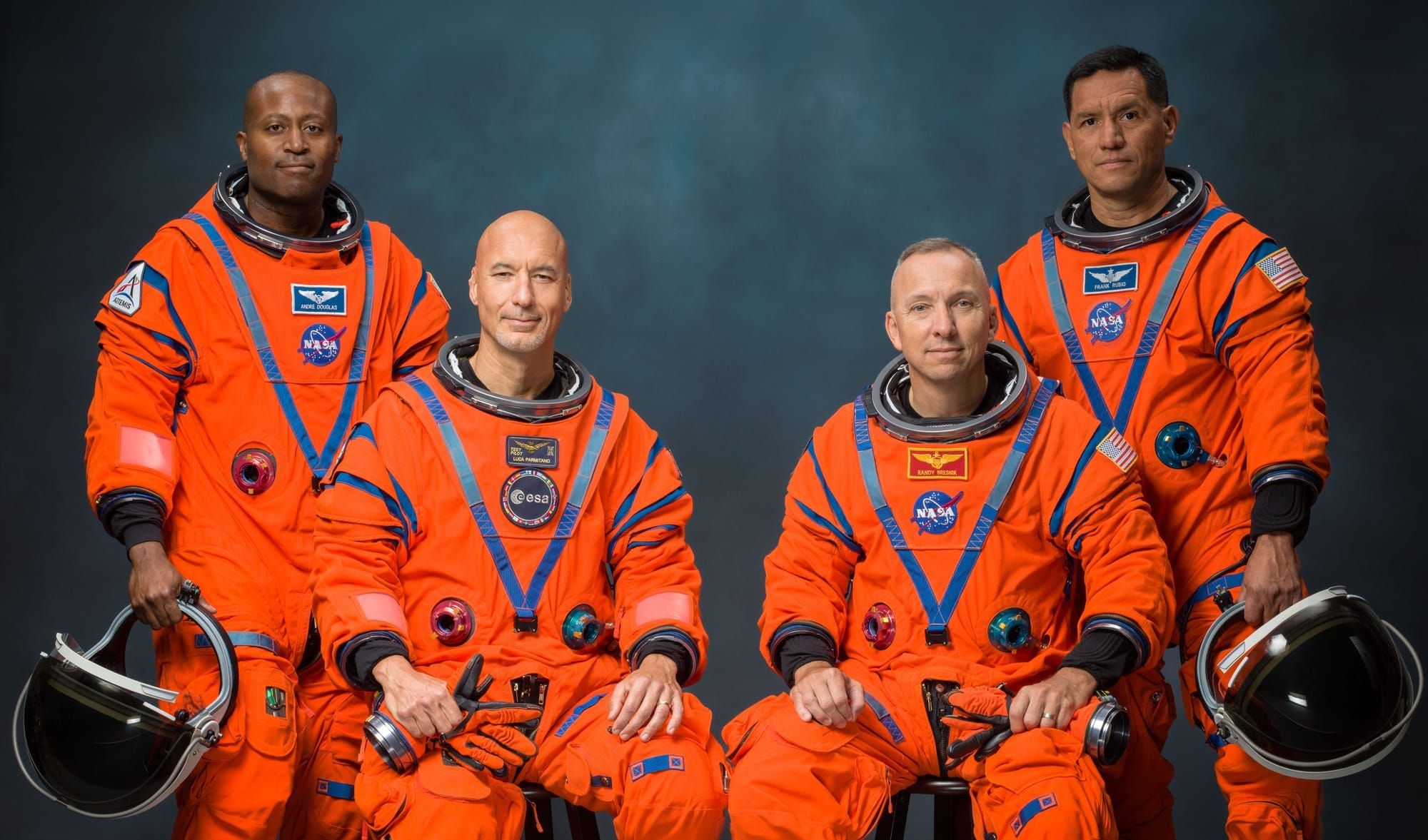
At a livestreamed event at the Johnson Space Center in Texas, NASA announced which of its astronauts, and one from an international partner, will fly aboard the Artemis III mission next year, to spend about two weeks in low Earth orbit sometime in 2027.
Commanding the Orion spacecraft will be Randolph Bresnik, for his third spaceflight. He has previously been to space as part of STS-129 and then the Soyuz MS-05 mission, allowing him to accumulate 149.5 days in orbit. Before joining NASA in 2004, Bresnik served as a pilot in the United States Marine Corps, spending over seven thousand hours in the air.
The Pilot for the Artemis III mission is Italy's Luca Parmitano, a European Space Agency astronaut, also flying for the third time. Through the Soyuz TMA-09M and MS-13 missions to the International Space Station, he has spent 367 days in space. Prior to astronaut selection in 2009, Parmitano spent over two thousand hours flying in the Italian Air Force.
Artemis III also has two Mission Specialists supporting its mission, with the first being Frank Rubio as part of his second trip to space. He flew to the International Space Station aboard Soyuz MS-22 and returned via MS-23 after his original spacecraft sprung a leak, having him stay for 370 days onboard. Prior to being selected by NASA in 2017, Rubio served in the United States Army, spending over one thousand one hundred hours in flight during military operations.
Lastly, there is Mission Specialist Andre Douglas, who will be heading into space for the first time as part of the Artemis III mission. Before joining NASA in 2021, Douglas served in the United States Coast Guard, as part of humanitarian operations, and worked at the Johns Hopkins University Applied Physics Laboratory, supporting missions like the Double Asteroid Redirection Test and a neutron and gamma-ray spectrometer for Japan's Martian Moons eXploration mission. He was also a backup crew member for the Artemis II mission.
In case one of the previously mentioned four cannot fly, NASA has chosen Bob Hines as a backup crew member, able to step into any role when needed. Hines has already been to space as part of the Crew-4 mission, spending 170 days onboard the International Space Station.
Notably, the Artemis III crew features no women in a program meant to emphasize their role, despite NASA's active astronaut pool employing many and Artemis II's Christian Koch becoming a female icon by becoming the first to fly around the Moon. The last time the U.S. assigned no women to a spaceflight was the Crew-6 in 2023, the SpaceX Crew Dragon Demo-2 mission in 2020, and STS-132 aboard Space Shuttle Atlantis in 2010.
At the event where the crew was revealed, NASA also shared a general update on the mission's plans for SpaceX and Blue Origin-developed landers. Under the present concept of operations, Blue Origin's lander will be placed into low Earth orbit first, then being met by Artemis III's Orion spacecraft, allowing its astronauts to board the lander for a few days as part of systems tests. While those tests are going on, SpaceX will place a Starship-derived vehicle into orbit ahead of Orion making its way over. When Orion rendezvous with SpaceX's lander, it will dock with it for about a day. Astronauts will not board the Starship-derived vehicle.
Both SpaceX and Blue Origin are confident they will be ready for the Artemis III mission next year, despite a lack of progress on the Starship-derived vehicle and a recent major explosion at Blue Origin's only orbital launch pad.