
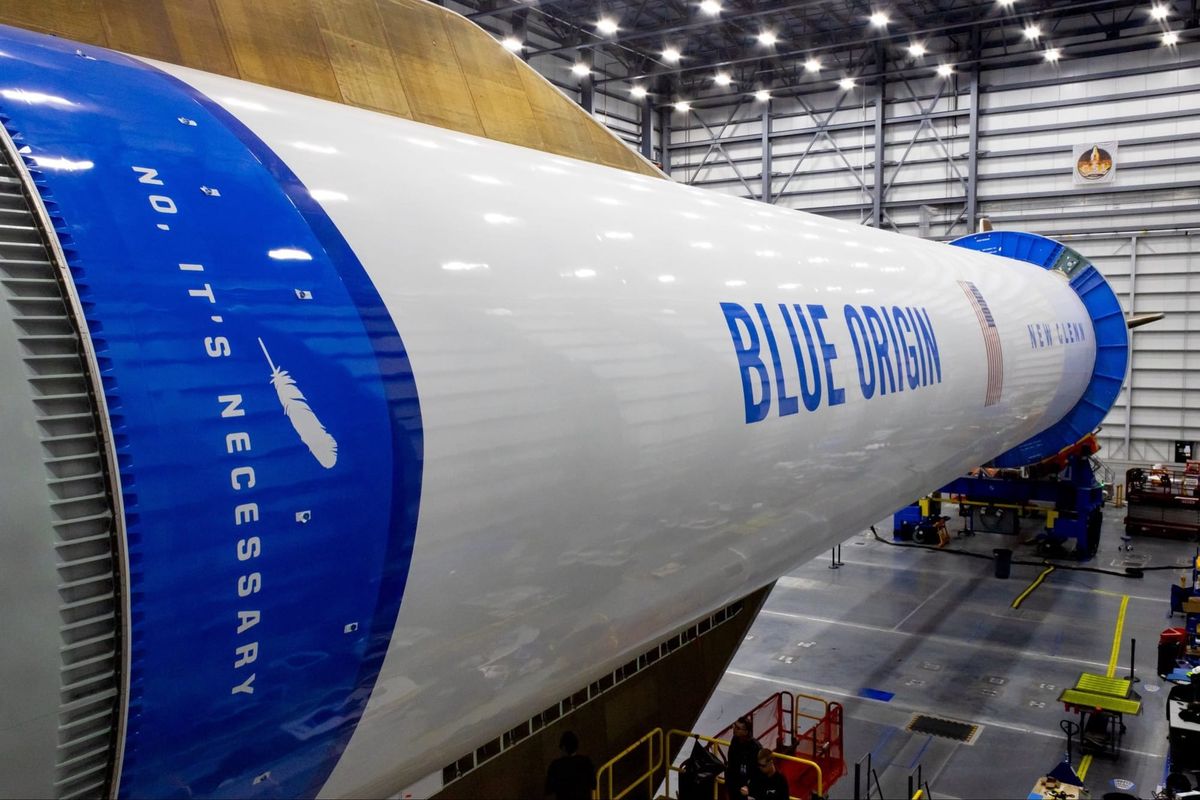
At around 21:00 pm Florida local time on May 28th (01:00 am Universal Coordinated Time on May 29th), New Glenn exploded during a pre-launch qualification static fire at Launch Complex 36, the largest at America's premier launch site in its decades long history.
That explosion appeared to begin moments after the ignition of seven BE-4 engines at the base of booster 'No, It's Necessary', before heading up the first-stage's liquid methane and liquid oxygen, then causing a secondary detonation in the liquid hydrogen and liquid oxygen second-stage. A shockwave caused by the launch vehicle's loss appeared to fling internal composite overwrapped pressure vessels substantial distances.
Sound synchronized from @NASASpaceflight footage pic.twitter.com/EWr9t8iegP
— Scott Manley (@DJSnM) May 29, 2026
Here's our video of the explosion at Launch Complex 36. It happened about 9 pm ET (0100 UTC) as Blue Origin was beginning a static fire test of its New Glenn rocket.
— Spaceflight Now (@SpaceflightNow) May 29, 2026
Watch live views: https://t.co/tm2wZQmAVD pic.twitter.com/PmbgQC6Qmq
Quickly afterwards, Blue Origin confirmed that it had accounted for all of its personnel working on the static fire. Mike Haridopolos, Congressional Representative of the district in which the Kennedy Space Center and Cape Canaveral Space Force Base are, shared that there were no reported injuries.
Damage visibly caused is the complete loss of New Glenn's transporter-erector and one of its two lightning towers. The remaining tower was briefly shaken and had its systems knocked out, including aircraft warning beacons. With the size of the explosion, heavy damage is likely to Launch Complex 36's facilities, such as those to load propellant.
New Glenn's horizontal integration facility also appeared to have been shook with external panels pushed back by the shockwave. That facility has the twice-flown booster, dubbed 'Never Tell Me The Odds', inside ahead of another mission.
A bit further away, still within the Cape Canaveral Space Force Base, United Launch Alliance's Atlas V, currently preparing to deploy a group of Amazon Leo satellites, and SpaceX's Falcon 9, set to carry a batch of Starlink spacecraft, may have been mildly jostled by the shockwave. Those vehicles are set to launch a few hours after the explosion, at the time of publication, as other companies' systems may have been unaffected.
Luckily for Blue Origin, New Glenn had no payloads atop of it when it detonated. About a week from now, it was planned to bring forty-eight more Amazon Leo satellites into Earth orbit. Those were stored a few miles away, on the Kennedy Space Center side, on the evening of May 28th.
Quite significantly, Launch Complex 36 is the company's only launch pad able to support New Glenn. It is now majorly damaged. Owner of Blue Origin, billionaire Jeff Bezos, said that the company will repair whatever was damaged, writing on social media:
"Very rough day, but we’ll rebuild whatever needs rebuilding and get back to flying. It’s worth it."
Today's explosion also comes less than two months after New Glenn failed during its third launch, due to its second-stage underperforming and subsequently stranding a customer satellite. The U.S. Federal Aviation Administration approved the vehicle to return to flight on May 22nd, and this static fire was part of that effort.
Back in June 2025, SpaceX suffered a similar loss of vehicle when Ship 36 detonated on its static fire stand, wiping out the Massey's test side for eleven months. A difference is that Ship 36 was partially loaded, with a few hundred tons of propellant, while New Glenn was near a full load, over a thousand tons.
Another similar event from almost a decade ago was the loss of Israel's AMOS-6 satellite during a routine Falcon 9 static fire when it exploded at Space Launch Complex 40, destroying infrastructure too. Falcon 9 returned to flight four months after that failure, and resumed launching from Space Launch Complex 40 fifteen months after the explosion, with numerous ground-side upgrades implemented during the time away.
It remains to be seen how fast Blue Origin will work on restoring Space Launch Complex 36 and returning New Glenn to flight. The company may utilize the opportunity to rebuild and move onto a bigger, more capable version of the launch vehicle officially designated '9x4'.
Bad news for Artemis
Regardless of how long it takes New Glenn to return, the explosion has had a major impact to NASA's Artemis program, which it is contracted for as both a cargo and crew lander. A few months in the future, the launch vehicle was set to start the maiden Blue Moon Mk1 mission to the lunar surface, followed by two more missions to deliver rovers by 2028.
Those missions are likely delayed significantly now, impacting NASA's efforts to send American astronauts back to the Moon this decade and to build a Moon base. The U.S. space agency is assessing the mission impacts of the explosion, with NASA Administrator Jared Isaacman writing:
"We will work with our partners to support a thorough investigation of this anomaly, assess near-term mission impacts, and get back to launching rockets. We will provide information on any impacts to the Artemis and Moon Base programs as it becomes available."
Artemis' other large cargo and crew lunar lander, based upon a version of SpaceX's Starship upper-stage, spent 2025 writing off progress on its development with hardware failures on the ground, during ascent, and in space.
Crewed lunar landers from both companies are required to be in low Earth orbit next year for the Artemis III mission to demonstrate joint operations with the Orion spacecraft and astronauts.
Join the discussion
Commenting is available to paid members.
View membershipSign in