
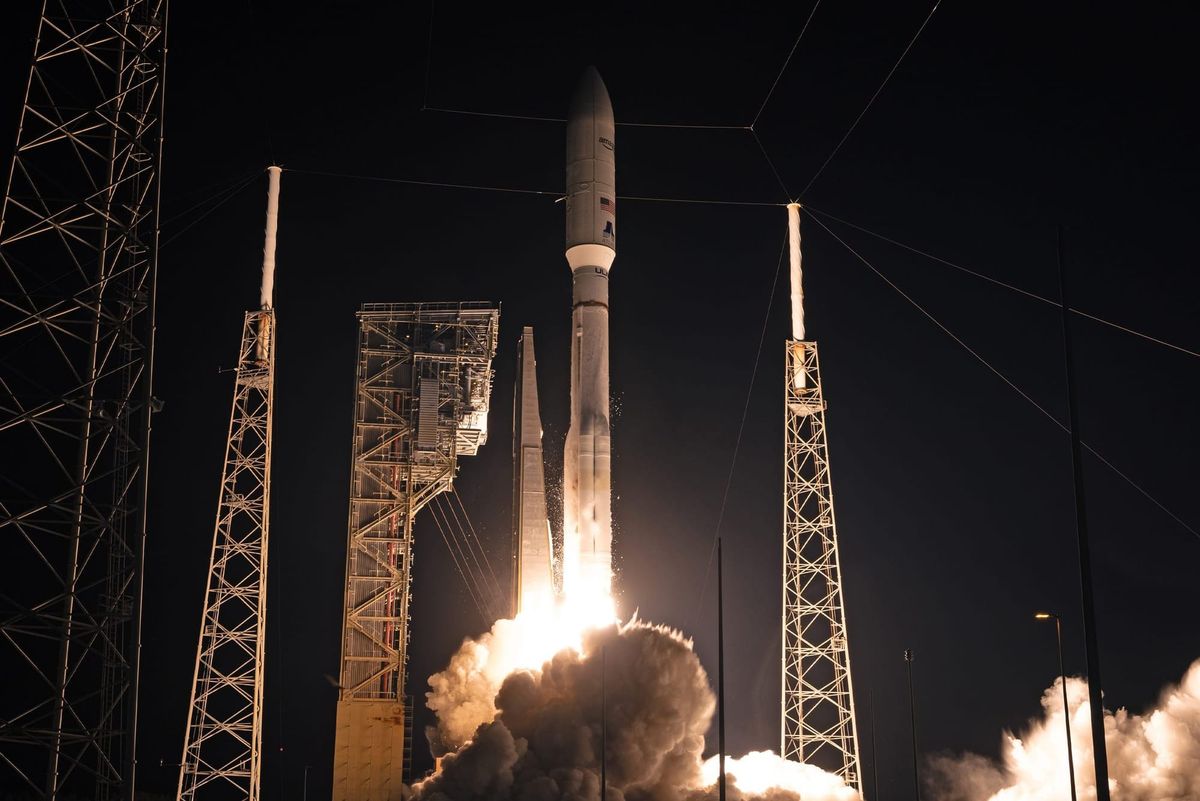
Amazon Leo has had its fourteenth group of Leo space-based internet satellites brought into orbit for its final delivery via Atlas V today.
Through the power of five solid rocket boosters and an RD-180 engine for the final time, Atlas V departed from Space Launch Complex 41 at 04:30 am Universal Coordinated Time on July 2nd as part of its eighth mission on behalf of Amazon. The five boosters provided the majority of the thrust for just over ninety seconds, being dropped a dozen seconds later. Meanwhile, the RD-180-powered ascent for three more minutes before the Centaur upper-stage ignited. Centaur brought the Leo satellites into low Earth orbit at 04:48 am.
Like many times before, satellite deployment began twenty-one minutes after launch, occurring over the course of almost seventeen minutes, separating the 29 Leo satellites from the Centaur upper-stage.
Those satellites are the final to be released in the Atlas family of rocket's almsot sixty year history, as the remaining flights of Atlas V are all booked in support of Boeing's Starliner, which will fly to the International Space Station until around 2030.
LIFTOFF of the United Launch Alliance Atlas V rocket with a star‑spangled start to the Amazon Leo 8 mission as America’s 250th Birthday approaches! pic.twitter.com/JUTHoXnaQN
— ULA (@ulalaunch) July 2, 2026
Previous groups and today's are heading up to, or operating in, an orbital altitude of around 630 kilometers to prepare to provide internet services to customers. In April, Amazon expected to begin providing that service in the second half of this year at speeds of up to one gigabit per second, something already demonstrated.
With today's deployment, Amazon now has 396 satellites to provide space-based internet services in orbit through fourteen launches. Those launches have, so far, been performed by seven previous Atlas V, three Ariane 6 missions from Arianespace, and three uses of SpaceX's Falcon 9.
Recognising the significance Atlas V has played in deploying Leo satellites, Amazon Leo Director of Launch Systems Melissa Wuerl stated:
"Atlas V has played a critical role in the early deployment phase for Amazon Leo, launching 224 satellites with a 100% success rate across all eight missions, and we're excited to build on that foundation with [United Launch Alliance] as we transition to Vulcan. With hundreds of flight-ready satellites standing by at the Cape and a new, dedicated vertical integration facility ready to support Leo Vulcan 1 and subsequent missions, we have a clear path to increase launch and deployment cadence, helping us quickly expand network coverage following an initial service rollout later this year."
At the time of publication, Amazon has not shared when its next launch of Leo satellites will be. The company has thirty-eight Vulcan missions, also from United Launch Alliance, on contract alongside fifteen more Ariane 6 and an additional ten Falcon 9. There are also twenty-seven to-be-fulfilled launches of Blue Origin's New Glenn, which exploded ahead of its first Leo mission in May.
By July 2028, Amazon is required by the U.S. Federal Communications Commission to have half of the Leo constellation's satellites, 1,616, in orbit, and then have the full constellation of 3,232 satellites in space by the end of July 2029.
What is Atlas V?
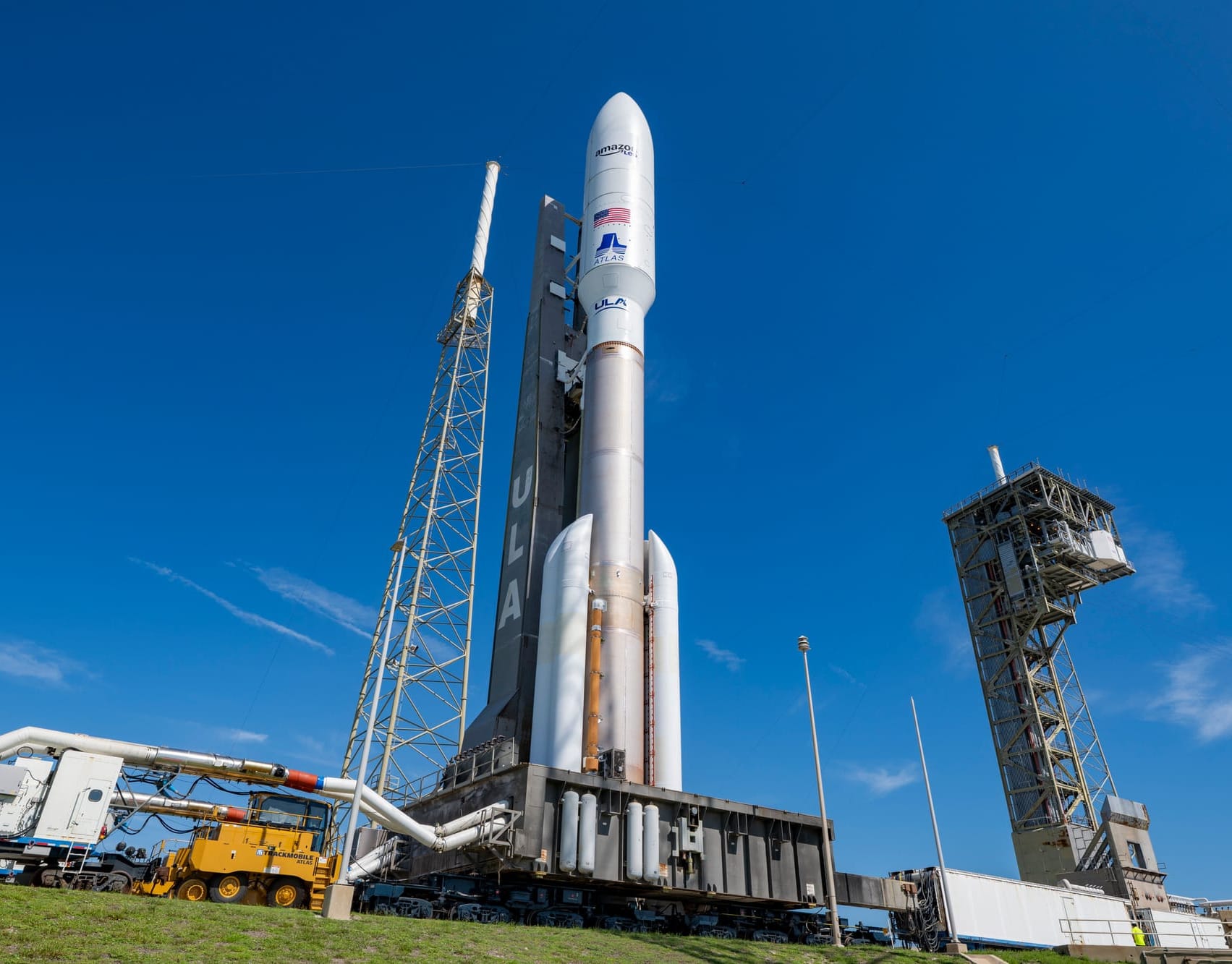
Atlas V is United Launch Alliance's oldest two-stage rocket in service. The rocket is currently planned to be replaced by Vulcan when it retires before 2030.
The first-stage is powered by a single RD-180 generating 390 tons of thrust burning rocket-grade kerosene and liquid oxygen for four minutes and thirteen seconds. The RD-180 is manufactured by NPO Energomash in Russia.
The Centaur upper-stage is powered by either one or two RL-10 engines generating 10 tons of thrust each while burning liquid hydrogen and liquid oxygen for up to fourteen minutes and two seconds. Aerojet Rocketdyne, an L3Harris Technologies Company, manufactures the RL-10 engines.
Atlas V can also launch with between zero and five GEM-63 solid rocket motors to augment the rocket's thrust and payload capability. Each booster burns a solid propellant, consisting of Hydroxyl-terminated polybutadiene and Aluminum-Ammonium perchlorate, generating 169 tons of thrust each for a believed one minute and thirty-four seconds. Northrop Grumman manufactures the solid rocket boosters for use with United Launch Alliance.
Atlas V also has eleven different configurations with the following payload capacities: up to 18,814 kilograms to low Earth orbit, up to 8,900 kilograms to geostationary transfer orbit, or up to 3,850 kilograms to geostationary orbit.
Join the discussion
Commenting is available to paid members.
View membershipSign in