SpaceX Wants to Catch Starship in Its Next Flight, Spends Billions on AI

SpaceX held its first quarterly earnings call on the afternoon of August 4th, having become a publicly traded company in mid-June. That call largely focused on the future of the in-development, to-be-fully-reusable Starship-Super Heavy launch vehicle.
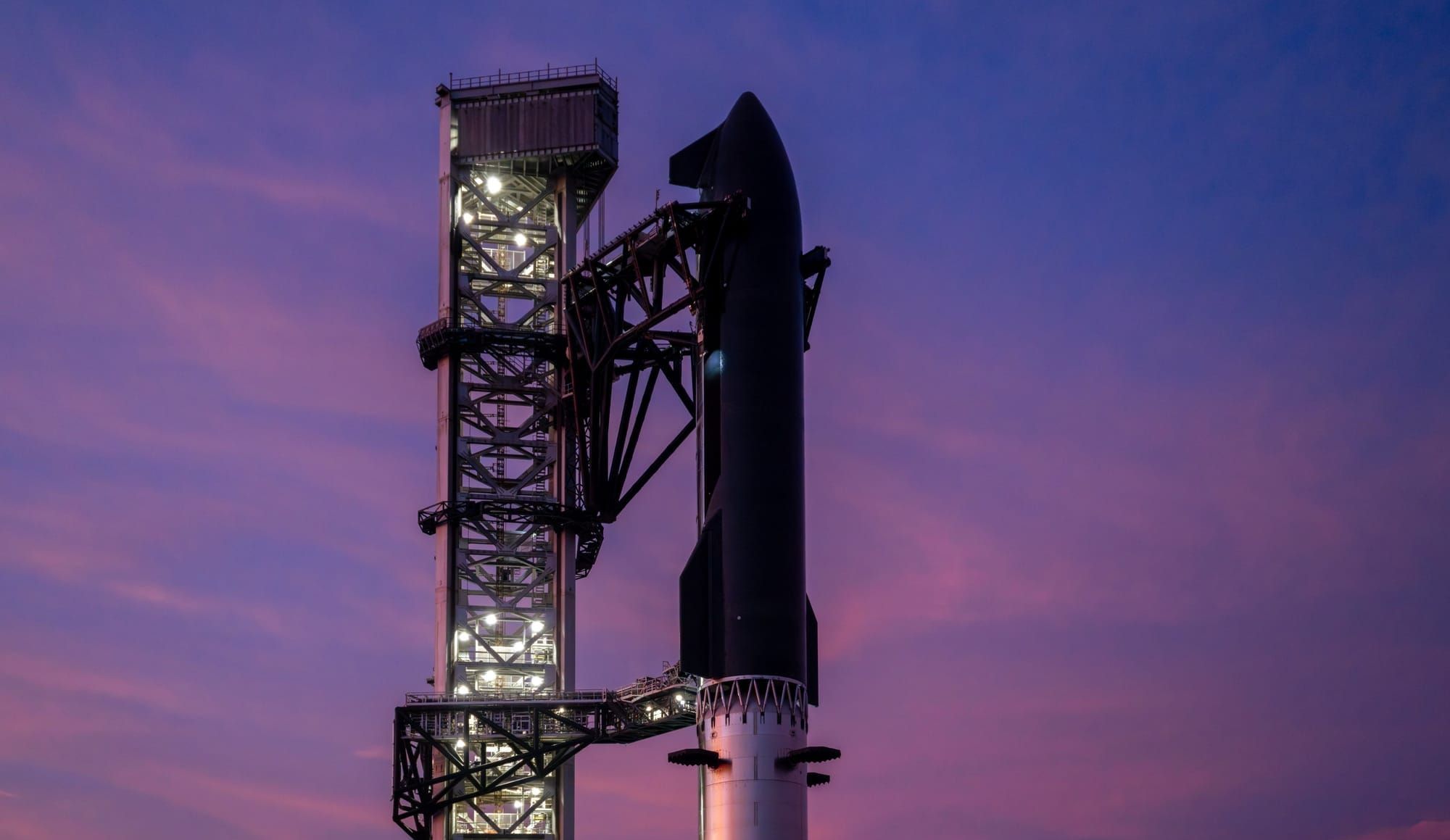
During it, SpaceX Chief Executive Officer Elon Musk shared that the fourteenth test flight of Starship is hoped to occur before the end of the month, should Ship 41 and Booster 21 complete pre-flight testing in time. Like the last test flight, the upcoming one will carry Starlink 'V3' satellites, but this time bringing them into low Earth orbit. Orbit will then be followed by a return to Earth and catch for Ship 41. That could be the first time Starship-Super Heavy enters orbit, having flown sub-orbitally since April 2023.
A major thing holding up an orbital launch attempt is regulatory approval from the United States Federal Aviation Administration. They may not approve of such a flight as it would be the third time a 'Block 3' Starship vehicle is flown. Those vehicles have also only demonstrated one in-space relight of a 'Raptor 3' engine.
Compared to 2025's Starship vehicles, the 'Block 3' ones have had a tendency to work so far. May and July flight tests have completed most test criteria, while losing the Super Heavy boosters both times due to engine startup problems. The most recent flight tests had a first gentle splashdown of a Starship as well, allowing SpaceX to begin their first recovery attempt.
SpaceX executives have been encouraged by the initial success of 'Block 3', saying that several flights in the remainder of this year are set to deploy batches of Starlink 'V3' satellites. Musk added that Starship could fly daily just over a year from now, but that is quite unrealistic with present and under-construction supporting infrastructure.
And the Moon?
Getting next to no mention during the call was SpaceX's multi-billion dollar contract with NASA to develop a Human Landing System (HLS) to bring astronauts to the surface of the Moon through the Artemis Program.
Gwynne Shotwell, the company's President and Chief Operating Officer, briefly noted that a human-rated Starship will venture to the Moon sometime in 2028, the same time as NASA's planned Artemis 4 and Artemis 5 missions. Those missions were not spoken of. That vehicle will come after a few cargo-carrying lunar Starships, which had no schedules mentioned according to Shotwell.
Human and non-human rated Starships will both require minimal boiloff technology and Ship-to-Ship propellant transfer systems, something yet to be demonstrated by SpaceX. A demonstration of that system has been delayed several times due to no Starships flying into orbit, which also led to the Artemis 3 mission being moved from the Moon to low Earth orbit.
Insane AI spending
Another major part of the quarterly earnings call was, of course, the capital SpaceX has earned, spent, and lost. The earnings release for the second quarter (April, May, June) disclosed that between January and June SpaceX has earned 12.5 billion United States Dollars, mostly by Starlink, and spent 28.4 billion United States Dollars in capital expenditures. A grand majority of that expenditure, 23.5 billion of it, was for related artificial intelligence and compute systems.
While burning an insane amount of capital on AI, Nvidia is receiving part of it by selling its 'Vera Rubin NVL72' hardware to SpaceX for use on its compute satellites. That hardware will do all of the satellite number crunching for the company's hoped-to-be million-strong constellation.
The constellation itself will be made up of huge satellites 30 meters tall and 75 meters wide, featuring a massive 160 square meter set of radiators and two giant solar arrays. Each operational satellite will weigh several tons while providing 175 kilowatts of compute.
SpaceX is partnering with @Nvidia to design the Starmind AI1 satellite compute payload.
— SpaceX (@SpaceX) August 4, 2026
Each of the Starmind satellites will include NVIDIA Rubin GPUs and Vera CPUs for datacenter class space compute → https://t.co/4MOQv0DvTQ pic.twitter.com/rC7UBAznAO
Before any SpaceX compute satellites can launch, a demonstration satellite, or set of satellites, will need to be deployed. No timeline has been given to do that. An entry on SpaceX's website says that compute satellites will start being launched in late 2027.
For serious competition on orbital computing from within the United States, Starcloud is ahead of SpaceX, as they already have a demonstrator spacecraft in orbit. They also plan to launch an operational satellite later this year ahead of an 88,000-satellite constellation, which will be enabled by Starship-Super Heavy.
Ahead of the U.S. as a whole is China, with two commercial firms with assets in orbit. On par with Starcloud, there is Orbital Chenguang, having a demonstrator launched last month, and backed by billions of United States Dollars in strategic credit lines. Far ahead of everybody, however, is ADA Space with its Three-Body Computing Constellation. That constellation has been crunching compute for a variety of users, attracting interest from China's technology giants and regional governments. Additionally, its technology is being continuously refined ahead of a tripling of compute capacity by year's end.