
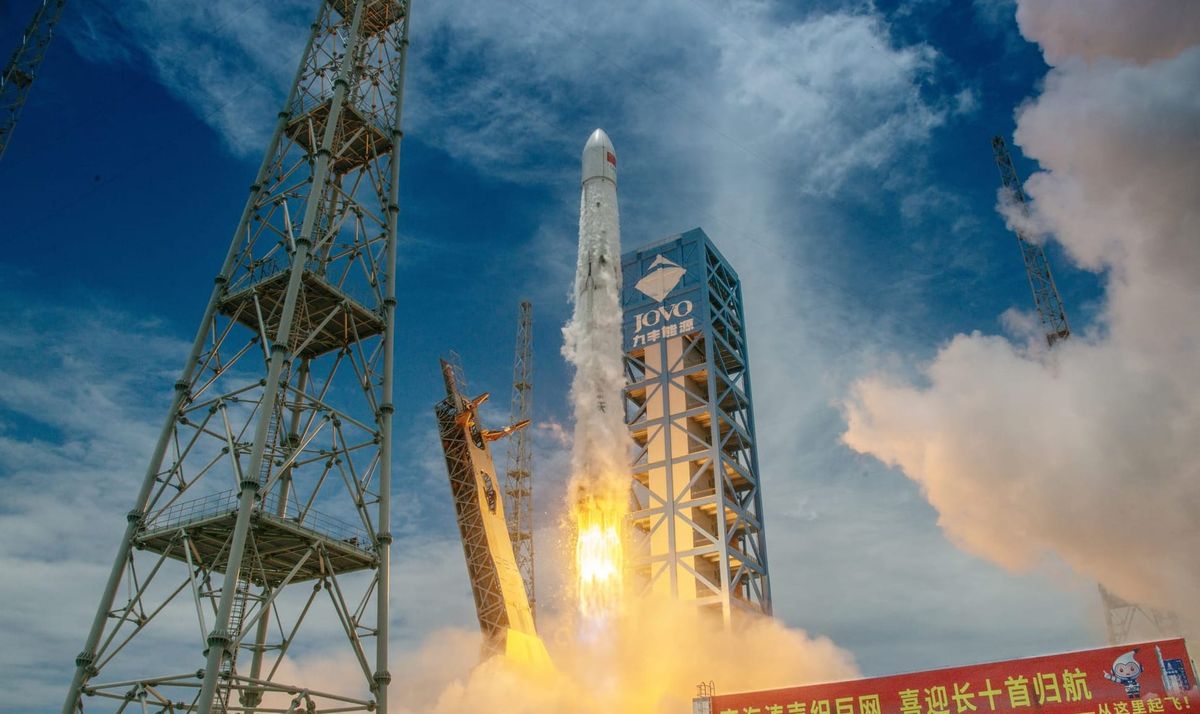
After a decade-long wait, there are now two nations in possession of operational reusable rockets, the United States and China. The former has had them since December 2015, with SpaceX's Falcon 9 fleet, and added Blue Origin's New Glenn in November 2025. But neither of those proved their ability to be recovered on their first try.*
On July 10th via the China Academy of Launch Vehicle Technology, China proved its first reusable rocket with the inaugural launch of the Long March 10B from the coastal Wenchang Commercial Space Launch Site, with it carrying an experimental satellite into low Earth orbit on behalf of one of its connectivity constellation operators. The reusable first-stage booster used to support that was caught minutes after launch on board the drone ship 'Linghangzhe', guided by four grid fins and slowing via a few engine burns from reentry.
The systems onboard 'Linghangzhe' to enable a catch have the ship and a descending booster measuring their distance from one another while communicating where they both determine the other to be. If the measurements align, the first-stage slows its descent and positions itself above the ship before falling onto a set of guided tensioned steel wires, with four metal hooks securing it. Additional cables and a dedicated arm, for removing leftover propellant, grab onto the booster for transport back to shore.
另一个角度。 pic.twitter.com/87CpsuyHtG
— SegerYU (@SegerYU) July 10, 2026
Before that successful recovery commercial launch provider LandSpace attempted to perform China’s first launch vehicle booster landing with the debut flight of Zhuque-3, coming within seconds of doing so in December 2025. The Shanghai Academy of Spaceflight Technology then followed weeks later with the inaugural Long March 12A mission, but failing not long after atmospheric reentry. It has also flown the Long March 12B to trial select first-stage recovery systems.
Efforts to land those vehicles' boosters have continued since their debut missions in past months. As of the end of June, LandSpace has completed all necessary testing of its second Zhuque-3 vehicle, culminating in a static fire and full propellant load of both stages. Like its first flight, it is planned to recover its booster on a landing pad a few hundred kilometers away from the inland Jiuquan Satellite Launch Center.
While working in relative external communications silence, progress is being made on the second Long March 12A too, which should be closer to a final capability vehicle. The Long March 12B supposedly has its second launch booked this year, but a landing pad for it has yet to be built if the next mission will be a recovery attempt.
Additionally, after the conclusion of the Long March 10B, the owner of its manufacturer the China Aerospace Science and Technology Corporation, shared that another flight of the rocket is planned later this year, possibly reusing the recovered stage or a brand-new one.
Other enterprises seeking reusable rockets
Beyond rockets that are reusable from their first flight, other launch providers are seeking to make their initially expendable ones reusable after a few flights. CAS Space is one of those with its Kinetica-2, first reaching orbit in March. Reusable systems, like grid fins and restartable engines, are planned to be added between its third and tenth flights, in 2028.
Galactic Energy has a similar plan with its Pallas-1 launch vehicle as well. It arrived at its launch pad for the first time in May, having completed static fires of both stages. It's unknown when Pallas-1 will perform its debut flight.
Tianlong-3 from Space Pioneer has also flown once so far, with an April maiden flight that made it a few minutes before failure a few dozen kilometers above the Jiuquan Satellite Launch Center. Hardware for expendable and reusable Tianlong-3 is reportedly in production, although details have been unspecified.
In an in-between state, Deep Blue Aerospace's Nebula-1A had made visits to its launch pad at the Haiyang Oriental Spaceport for either a suborbital test flight, to demonstrate reusable systems, or an orbital one. Both stages of the rocket have undergone relevant tests last year.
*While SpaceX's Starship-Super Heavy has reused first-stage boosters, the launch system is still in testing, yet to carry a useful payload, or head into orbit, and therefore is not an operational reusable rocket.
Join the discussion
Commenting is available to paid members.
View membershipSign in