

Table of Contents
Welcome to our twenty-sixth Monthly Dose of Space! In this monthly newsletter, we bring you news from the past month. November begins the end of a busy year in space globally, so let's jump into the past month.
News of the Month
During November, the world's second reusable rocket proved that its boosters can land and return to their production site to fly again, three more reusable rockets are preparing to fly this year, human spaceflight missions suffer from damage on Eath and in space while removing crews, NASA prepares to have a new administrator, and the European Space Agency secures funding.
- New Glenn Booster Lands, Begins ESCAPADE's Long Trek to Mars
- Triumphant New Glenn Booster Sails Into Florida
- NASA Withdraws Astronauts From Future Boeing Starliner Flights
- Soyuz MS-28 Mission Leaves Damage to Its Baikonur Launch Pad
- Isaacman renominated to lead NASA
- Deep Space Network antenna damaged
- 'Upgraded' Starship-Super Heavy booster fails first test
- Amazon's mega-constellation rebrands, prepares more launches
- China to debut three reusable launch vehicles
- ESA funding increased for next three years
- Shenzhou-21 crew boards Tiangong
- Shenzhou-20 return delayed
- Shenzhou-20 crew returns after debris concern
Launches of the Month
This month saw 32 launches worldwide, continuing a busy year. If you want to know what each launch was we have them all listed below!
November 2nd - Falcon 9 with Bandwagon-4
SpaceX launched its fourth mid-inclination low Earth orbit rideshare mission, carrying eighteen payloads, atop of a Falcon 9 flying from Space Launch Complex 40, in Florida. Supporting this mission was booster B1091, for its third flight with a landing back in Cape Canaveral at Landing Zone 2.
November 2nd - LVM-3 with GSAT-7R
India's LVM-3 rocket launched from the Satish Dhawan Space Centre carrying the GSAT-7R communication satellite to geostationary transfer orbit on behalf of the Indian Navy. Once operational, the satellite will provide secure multi-band communications services.
November 3rd - Long March 7A with Yaogan-46
A Long March 7A blasted off from Launch Complex 201 at the Wenchang Space Launch Site, carrying the Yaogan-46 remote sensing satellite into medium Earth orbit. Yaogan-46 is planned to be used for land resource surveys, crop yield estimation, meteorology, hydrology, scientific experiments, as well as disaster prevention and relief efforts.
November 4th - Ariane 6 with Sentinel-1D
Arianespace launched its Ariane 6 rocket from the Guiana Space Centre into sun-synchronous orbit carrying the Sentinel-1D weather satellite on behalf of the European Space Agency. The satellite will be used for sea ice, tracking icebergs, glaciers, subsidence, and oil spills.
November 5th - Electron for 'The Nation God Navigates'
Rocket Lab's Electron flew from Rocket Lab Launch Complex 1B on the Māhia Peninsula, in New Zealand, into low Earth orbit with a synthetic aperture radar satellite on behalf of iQPS. This satellite is planned to be part of a thirty-six-spacecraft constellation for regular monitoring of Earth below.
November 6th - Falcon 9 with Starlink Group 6-81
Twenty-nine Starlink satellites were launched into low Earth orbit from Space Launch Complex 40 atop of a Falcon 9. Booster B1094 supported this mission for its fifth flight, with a landing downrange on the drone ship 'Just Read The Instructions'.
November 6th - Falcon 9 with Starlink Group 11-14
Twenty-eight more Starlink satellites were sent into low Earth orbit by a Falcon 9 flying out of Space Launch Complex 4E, in California. Supporting this mission was booster B1093, on its eighth flight with a landing on the drone ship 'Of Course I Still Love You' downrange.
November 8th - Long March 11 with Shiyan-32 trio
A Long March 11 blasted off from a sea-launch platform near Haiyang, in Shandong province, carrying three Shiyan-32 satellites into low Earth orbit. The Shiyan-32 trio is set to test new optical technologies.
November 9th - Kinetica-1 with Chutian-2-01 & 02
From Launch Area 130 at the Jiuquan Satellite Launch Center, CAS Space’s Kinetica-1 flew into sun-synchronous orbit carrying the Chutian-2-01 and Chutian-2-02 satellites. Both satellites are technology tests for a very-low Earth orbit remote sensing constellation.
November 9th - Falcon 9 with Starlink Group 10-51
A Falcon 9 blasted off from Launch Complex 39A, in Florida, carrying twenty-nine Starlink satellites into low Earth orbit. Supporting this mission was booster B1069 for its twenty-eighth mission, landing on the drone ship 'A Shortfall Of Gravitas' downrange.
November 10th - Long March 12 with GuoWang Group 13
A Long March 12 flew from Commercial Launch Pad 2 at the Wenchang Commercial Space Launch Site carrying nine GuoWang satellites into low Earth orbit. With this launch, the state-backed internet connectivity constellation has 104 satellites in space.
November 10th - Ceres-1 with three satellites
Galactic Energy attempted to launch its Ceres-1 rocket into sun-synchronous orbit from the Jiuquan Satellite Launch Center, but the rocket's fourth stage shut down earlier than planned, resulting in the loss of the rocket and the three satellites onboard. The satellites atop of the rocket were Jixing Gaofen 04C, Jixing Platform 02A04, and North China University of Technology Satellite-1.
November 11th - Falcon 9 with Starlink Group 6-87
Twenty-nine more Starlink satellites were delivered into low Earth orbit atop of a Falcon 9 flying from Space Launch Complex 40, in Florida. Booster B1096 supported this mission for its third flight, landing downrange on the drone ship 'Just Read The Instructions'.
November 13th - New Glenn with ESCAPADE
Blue Origin launched its New Glenn rocket from Launch Complex 36, in Florida, for the second time, setting the twin ESCAPADE spacecraft on a long trek toward Mars. During this launch, New Glenn's booster, 'Never Tell Me The Odds', landed on the drone ship 'Jacklyn' for the first time!
November 14th - Atlas V with ViaSat-3 F2
United Launch Alliance launched its Atlas V rocket from Space Launch Complex 41, in Florida, carrying the second ViaSat-3 satellite into a geostationary transfer orbit. ViaSat-3 F2 is planned to be capable of rapidly shifting capacity throughout its coverage area to best deliver bandwidth to users on Earth below.
November 15th - Falcon 9 with Starlink Group 6-89
Another Falcon 9 delivered twenty-nine Starlink satellites to low Earth orbit from Launch Complex 39A. Supporting this mission was booster B1092, for its eighth flight with a landing on the drone ship 'A Shortfall Of Gravitas' downrange.
November 15th - Falcon 9 with Starlink Group 6-85
Twenty-nine more Starlink satellites were put into low Earth orbit by a Falcon 9 flying out of Space Launch Complex 40. Booster B1078 supported this mission for its twenty-fourth flight, landing downrange on the drone ship 'Just Read The Instructions'.
November 17th - Falcon 9 with Sentinel-6B
Out of Space Launch Complex 4E, in California, a Falcon 9 carried the Sentinel-6B mission into low Earth orbit on behalf of NASA, the European Space Agency, the U.S. National Oceanic and Atmospheric Administration, and the European Organisation for the Exploitation of Meteorological Satellites to study climate change. Supporting this mission was booster B1097 for its third flight, returning to Landing Zone 4 at the Vandenberg Space Force Base.
November 18th - Electron for 'Prometheus Run'
Rocket Lab flew its Electron rocket in its suborbital HASTE (Hypersonic accelerator suborbital test electron) configuration from Wallops Island, in Virginia, on behalf of various U.S.-government-linked payloads related to missile defense.
November 19th - Falcon 9 with Starlink Group 6-94
A Falcon 9 carried twenty-nine Starlink satellites into low Earth orbit out of Space Launch Complex 40, in Florida. Booster B1085 supported this mission for its twelfth flight, landing downrange on the drone ship 'A Shortfall Of Gravitas'.
November 19th - Long March 2C with Shijian-30 trio
From the Jiuquan Satellite Launch Center's Launch Area 4, a Long March 2C flew into low Earth orbit carrying Shiyan-30A, 30B, and 30C. The three satellites are planned to verify space environment monitoring technologies.
November 20th - Electron for 'Follow My Speed'
A surprise Electron flew into low Earth orbit from Launch Complex 1A, on the Māhia Peninsula in New Zealand. Rocket Lab did not reveal the identity of the customer or how many satellites were onboard.
November 21st - Falcon 9 with Starlink Group 6-78
Another twenty-nine Starlink satellites were launched into low Earth orbit by a Falcon 9 flying from Launch Complex 39A, in Florida. Supporting this mission was booster B1080 for its twenty-third flight, landing downrange on the drone ship 'Just Read The Instructions'.
November 21st - Long March 3B/E with TJSW-21
A Long March 3B/E flew from Launch Complex 2 at the Xichang Satellite Launch Center carrying the TJSW-21 spacecraft into an orbit peaking above the geostationary orbit belt. TJSW-21 is set to be used for communications, radio, television, and data transmission while demonstrating multi-band high-speed throughput communication technologies.
November 22nd - Falcon 9 with Starlink Group 6-79
Twenty-nine more Starlink satellites were delivered to low Earth orbit atop of Falcon 9, flying out of Space Launch Complex 40. Booster B1090 supported this mission for its ninth flight, landing on the drone ship 'A Shortfall Of Gravitas' downrange.
November 23rd - Falcon 9 with Starlink Group 11-30
Twenty-eight Starlink satellites were delivered to low Earth orbit by a Falcon 9 flying out of Space Launch Complex 4E, in California. Supporting this mission was booster B1100 for its first flight, with a landing downrange on the drone ship 'Of Course I Still Love You'.
November 25th - Long March 2F/G with Shenzhou-22
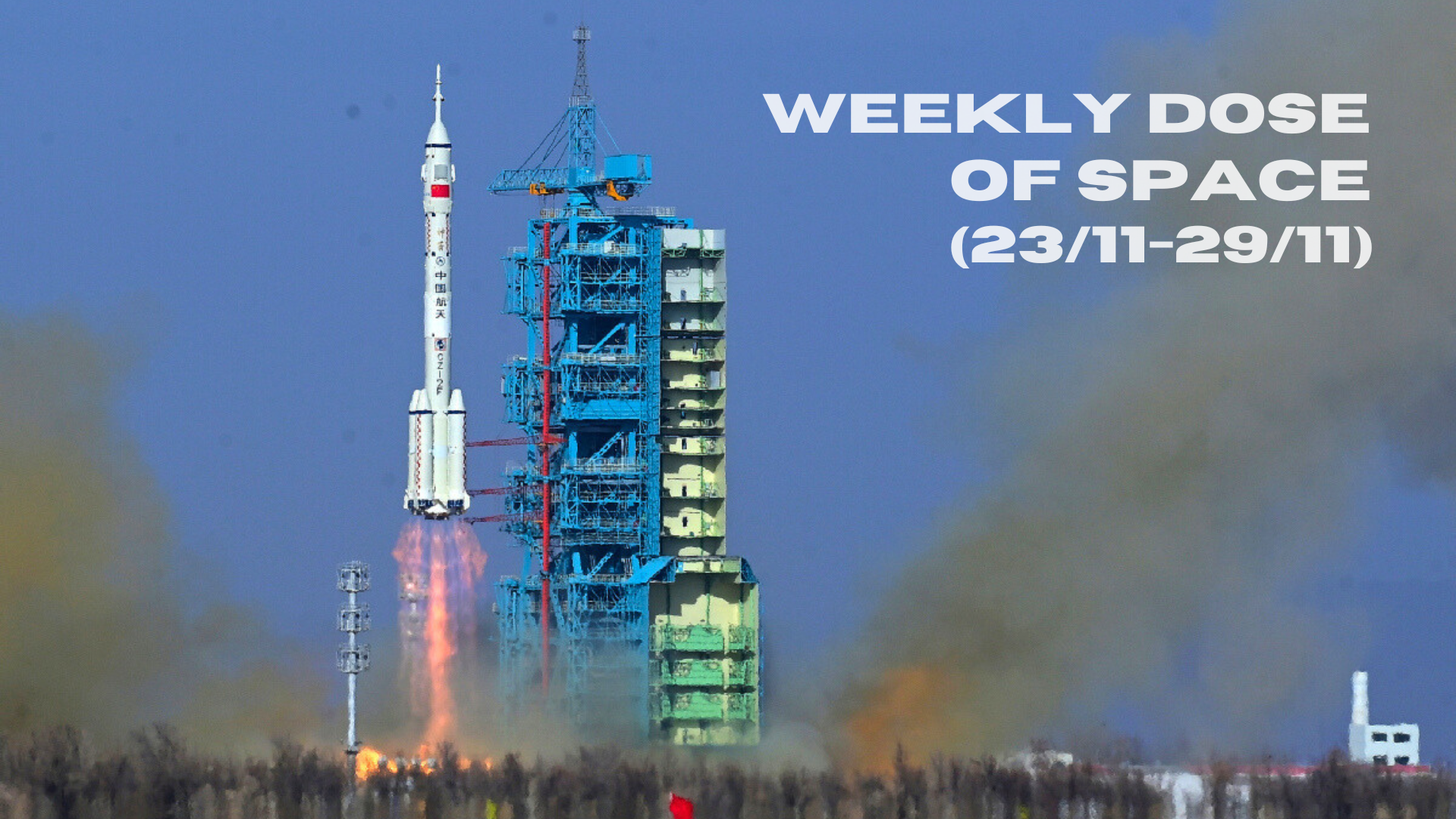
An uncrewed Shenzhou-22 spacecraft rode into orbit toward China's Tiangong Space Station atop of Long March 2F/G out of Launch Area 4 at the Jiuquan Satellite Launch Center. This launch was to provide the Shenzhou-21 taikonauts with a way to return to Earth alongside scientific cargo after the Shenzhou-20 crew took their spacecraft back to Earth following a debris strike with the Shenzhou-20 spacecraft.
November 25th - Angara 1.2 with unknown payloads
An Angara 1.2 rocket blasted off from the Plesetsk Cosmodrome heading for low Earth orbit, carrying payloads for military communications.
November 26th - KSLV-2 with CAS500-3
South Korea launched its CAS500-3 (Compact Advanced Satellite 500-3) Earth observation technology verification spacecraft into sun-synchronous orbit atop of the first KSLV-2 rocket in two and a half years, flying from the Naro Space Center. Twelve CubeSats were also onboard, from national universities, institutions, and enterprises.
November 27th - Soyuz 2.1a with MS-28
Out of the Baikonur Cosmodrome, a Soyuz 2.1a chased down the International Space Station while carrying the MS-28 mission, with cosmonauts Sergei Kud-Sverchkov and Sergei Mikayev, as well as NASA astronaut Christopher Williams. The three crew are planned to stay onboard the station for eight months.
November 28th - Falcon 9 with Transporter-15
SpaceX performed its fifteenth Transporter rideshare mission to sun-synchronous orbit out of Space Launch Complex 4E with a Falcon 9, carrying 140 satellites from a handful of countries for a variety of different uses. Booster B1071 supported this mission, for its thirtieth flight, with a landing on the drone ship 'Of Couese I Still Love You' downrange.
November 30th - Long March 7A with Shijian-28
From Launch Complex 201 at the Wenchang Space Launch Site, a Long March 7A blasted off heading for a geosynchronous transfer orbit carrying the Shijian-28 spacecraft. Unlike other Shijian spacecraft before it, no task has been stated for the technology-proving mission of Shijian-28.
Launches to look out for in December!
December will conclude a hectic year for worldwide launches. Listed below are all of the launches expected or likely to happen next month, launches on the 1st of September may have already occurred due to when this newsletter is published.
December 1st - Faclon 9 with Starlink Group 6-86
A Falcon 9 is set to launch from Launch Complex 39A carrying a batch of Starlink satellites into low Earth orbit.
December 1st - Vega-C with KOMPSAT-7
KOMPSAT-7 (Korean Multi-purpose Satellite 7) is planned to head into a sun-synchronous orbit via a Vega-C flying from the Guiana Space Center, in French Guiana.
December 2nd - Falcon 9 with Starlink Group 15-10
Another Falcon 9 is preparing to fly from Space Launch Complex 4E while heading into low Earth orbit to deliver another batch of Starlink satellites.
December 2nd - Falcon 9 with Starlink Group 6-95
More Starlink satellites are set to be placed into low Earth orbit by a Falcon 9 launching from Space Launch Complex 40.
December 4th - Falcon 9 with Starlink Group 11-25
SpaceX is planning to fly Falcon 9 out of Space Launch Complex 4E to put another batch of Starlink satellites into low Earth orbit.
December 5th - Electron for 'RAISE And Shine'
Rocket Lab's Electron rocket is set to head into sun-synchronous orbit carrying the RAISE-4 (RApid Innovative payload demonstration Satellite-4) mission for its various on-orbit demonstrations.
December 7th - H3 with Michibiki-5
Japan's H3 rocket is planned to fly from the Tanegashima Space Center into a geostationary transfer orbit carrying the Michibiki-5 navigation satellite.
December 7th - Falcon 9 with Starlink Group 11-15
A Falcon 9 is set to fly from Space Launch Complex 4E carrying a batch of Starlink satellites to low Earth orbit.
December 7th - Falcon 9 with Starlink Group 6-92
Another batch of Starlink satellites are expected to be put into low Earth orbit by a Falcon 9 flying from Launch Complex 39A.
December 9th - Falcon 9 with NROL-77
SpaceX will launch a military spacecraft from the U.S. National Reconnaissance Office atop of its Falcon 9, launching out of Space Launch Complex 40.
December 10th - Falcon 9 with Starlink Group 15-11
Yet another Falcon 9 will carry Starlink satellites into low Earth orbit from Space Launch Complex 4E.
December 15th - LVM-3 with BlueBird-6
India's LVM-3 is planning to fly from the Satish Dhawan Space Centre into low Earth orbit carrying AST SpaceMobile's BlueBird-6 satellite, the 6th out of a planned 243.
December 15th - Atlas V with LA-04
Amazon will have another group of 27 satellites for its newly rebranded 'Leo' constellation, launching from Space Launch Complex 41 atop of Atlas V.
December 15th - Proton with Elektro-L
A Proton rocket is expected to blast off from the Baikonur Cosmodrome carrying the fifth Elektro-L weather satellite into a geostationary transfer orbit.
December 17th - Ariane 6 with two Galileo satellites
Europe's Ariane 6 is set to fly from the Guiana Space Center carrying two Galileo navigation satellites into a medium Earth orbit.
December 17th - Hanbit-Nano for 'Spaceward'
South Korean startup Innospace is preparing to launch its solid-hybrid rocket Hanbit-Nano into low Earth orbit for the first time, from the Alcântara Launch Center in Brazil.
NET December - Zhuque-3 for its debut flight
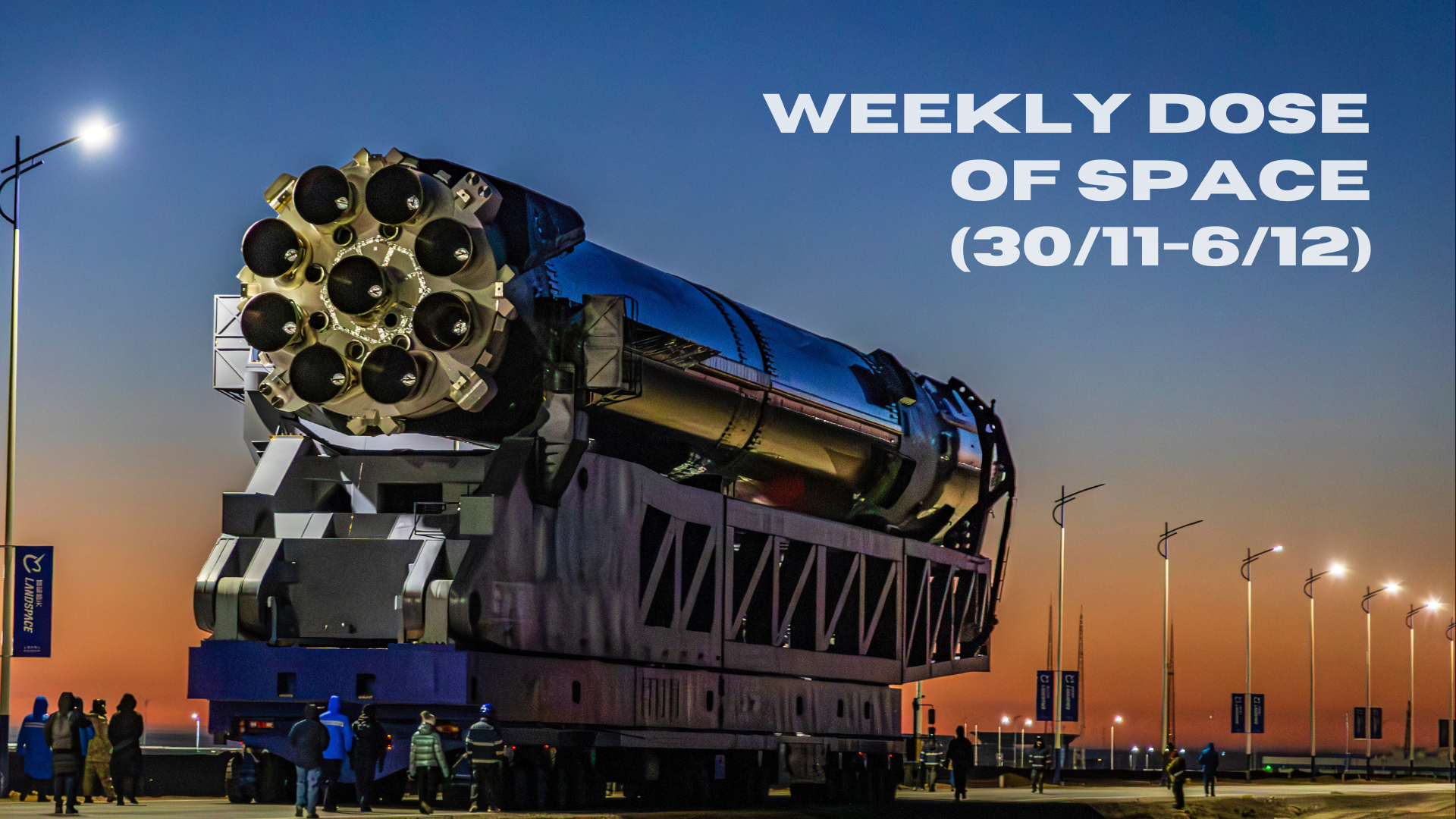
LandSpace has prepared its partially reusable Zhuque-3 launch vehicle for its debut flight out of the Jiuquan Satellite Launch Center. After liftoff, the first-stage booster will attempt to softly touchdown on a downrange landing pad.
NET December - Long March 12A for its debut flight
The Shanghai Academy of Spaceflight Technology is set to fly its partially reusable Long March 12A launch vehicle for its debut mission from the Jiuquan Satellite Launch Center. Following launch, the first-stage booster will attempt to touchdown on a downrange landing pad.
NET December - Tianlong-3 for its debut flight
Space Pioneer is looking to launch its partially reusable Tianlong-3 launch vehicle for its debut mission out of the Jiuquan Satellite Launch Center.