Vulcan Begins USSF-87 Mission With Minor Anomaly During Fourth Launch

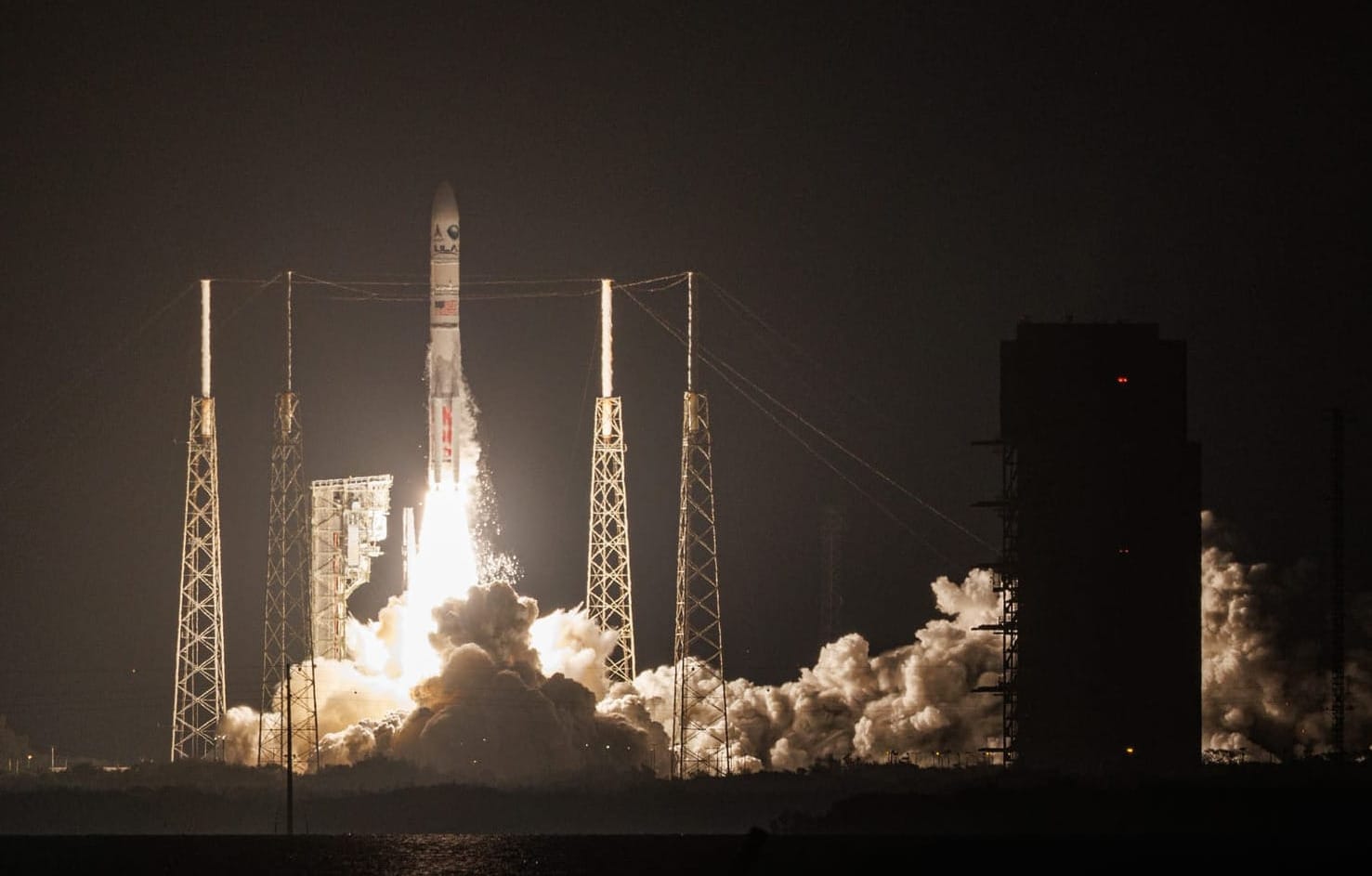
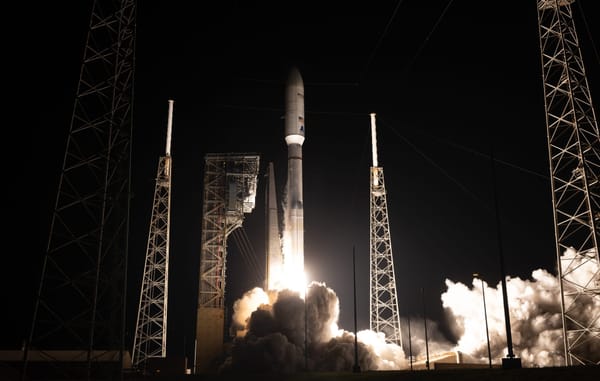
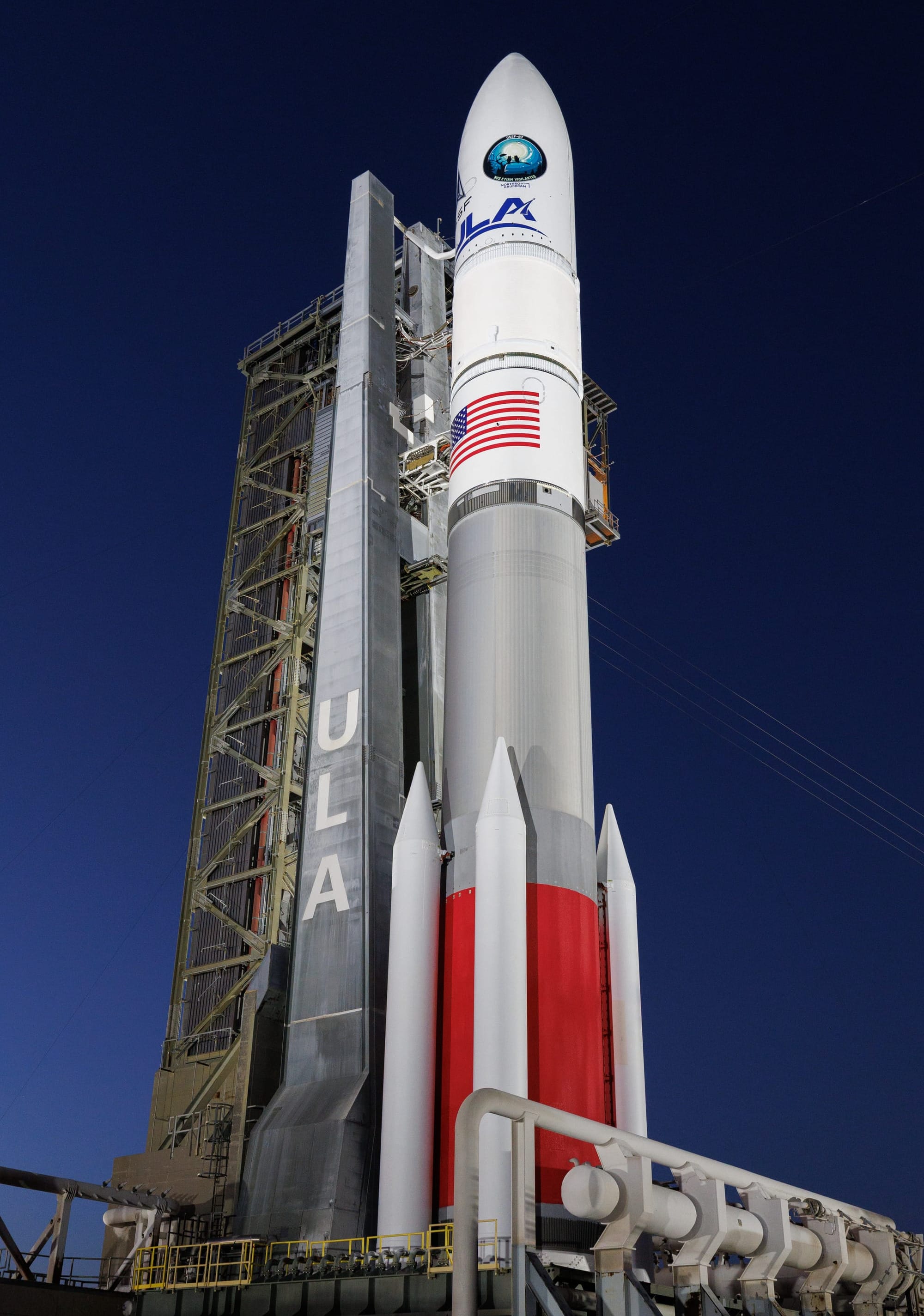
The U.S. Space Force's USSF-87 mission began at 09:22 am Universal Coordinated Time on February 12th, via United Launch Alliance's Vulcan rocket from Space Launch Complex 41 in Florida.
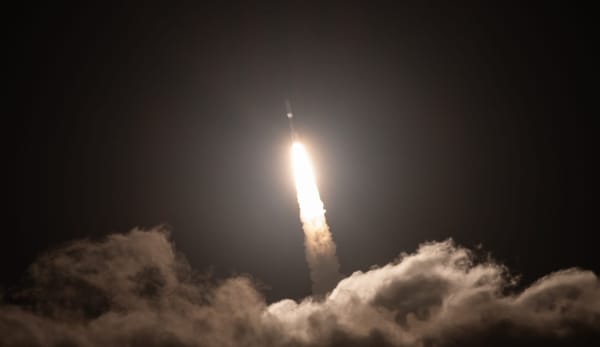
Under the power of two blue-flamed BE-4 engines and four GEM-63XL solid rocket boosters, Vulcan disappeared into the American East Coast's night sky. Shortly after liftoff and pointing downrange, one of the solid boosters appeared to experience and energentic anomaly (possibly repeating an earlier one), with fiery debris briefly appearing. The anomaly did not cause any issue for the remainder of the two BE-4 engines' burn, with official coverage ending afterwards as previously planned.
With the payloads of USSF-87, Vulcan's second-stage likely headed to a geosynchronous transfer orbit or straight for geosynchronous space. Neither the launch company of the Space Force shared where the launch was going, but did say it was the rocket's heaviest payloads to date.
To recap, Vulcan launched at 4:22 a.m. EST (0922 UTC) from Cape Canaveral for the U.S. Space Force Space Systems Command. At the request of our customer, this will conclude our live coverage of today's countdown and liftoff of USSF-87. https://t.co/cFp7QRXjp7 pic.twitter.com/E5oDbh0jLv
— ULA (@ulalaunch) February 12, 2026
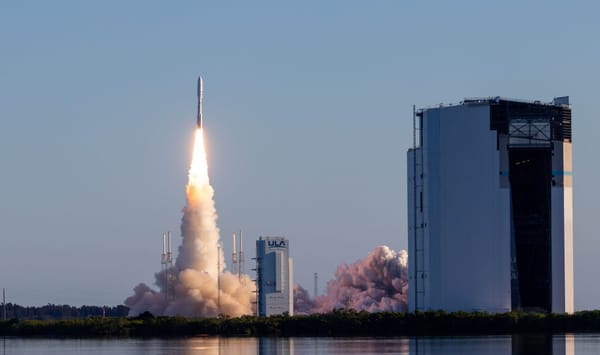
Vulcan lifting off from Space Launch Complex 41 on February 12th, via United Launch Alliance on Twitter.
Inside Vulcan's fairing was at least one Northrop Grumman-made Geosynchronous Space Situational Awareness Program (GSSAP) satellite. Those satellites head around geosynchronous space to monitor other spacecraft, primarily to allow the U.S. Space Force and the wider American military to understand other nation's capabilites. In April 2025, two operational GSSAP satellites buzzed three Chinese communications testing spacecraft.
A third spacecraft was also placed into orbit by the USSF-87 mission, being the 'Propulsive ESPA', also made by Northrop Grumman. That spacecraft is described as being for training U.S. military spacecraft operators on how to tactically maneuver satellites.
Confirmation of a successful launch for the USSF-87 mission was provided a few hours after liftoff, with United Launch Alliance's Vice President of Vulcan, Gary Wentz, sharing:
"Early during flight, the team observed a significant performance anomaly on one of the four solid rocket motors. Despite the observation, the Vulcan booster and Centaur performed nominally and delivered the spacecraft directly to geosynchronous orbit."
Today's Vulcan mission comes just two years after its first, while being its fourth overall. Previous payloads carried by the rocket include the ill-fated Peregrine lunar lander, upper-stage technology demonstrations, and a few spacecraft for the U.S. military. Since Vulcan's January 2024 debut, United Launch Alliance has conducted a handful of Atlas V launches from the same launch pad, including four deployments for Amazon's Leo network and Boeing's Starliner.
What is Vulcan?
Vulcan, sometimes called Vulcan-Centaur, is United Launch Alliance's in-development two-stage rocket. Vulcan is planned to replace the company's Atlas V and launch vehicle in the coming decade.
The first-stage is powered by two BE-4 engines generating 500 tons of thrust, burning liquid methane and liquid oxygen for about four minutes and fifty-nine seconds. Blue Origin manufactures the BE-4 engines for use with United Launch Alliance.
The second-stage is powered by two RL-10 engines generating 22 tons of thrust, burning liquid hydrogen and liquid oxygen. Aerojet Rocketdyne manufactures the RL-10 engines for use with United Launch Alliance. This stage is also called Centaur V due to the rocket stages' heritage.
Vulcan-Centaur can launch with either zero, two, four, or six GEM-63XL solid rocket motors to augment the rocket's thrust and capabilities. Each booster burns a solid propellant, consisting of Hydroxyl-terminated polybutadiene and Aluminum-Ammonium perchlorate, generating 224 tons of thrust each for a believed one minute and fifty seconds. The solid rocket boosters are manufactured by Northrop Grumman for use with United Launch Alliance.
Two fairing sizes are offered for Vulcan to suit customer needs, both 5.4 meters in diameter. The standard fairing is 15.5 meters long, while the extended long fairing is 21.3 meters long. A 'multi-manifest' version of the 21.3-meter-long fairing is also available for launching multiple spacecraft on a single launch.
United Launch Alliance claims Vulcan-Centaur can deliver the following amount of payload in its four potential configurations:
- Vulcan Centaur VC0
- 10,800 kilograms to low Earth orbit
- 3,500 kilograms to geosynchronous transfer orbit
- 2,300 kilograms to a trans-lunar injection
- Vulcan Centaur VC2
- 19,000 kilograms to low Earth orbit
- 8,400 kilograms to geosynchronous transfer orbit
- 6,300 kilograms to a trans-lunar injection
- Vulcan Centaur VC4
- 24,600 kilograms to low Earth orbit
- 11,700 kilograms to geosynchronous transfer orbit
- 9,200 kilograms to a trans-lunar injection
- Vulcan Centaur VC6
- 27,200 kilograms to low Earth orbit
- 15,300 kilograms to geosynchronous transfer orbit
- 12,100 kilograms to a trans-lunar injection
The naming scheme of each Vulcan-Centaur configuration is as follows: V stands for Vulcan, C stands for Centaur, 0/2/4/6 stands for the number of solid rocket motors, and S/L stands for the payload fairing length.