India's Skyroot Aerospace Achieves Orbit on First Attempt

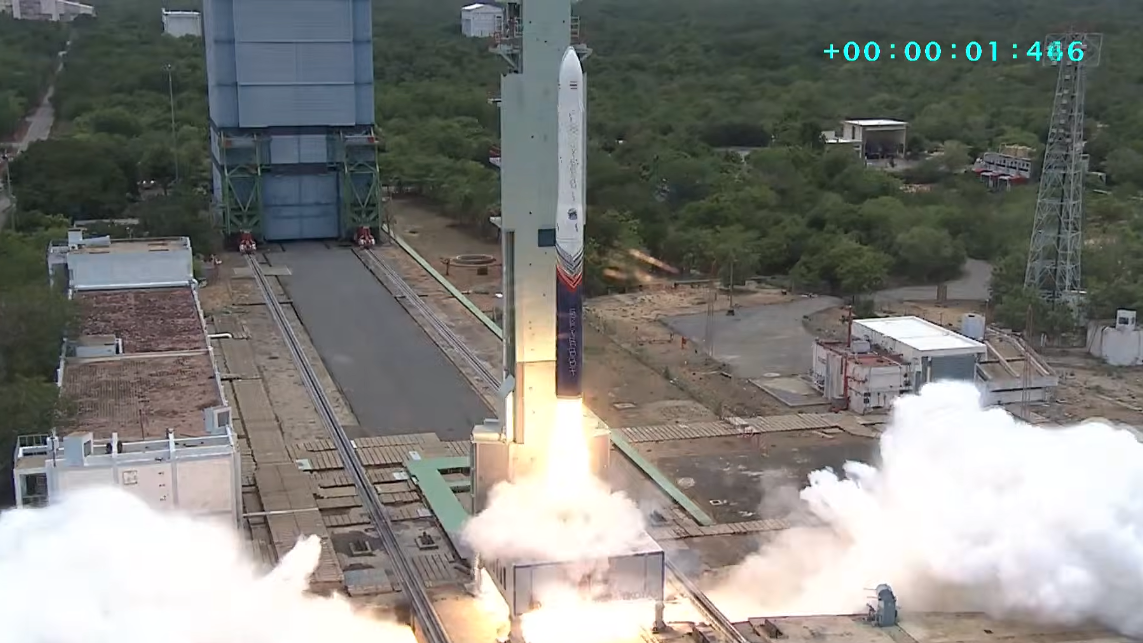
From the First Launch Pad at the Satish Dhawan Space Center, Skyroot Aerospace flew India's first privately developed launch vehicle, called Vikram-1, into low Earth orbit for its debut flight. Liftoff occurred at 06:35 am Universal Coordinated Time.
Vikram-1's ascent into orbit was performed as designed, with three solid-propellant stages bringing the vehicle out of the atmosphere, while a storable liquid-propellant stage achieved the final orbit, about 450 kilometers in altitude.
While acting as a test flight of Vikram-1's systems in a flight environment, a few customer payloads were placed into orbit. Remaining attached to the fourth-stage is a new actuator from DCUBED and a novel pair of robotic arms from Cosmoserve Space, designed to grapple dead satellites, to allow both to undergo testing in microgravity. Grahaa Space had a 1U CubeSat deployed through the launch, with it set to gather and beam back information about solar radiation. Skyroot also had an internally owned technology demonstration 3U CubeSat, known as SCOPE, delivered via the flight.
Utilizing some of the other remaining lift capacity were small artworks and commemorative postcards from Skyroot employees and Indian government officials. The base of the first-stage was also signed by employees.
We’ll be watching this ignition on loop all day.
— Skyroot Aerospace (@SkyrootA) July 18, 2026
Kalam-1200 — Vikram-1's first stage, named for Dr. A.P.J. Abdul Kalam — roaring to life and lifting Vikram-1 off the pad, on a flight that reached orbit.#Vikram1 #MissionAagaman pic.twitter.com/ul9wlY8LzH
The successful debut launch of Vikram-1 drew praise from government officials, with Prime Minister Narendra Modi writing on social media:
"This is a defining moment in India’s space journey. The growing participation of our private sector is opening new frontiers and accelerating innovation."
Indian Vice-President Shri Chandrapuram Ponnusami Radhakrishnan also congratulated the company, adding:
"This landmark achievement marks a new chapter in India’s space journey, showcasing the growing strength of our private space sector, advancing indigenous innovation, and reinforcing India’s emergence as a global space power. The mission also reflects the immense potential of India’s rapidly expanding space economy."
At present. Vikram-1 is able to place up to 350 kilograms into Earth orbit. Skyroot plans to fly a more capable version of the launch vehicle, featuring side-mounted solid propellant boosters, to increase its lift capacity up to 550 kilograms. That rocket is then hoped to fly once a quarter and, in the future, once a month.