
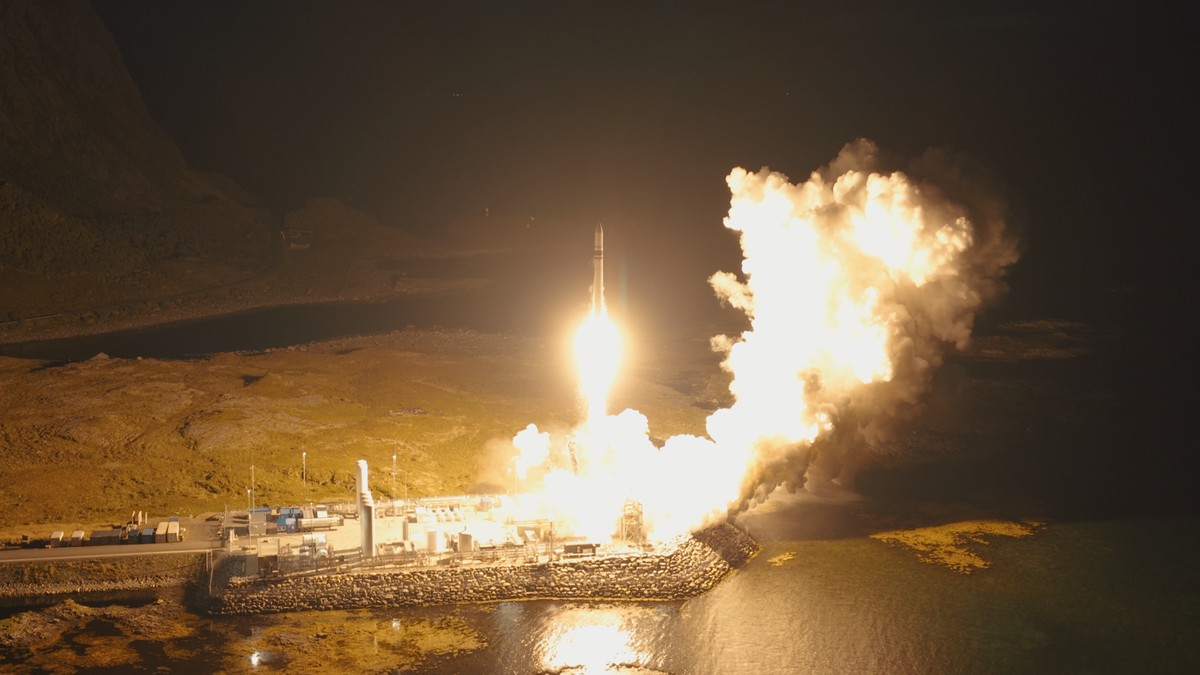
Having been delayed multiple times, German launch startup Isar Aerospace's Spectrum rocket took off from the Andøya Spaceport, within the Arctic Circle in Norway, for its second flight on September 5th at 20:12 Universal Coordinated Time, almost eighteen months after its first.
Nine Aquila engines powered the flight out of the launch site during the first-stage burn, which lasted for just over two and a half minutes until liquid propane and liquid oxygen were fully consumed. Good separation of the two stages took place not long after, followed by startup of the vacuum-optimized Aquila, and then the release of the payload fairing.
For four and a half minutes, the second-stage completed ascent over the poles to achieve an approximately 500-kilometer by 180-kilometer orbit. Half an orbit later, the second-stage's Aquila restarted to circularize the orbit successfully. All five customer satellites were deployed afterwards.
With that, Spectrum has become the first European rocket to launch from the western half of the European continent.
Liftoff: German company Isar Aerospace launched their Spectrum launcher, lifting off from Andøya Spaceport in Norway. 👏🚀
— ESA Space Transport (@transport.esa.int) 5 September 2026 at 21:31
[image or embed]
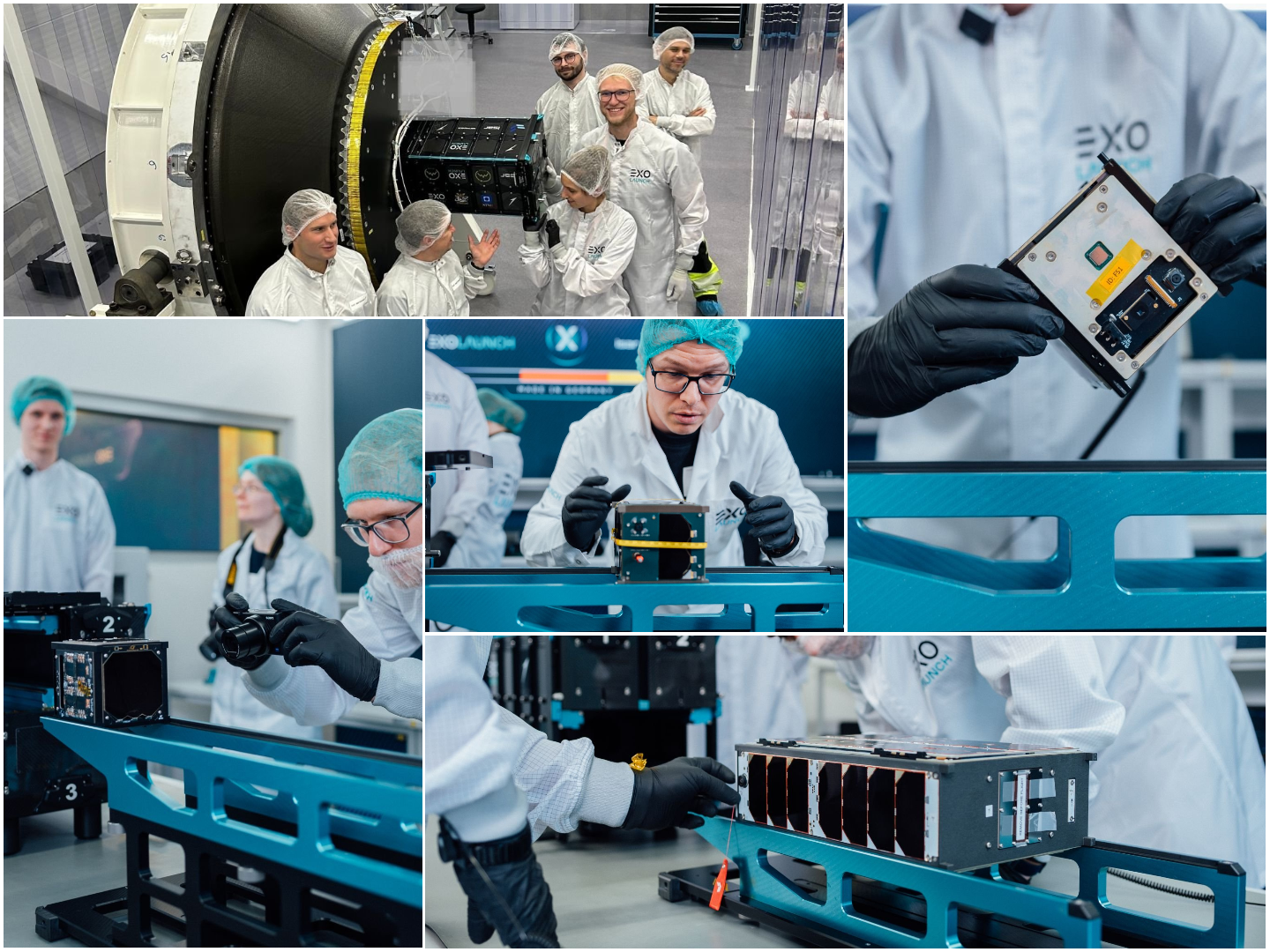
Riding atop of Spectrum for its second flight were five satellites from across Europe. Those satellites, deployed by Exolaunch in orbit, were:
- CyBEEsat from Technische Universität Berlin is a 1U CubeSat designed to test new ultra-thin perovskite solar cells and cybersecurity systems.
- TriSat-S from the University of Maribor is a 3U CubeSat demonstrating advanced battery hibernation performance and ultra-miniaturized imaging-based navigation.
- Platform-6 from EnduroSat, a spacecraft bus producer, is a vaguely described 6U CubeSat demonstration satellite.
- FramSat-1 from the Norwegian University of Science and Technology is an all-Norwegian-made 1U CubeSat set to test the team's designs and systems.
- SpaceTeamSat-1 from Technische Universität Wien is another 1U CubeSat, with the same goals as FramSat-1 while coming from Austria and featuring two cameras.
A payload attached to the rocket's second-stage was also onboard for this flight. That was from DCUBED to test their new release actuator, which will one day support the deployment of many satellites.
Isar Aerospace Chief Executive Officer and Co-Founder Daniel Metzler was quick to celebrate the successful flight into orbit, sharing via company press release:
"Today, Isar Aerospace opened space from Continental Europe. Launch continues to be the largest bottleneck for the global space industry and from today on, there is a true alternative for commercial and institutional customers. [...] I am incredibly proud of our team, that has made this success story from Europe possible. We will now focus on rapidly scaling launch vehicle production, deliver on our order pipeline, and meet surging global demand."
In the same press release, Isar Aerospace stated that they are already working on the next four Spectrum flights at their production facilities. The company plans to build forty rockets per year eventually.
A few hours later, European Space Agency Director General Josef Aschbacher added:
"A historic launch from Andøya Spaceport in Norway today, the first European Launcher Challenger to reach orbit. Spectrum quite literally rose to the challenge and delivered its payloads in low Earth orbit. An astounding achievement by German company Isar Aerospace, founded only eight years ago, and backed by the European Space Agency. This is yet another step towards a more diverse autonomous European launch service sector, and I am excited for what is still to come!"
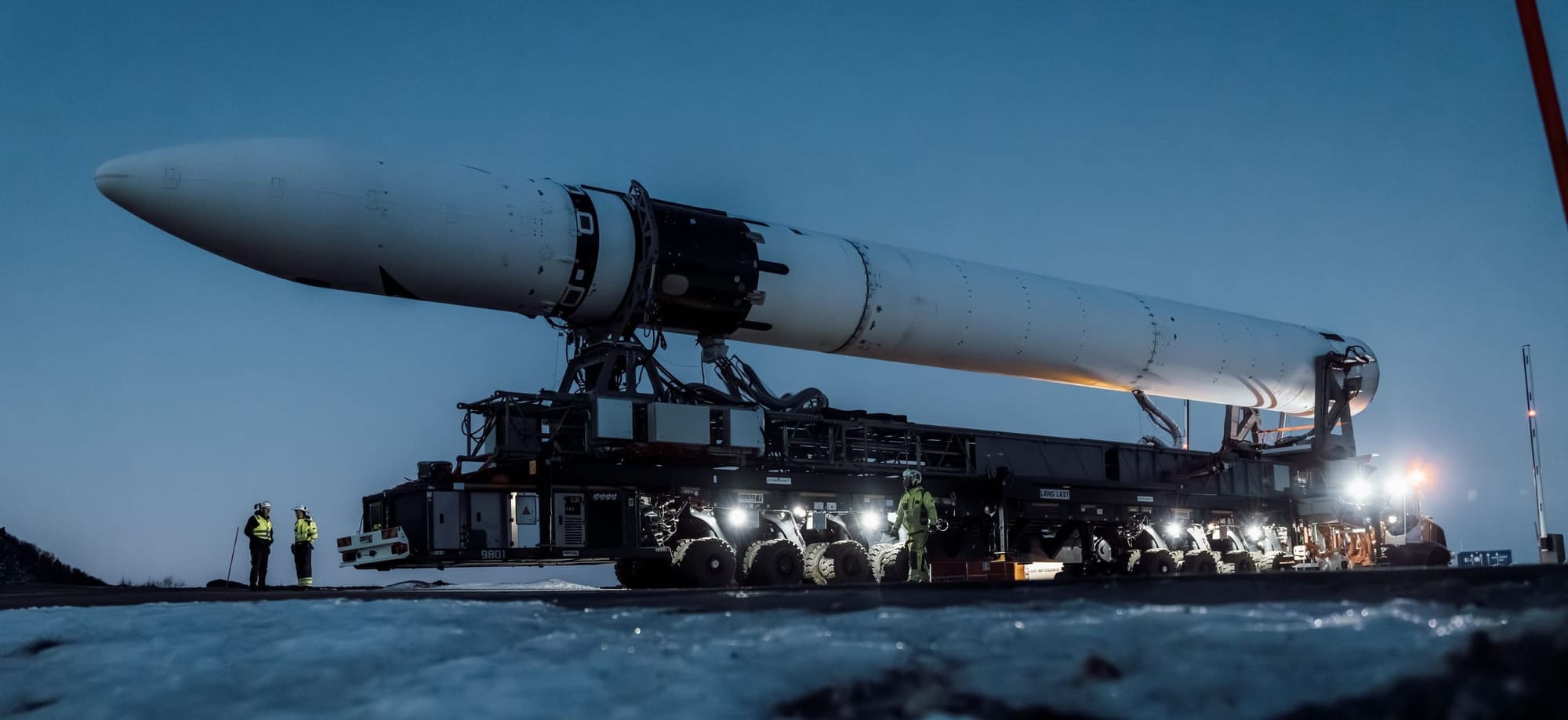
Spectrum is a fairly small rocket, compared to Europe's premier launch vehicle Ariane 6, standing just 28 meters tall while being 2 meters in diameter across its two-stages. Due to that, the rocket is able to carry up to 1,000 kilograms to low Earth orbit by burning liquid propane and liquid oxygen in nine Aquila engines on the first-stage and a single Aquila engine on the second-stage.
Despite its size, Spectrum has already secured a good handful of launch contracts from several nations. In March 2025, the Norwegian Space Agency awarded the company the launch for its Arctic Ocean Surveillance satellites, while the European Space Agency agreed to subsidize further flights of the rocket through its Flight Ticket Initiative, having been first added in 2024. Germany's R-Space and Japan's Astroscale selected Spectrum to launch critical missions for them, R-Space's first satellites and Astroscale's orbital debris mitigation demonstration. Multiple launches have also been bought by France's Exotrail and the U.S.'s SEOPS, to launch many small satellites.
Many of the payloads for Spectrum may end up being European with Isar Aerospace positioning its launch services as a way to secure European sovereignty, following a visit from German Chancellor Friedrich Merz and Norwegian Prime Minister Jonas Gahr Støre in March, and another by German Minister of Defence Boris Pistorius in July.
Much of the company's messaging from executives ahead of its first launch stressed the need for European-made satellites to launch on European-developed rockets from Europe's territories. Spectrum is supported by the European Space Agency's 'Boost!' program. There are also plans to bring the rocket to Canada once it is proven.
Recognising the strategic need for a rocket like Spectrum, Isar Aerospace received 270 million Euros for its Series D funding round on June 9th, while its second launch campaign was underway. Investors providing new capital were 'European stakeholders', with the company saying the money will be used to scale production and operations. A further 200 million Euros was secured in late August from the European Space Agency through its European Launcher Challenge.
Join the discussion
Commenting is available to paid members.
View membershipSign in