
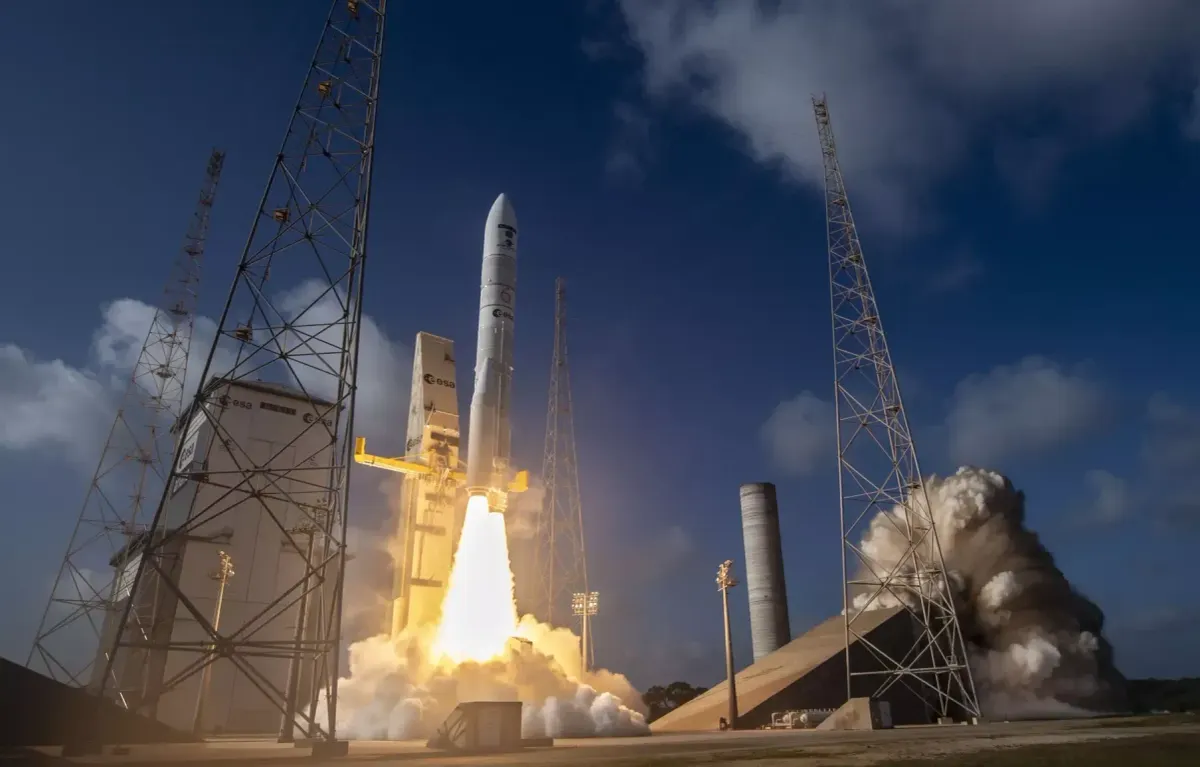
Europe's Ariane 6 performed its first mission towards geostationary space earlier today, August 27th, with a mission departing the Guiana Space Center at 20:11 pm Universal Coordinated Time.
Quickly disappearing from its South American launch site, Ariane 6 shot its way into the sky through the power of its two solid rocket boosters and the assistance of its single Vulcain 2.1 engine on the first-stage. For just over two minutes, the boosters continued to provide a majority of the thrust, before being separated and allowing Vulcain 2.1 to continue ascent on its own until a little under eight minutes after liftoff.
At around eight minutes post-liftoff, and following the release of the second-stage, the lone Vinci ignited to bring Ariane 6 toward its first geostationary trajectory, via a burn that would last for almost fourteen minutes. That burn would be completed without issue, allowing for the release of Europe's newest meteorological satellite about thirty-six and a half minutes after launch, and concluding the rocket's first mission towards geostationary space.
LIFTOFF! 🚀 Ariane 6 #VA270, launching MTG-I2, completing Europe's Meteosat constellation.
— European Space Agency (@esa.int) 27 August 2026 at 21:13
[image or embed]
Now floating in space, the 3,800-kilogram Meteosat Third Generation Imager 2, commonly known as MTG-I2 in short, will begin commissioning its systems before maneuvering to its allocated slot in geostationary space a few weeks from today. Once there, it will begin providing imagery to meteorologists from its two primary instruments:
- Flexible Combined Imager: for gathering imagery in sixteen wavelengths at a resolution of between 0.5 and 2 kilometers to track clouds and water vapor features as they move through the atmosphere.
- Lightning Imager: to, as its name suggests, image lightning flashes and measure their intensity, while being able to study convective precipitation and the creation of common nitrogen oxides.
Alongside them is a small instrument dedicated to space weather, known as the Radiation Monitor Unit, for detecting and measuring energetic particles in space. It is one of many European weather satellites with the instrument, which will better characterize space weather events.
MTG-I2 is the third spacecraft in the Meteosat Third Generation system to be launched out of a planned six, started in 2022 and continuing until 2036. It is also the fourteenth spacecraft to be deployed in the Meteosat program, managed by the intergovernmental entity EUMETSAT.
Speaking on the capabilities of their newest satellite and the importance of Ariane 6 in the months ahead of launch, Director-General Phil Evans stated:
"The rapid scanning over Europe provided by MTG-I2 will be invaluable for nowcasting dangerous conditions. As part of the Meteosat Third Generation constellation, MTG-I2 data will support meteorologists in tracking the full life cycle of severe storms, from their formation to dissipation. Ariane 6 gives Europe the means to launch our vital meteorological satellites, ensuring long-term resilience."
MTG-I2 is expected to be in service until around 2037, according to information provided to the World Meteorological Organization. Areas under the coverage of the satellite are Europe and North Africa.
What is Ariane 6?
Ariane 6 is ArianeGroup's latest launch vehicle in the Ariane family of rockets. ArianeGroup has been manufacturing and marketing the Ariane launch vehicles on behalf of the European Space Agency since Ariane 4. Two versions of the Ariane 6 rocket are available, Ariane 62 and Ariane 64.
These two versions share the first and second stages. The first stage of Ariane 6 burns liquid hydrogen and liquid oxygen in a single Vulcain 2.1 engine, producing 139 tons of thrust. The second stage of Ariane 6 also burns liquid hydrogen and oxygen, but in a single Vinci engine that generates 18 tons of thrust.
Each of the solid rocket boosters burns a mixture of aluminum and hydroxyl-terminated polybutadiene to produce 474 tons of thrust each. This allows Ariane 62 to generate 1088 tons of thrust at liftoff, while Ariane 64 can generate 2036 tons of thrust.
Ariane 62
Ariane 62 is the cheaper of the two configurations because it opts to use two solid rocket boosters. The lift capacity of Ariane 62 is as follows: 10,350 kilograms to low Earth orbit, 7,200 kilograms to a sun-synchronous orbit, 4,500 kilograms to geostationary transfer orbit, or 3,500 kilograms to a lunar transfer orbit.
On the launch pad, Ariane 62 weighs approximately 530,000 kilograms with a first-stage, second-stage, and faring diameter of 5.4 meters. Ariane 62 stands 56 meters tall ahead of launch.
Ariane 64
Ariane 64 is the more capable of the two configurations due to its utilization of four solid rocket boosters. The lift Capacity of Ariane 64 is as follows: 22,000 kilograms to low Earth orbit, 15,500 kilograms to a sun-synchronous orbit, 11,500 kilograms to geostationary transfer orbit, 8,600 kilograms to a lunar transfer orbit, or 5,000 kilograms to geostationary orbit.
On the launch pad, Ariane 62 weighs approximately 860,000 kilograms with a first-stage, second-stage, and faring diameter of 5.4 meters, exactly the same as Ariane 62. Ariane 64 is eight meters taller than Ariane 62 and is 62 meters tall ahead of launch.
Join the discussion
Commenting is available to paid members.
View membershipSign in