Artemis II Moon Mission Soars out of Florida to Start Ten-Day Flight

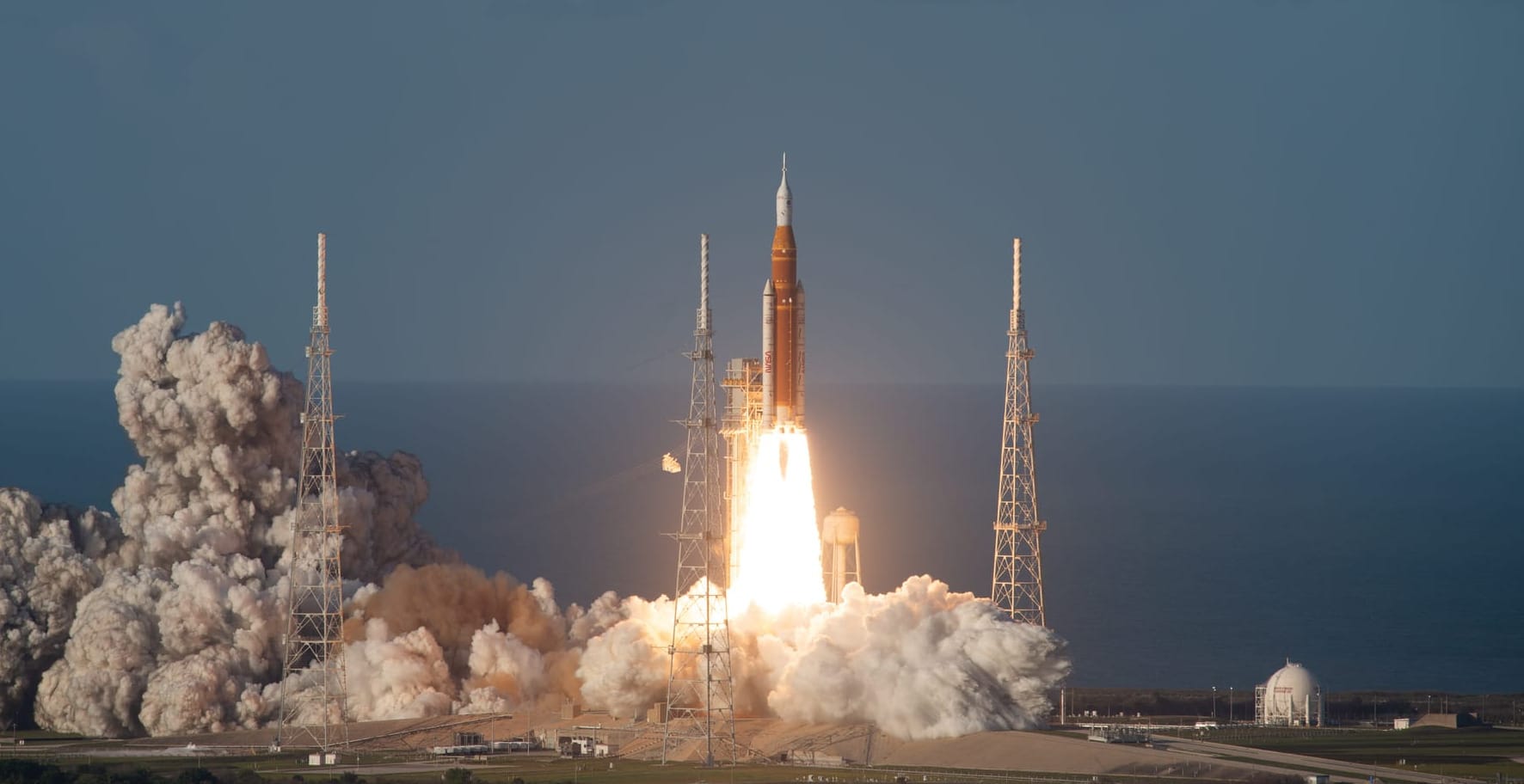
For the first time in just over fifty-three years, astronauts are heading towards the Moon, thanks to NASA's Space Launch System (SLS) rocket blasting off from Launch Complex 39B in Florida on April 1st, carrying astronauts Reid Wiseman, Victor Glover, Christina Koch, and Jeremy Hansen inside the Orion spacecraft, dubbed 'Integrity'.
Ascent off of the Florida coast began with the start-up of four RS-25 engines, followed by the ignition of SLS' two massive solid rocket boosters. For just over two minutes, the boosters and engines brought the astronauts out of the atmosphere until solid propellant ran out and the boosters were separated. The four engines continued to burn for six more minutes after delivering most of the speed to reach Earth orbit.
Staging. SRB Sep. pic.twitter.com/ljeFazfIZ6
— NSF - NASASpaceflight.com (@NASASpaceflight) April 1, 2026
Liftoff and solid rocket booster seperation of Artemis II's Space Launch Launch System rocket, via NASASpaceflight on Twitter.
Following ascent, the Interim Cryogenic Propulsion Stage was detached with Orion atop of it. About fifty minutes after liftoff, the upper-stage conducted its perigee raise burns to ensure that its orbit does not intersect with the atmosphere. That burn was followed by an apogee raise maneuver an hour later to put Orion in its target orbit.
Three and a half hours following launch, Orion spacecraft 'Integrity' was separated from the Interim Cryogenic Propulsion Stage. In the coming hours that allows the spacecraft and upper-stage to demonstrate proximity operations. It also enables the release of small international CubeSats from Argentina’s Comisión Nacional de Actividades Espaciales to measure radiation levels across Earth orbits, the German Space Agency DLR to determine space-environment effects on lunar hardware, the Korea Aerospace Administration to understand radiation effects on biological samples, and the Saudi Space Agency to further measurements about solar weather.
The Orion spacecraft successfully separated from the upper stage of the rocket, and the "proximity operations" test is underway. The Artemis II astronauts are manually piloting Orion similarly to how they would if they were docking with another spacecraft. pic.twitter.com/RWW4RSyaoq
— NASA (@NASA) April 2, 2026
Orion spacecraft 'Integrity' being separated from its Interim Cryogenic Propulsion Stage, via NASA on Twitter.
Currently staged in a highly elliptical Earth orbit, 'Integrity' and its crew of four will stay in that orbit for around twenty-four hours to test spacecraft systems. If all tests are successful and there are no major issues, Orion will perform a lunar-bound burn to head towards the Moon.
Once in lunar space, Victor Glover will become the first person of colour to fly around the Moon, while Christina Koch will be the first woman to do so, and Jeremy Hansen will be the first non-American.
Speaking on the Artemis II mission and its launch, NASA Associate Administrator Amit Kshatriya shared the following via a post-launch press release:
"Artemis II is a test flight, and the test has just begun. The team that built this vehicle, repaired it, and prepared it for flight has given our crew the machine they need to go prove what it can do. Over the next 10 days, Reid, Victor, Christina, and Jeremy will put Orion through its paces so the crews who follow them can go to the Moon’s surface with confidence. We are one mission into a long campaign, and the work ahead of us is greater than the work behind us."
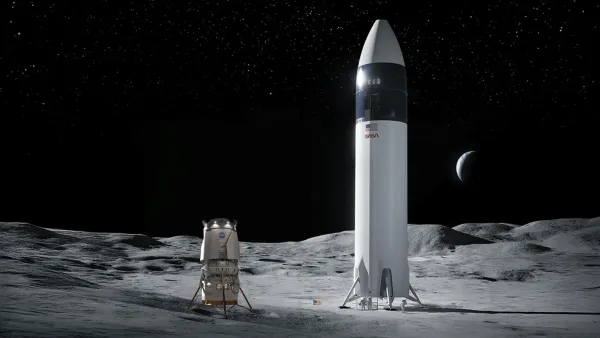
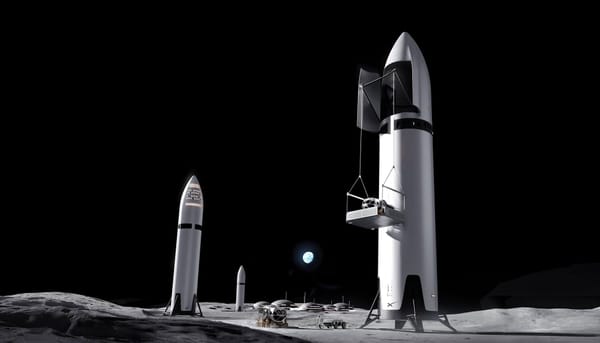
Mission ahead for the Artemis program includes a 2027 flight in Earth orbit to test one or both lunar landers contracted to Blue Origin and SpaceX, followed by lunar landings as soon as 2028 using said landers.
Who's going around the Moon?
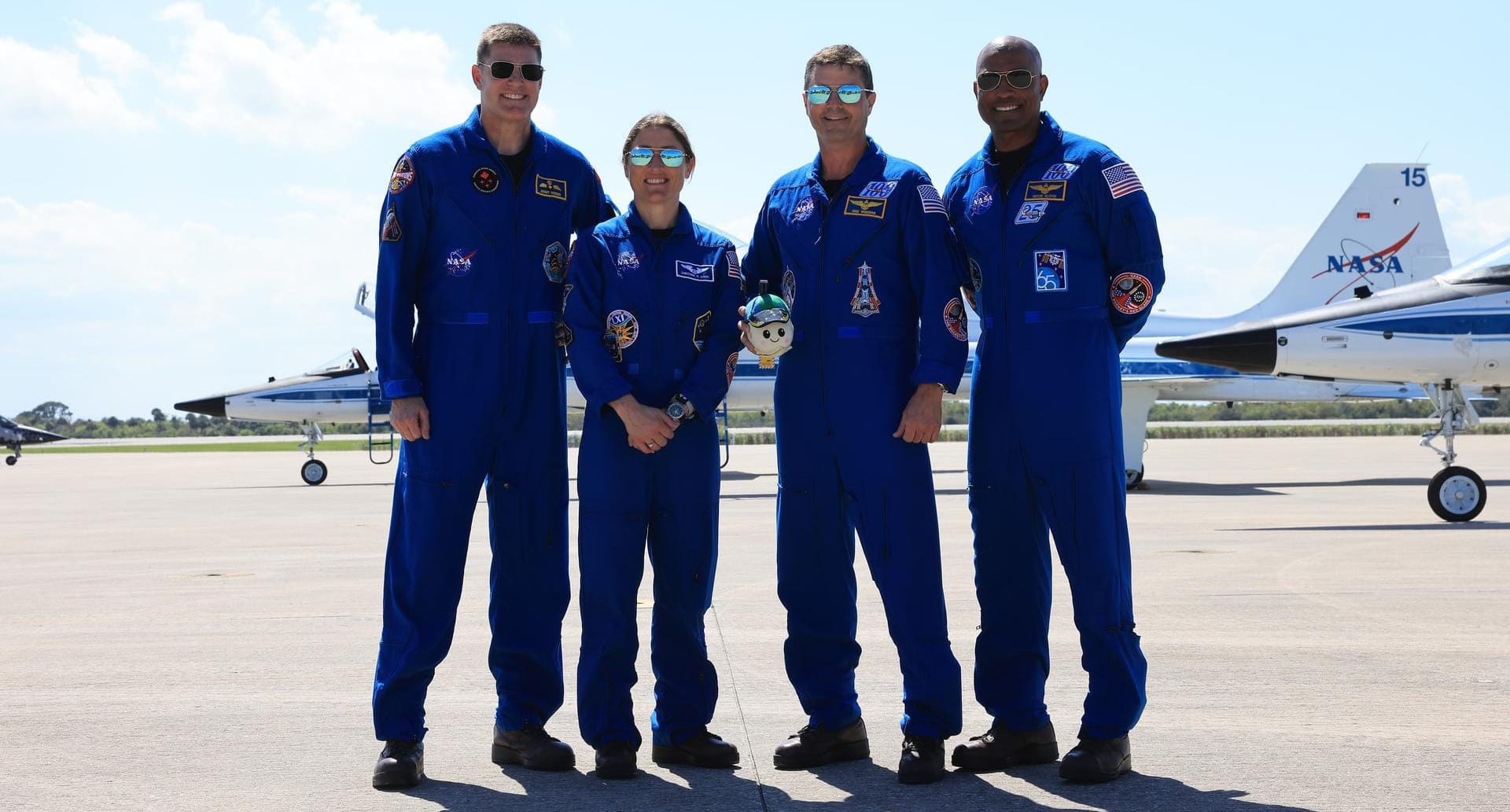
For the first time since the Apollo 17 mission in December 1972, astronauts are going to be around the Moon. For the Artemis II mission, there are four astronauts, and they are:
- Reid Wiseman, Commander of the Artemis II mission, for his second spaceflight. In 2014, he spent 165-days onboard the International Space Station, following selection in 2009 and training in 2011. Prior to joining NASA, he served in the U.S. Navy.
- Victor Glover, Pilot for the Artemis II mission, participating in his second spaceflight. For his first mission over 2020 and 2021, he flew for the Crew-1 mission to the International Space Station for 168-days, having been selected in 2013 and trained in 2015. Before becoming an astronaut, he served in the U.S. Navy.
- Christina Koch, Mission Specialist of the Artemis II mission, for her second spaceflight. Starting in 2019 and concluding in 2020, her first spaceflight spent 328-days onboard the International Space Station, following selection in 2013 and training in 2015. Prior to becoming an astronaut, she worked at NASA's Goddard Space Flight Center, was a Research Associate in the United States Antarctic Program, worked for Johns Hopkins University Applied Physics Laboratory, and performed research for the National Oceanic and Atmospheric Administration.
- Jeremy Hansen, Mission Specialist for the Artemis II mission, for his first spaceflight. Hansen is the only non-American member of the crew and is part of an agreement regarding Canada's contribution to the Artemis program. Prior to being trained as an astronaut, following selection in 2009, he served in the Royal Canadian Air Force.
Riding alongside the four astronauts is their zero gravity indicator known as 'Rise'. 'Rise' is a plushie of the Moon wearing a cap featuring the Earth and space. Within 'Rise' is an SD card holding the names of 5.6 million people from across the world.
What will they be up to?
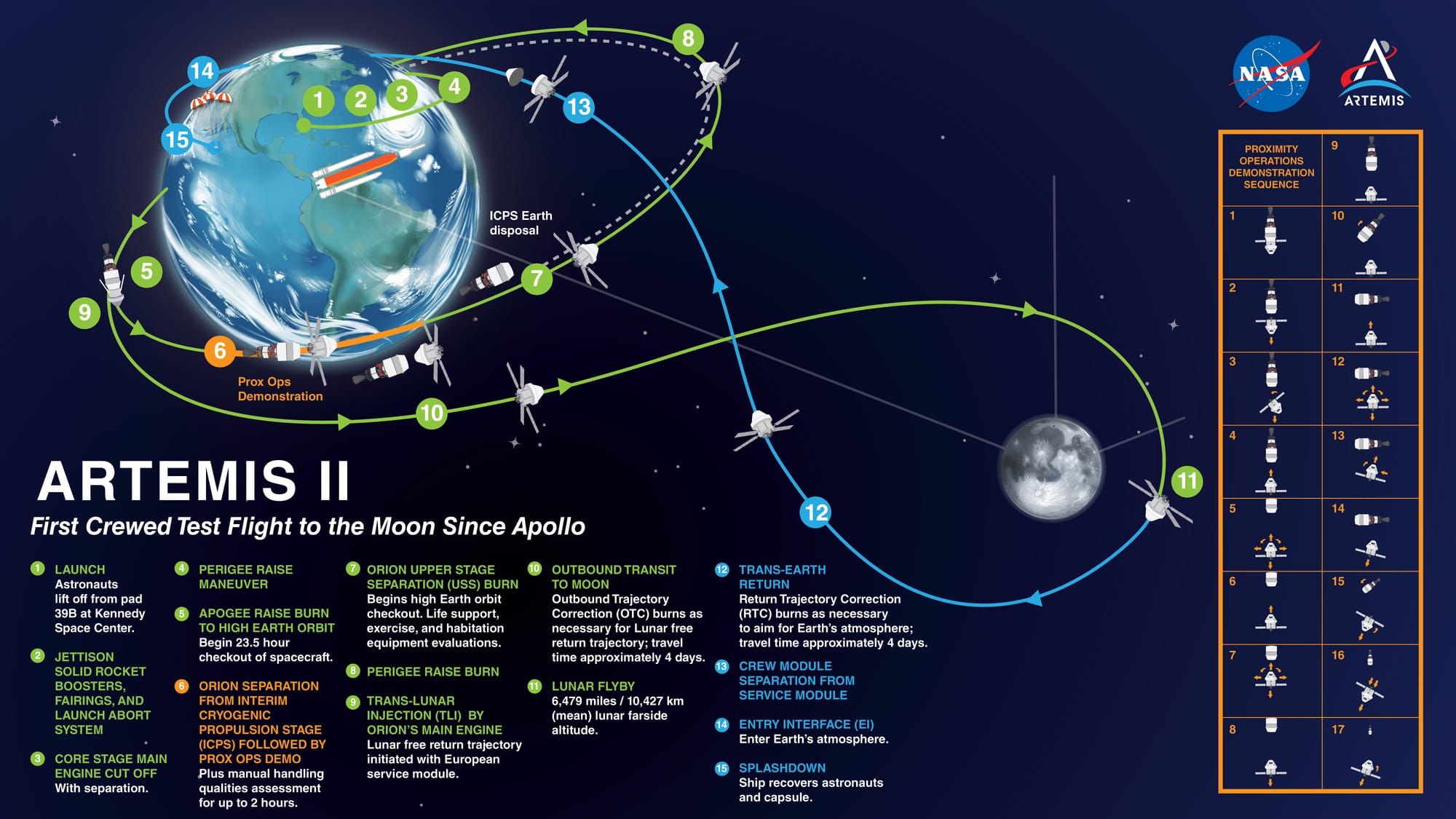
Now in space, the four astronauts onboard the Orion spacecraft have up to ten days of activity ahead of them, with a few of those for flying past the Moon. According to NASA, their time is scheduled as follows:
- Day 1: After SLS places Orion into a high-Earth orbit, the spacecraft will perform a slight orbital boost before the four astronauts test life support and other human-needed systems, like its toilet.
- Day 2: Following their first night in space, and the first ever onboard Orion, the crew will prepare for a lunar-bound engine burn that will be performed later that day. This day is also usable as an early return to Earth should major systems be acting anomalously.
- Day 3: A small burn will refine Orion's path toward the Moon while its four astronauts demonstrate the spacecraft's medical procedures and equipment, later verifying emergency communication systems.
- Day 4: Another burn will be performed to further refine Orion's path, while the crew has minimal activity besides a short time to photograph the Moon.
- Day 5: Orion will enter the Moon's sphere of influence for the second time in its flight history, and the first time with astronauts onboard. This day will also have the crew testing their spacesuit systems while they remain a considerable distance from the Moon, and another burn will refine Orion's path to start aiming it for the Pacific Ocean back on Earth.
- Day 6: Orion will be at its furthest distance away from Earth while coming closest to the Moon, at a distance of 6,440 to 9,650 kilometers. Depending on lighting conditions, the four astronauts on board will conduct photography of the lunar surface as they fly by.
- Day 7: After just two days in it, Orion will exit the Moon's sphere of influence while the crew informs teams back on Earth of the experience of flying past the Moon. Another engine burn will be performed too, for refining the spacecraft's path back to Earth.
- Day 8: Now heading back to Earth, the four astronauts will demonstrate setting up a radiation shelter within Orion due to the spacecraft's prolonged future missions, which may see crews exposed to events like solar flares.
- Day 9: Ahead of reentry to the atmosphere the following day, the crew will conclude Orion systems demonstrations and perform various health measurements relating to their re-adaption to the planet following the lunar mission.
- Day 10: Orion will perform its final burn to aim for recovery locations in the Pacific Ocean, then separate the capsule from the service module for reentry into Earth's atmosphere. Reentry will last several minutes to slow the capsule down from about Mach 30. Once throught atmosphere, parachutes will deploy to slow the capsule for a gentle splashdown, after which the crew will be recovered to end the Artemis II mission.
Over those ten days, the astronauts will consume pre-prepared shelf-stable meals three times a day.
So what's Orion?
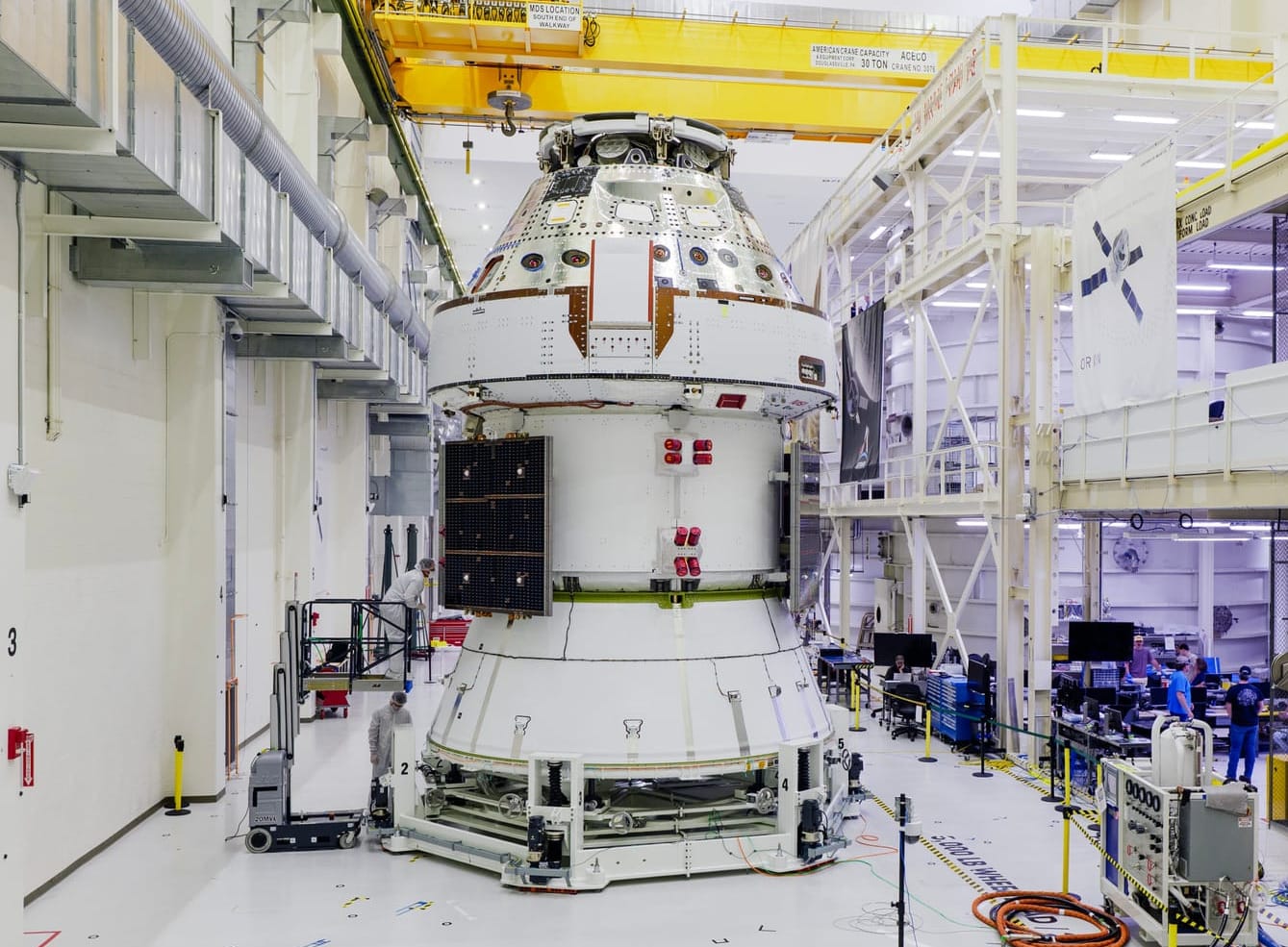
To allow for the exploration of the lunar environment this century, NASA has developed the Orion spacecraft with international and American partners. The spacecraft is able to carry four astronauts in space around the Moon for up to three weeks.
The only part of Orion accessible to astronauts is the Lockheed Martin-made capsule, which is 5 meters in diameter with a pressurized volume of 19.56 square meters, with 8.9 square meters of crew habitable volume. During an astronaut's mission onboard Orion, the capsule stores all of their food and sleeping areas, as well as the toilet, with five windows to look out of when not needed at the spacecraft's controls. For reentry to Earth's atmosphere, twelve thrusters are situated across the capsule to correctly point it heat shield first.
Managing, powering, and propelling Orion during its time in space is the European Service Module, provided via the European Space Agency. The service module handles the spacecraft's power generation through four solar arrays, thermal management duties, and supplies water and oxygen to the crew inside the capsule. Orion's main propulsion and attitude control is handled by the service module too, with the Space Shuttle orbiter-derived Orbital Maneuvering System engine for major maneuvers and thirty-two other thrusters for controlling orientation alongside small trajectory adjustments.
Like every other current operational crewed spacecraft, Orion has an abort system, opting to use a launch escape tower from Northrop Grumman. That system is able to quickly react to any issues during ascent out of the atmosphere, and if needed, can pull Orion's capsule away in a couple second via its 181 tons of thrust.
And what is the SLS rocket?
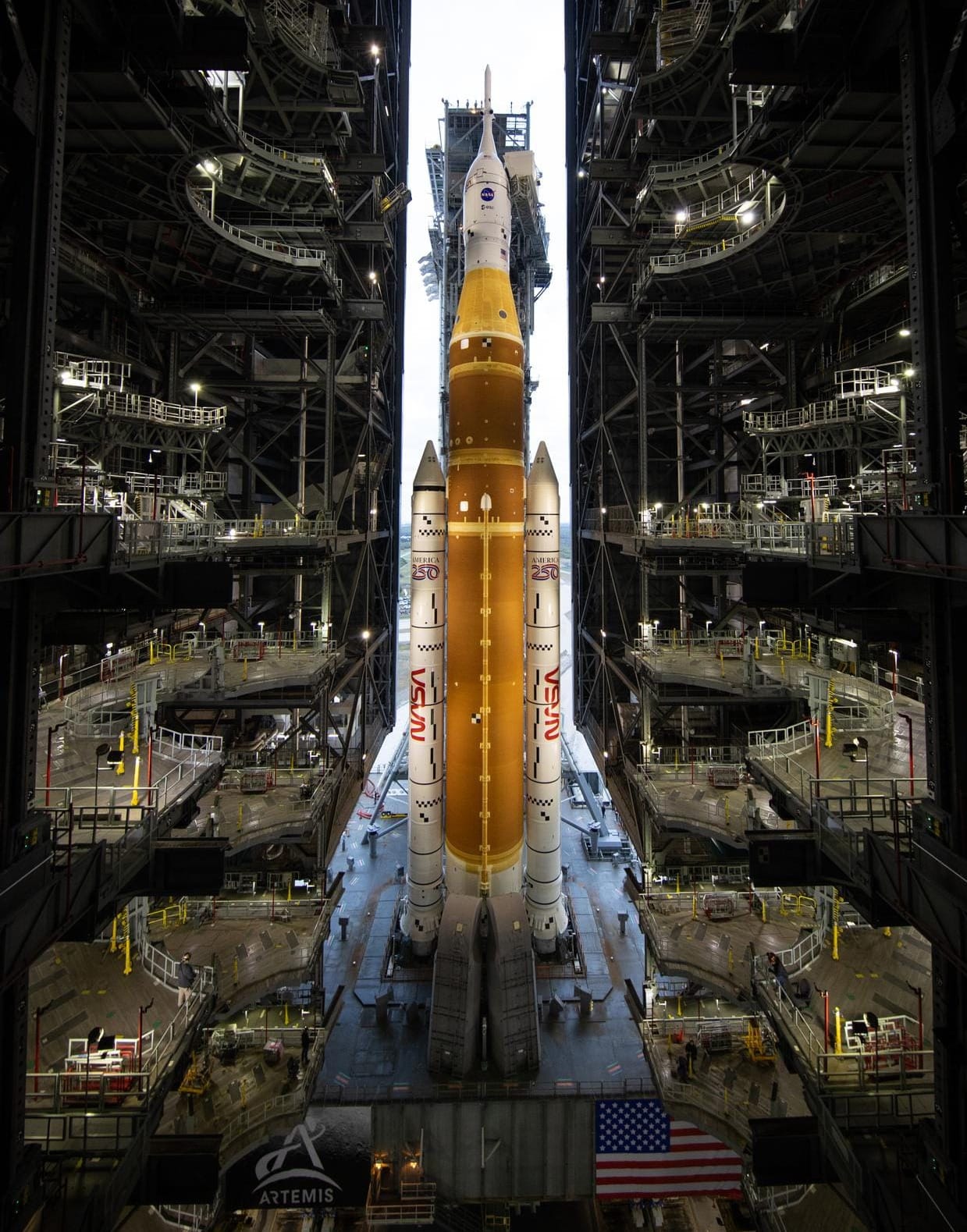
To send the Orion spacecraft toward the Moon with its astronauts on board, a massive rocket is needed. As such, NASA has the Space Launch System (SLS) rocket, standing at 98.27 meters tall and weighing 2,604 tons when fuelled for launch. SLS is able to throw up to 27 tons onto a trans-lunar trajectory.
Powering SLS from liftoff are four core stage-mounted RS-25 engines from L3Harris Technologies, each producing up to 232 tons of thrust individually from burning liquid oxygen and liquid hydrogen. The four engines are augmented by two 53.9-meter-tall five-segment solid rocket boosters made by Northrop Grumman, generating 1,632 tons of thrust each. Through the four RS-25's and two solid boosters, SLS can generate up to 4,192 tons of thrust to carry SLS, Orion, and four astronauts out of the atmosphere.
In space, Orion is initially still attached to United Launch Alliance's Interim Cryogenic Propulsion Stage, which SLS' core stage places into an almost stable orbit. The Interim Cryogenic Propulsion Stage, also fuelled with liquid oxygen and liquid hydrogen, is equipped with one of L3Harris Technologies' RL10C-2 engines, which can produce 11.2 tons of thrust. This stage is highly efficient and throws Orion with its astronauts towards the Moon.