Artemis II Heads Back to the Launch Pad Ahead of April Moon Mission

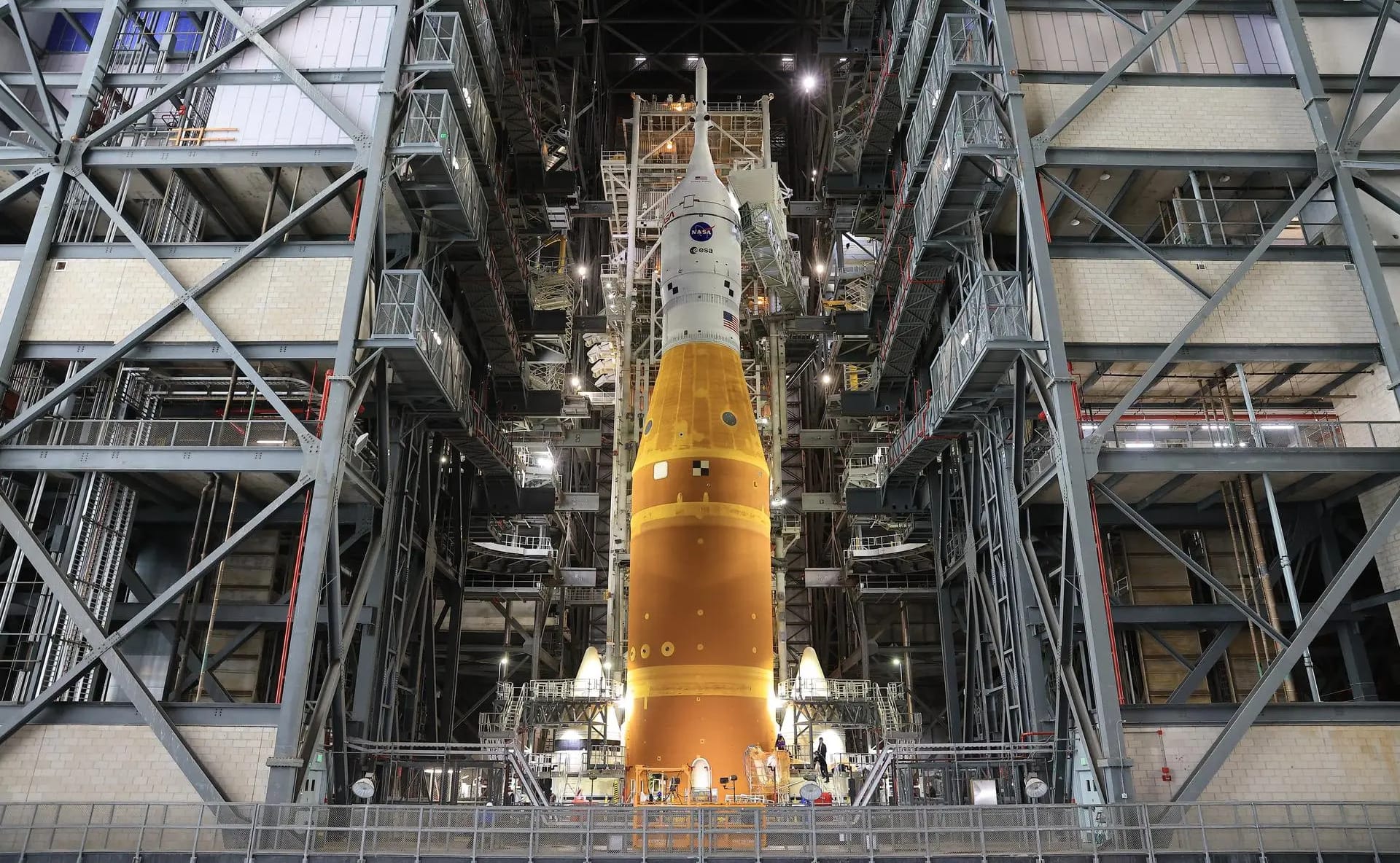
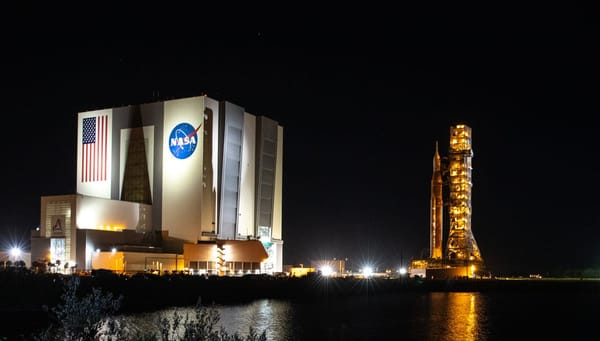
In the morning of March 20th, NASA began the twelve-hour process of rolling its Space Launch System (SLS) rocket out to Launch Complex 39B from the Kennedy Space Center's Vehicle Assembly Building. The rocket's trip is being performed by one of the space agency's crawler-transporters, with a blistering top speed of 0.3 miles per hour.
Over two months ago, Artemis II's SLS headed out for flight, completing tests to full fuel and preparing all systems. Later fueling tests were completed as planned, but a helium leak on the Interim Cryogenic Propulsion Stage, causing a a trip back to the Vehicle Assembly Building on February 25th. That leak was found to be from a seal in the quick-disconnect systems, with teams utilizing the rockets' time off the pad to refresh battery and flight termination systems as well.
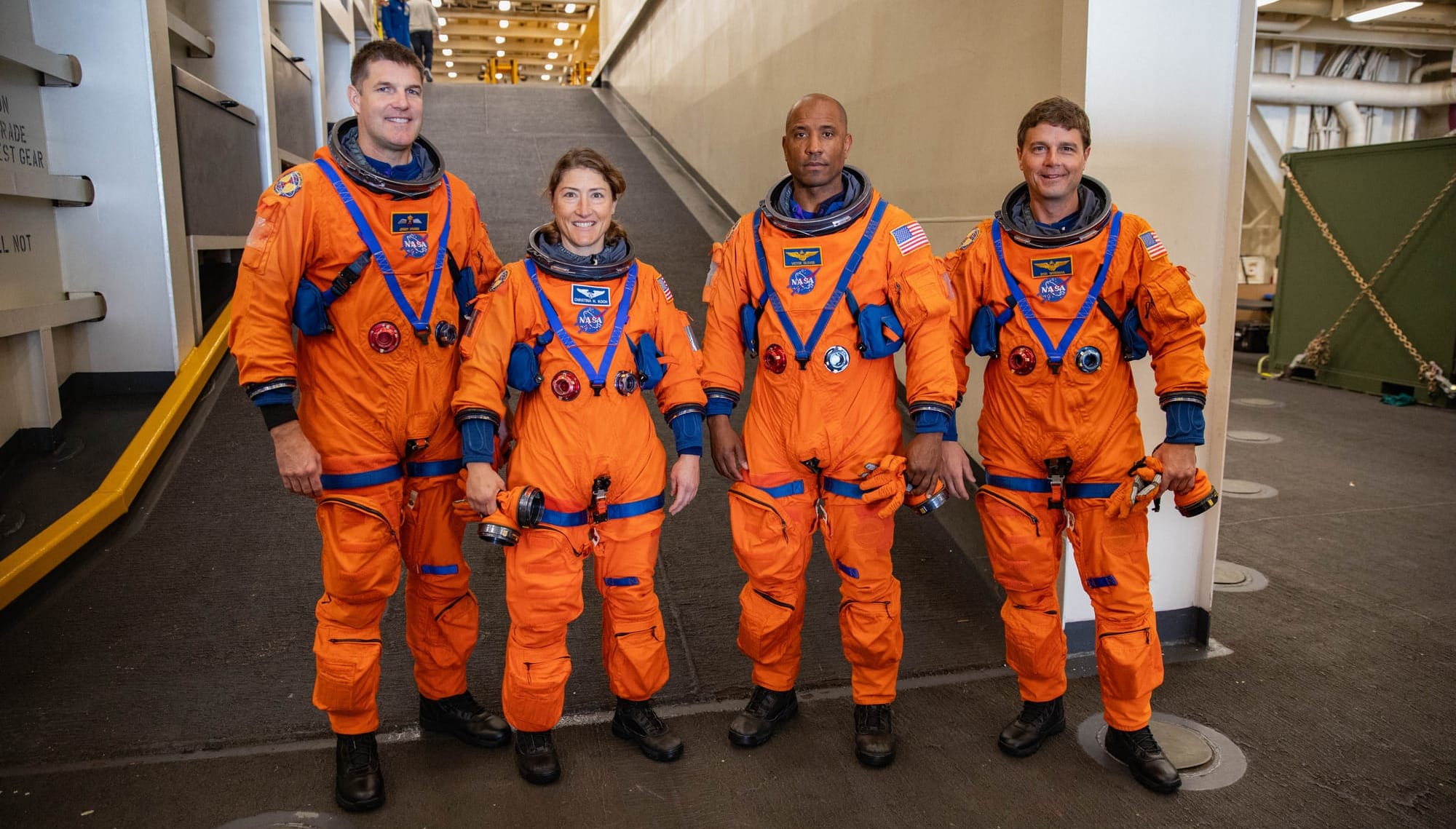
Meanwhile, the four astronauts waiting to fly on board Orion have entered their two-week pre-flight quarantine in Houston, limiting their contact to non-NASA personnel, ahead of a flight over to the Kennedy Space Center in a few days.
With SLS heading back to Launch Complex 39B and the crew in quarantine, NASA is preparing to begin the Artemis II mission no earlier than April 1st in a launch window that runs until April 6th. If no launch occurs in those six days, another window begins on April 30th.
When the Artemis II mission does begin via its SLS launch, the mission's crew will spend up to ten days onboard the Orion spacecraft, with their time scheduled as follows:
- Day 1: After SLS places Orion into a high-Earth orbit, the spacecraft will perform a slight orbital boost before the four astronauts test life support and other human-needed systems, like its toilet.
- Day 2: Following their first night in space, and the first ever onboard Orion, the crew will prepare for a lunar-bound engine burn that will be performed later that day. This day is also usable as an early return to Earth should major systems be acting anomalously.
- Day 3: A small burn will refine Orion's path toward the Moon while its four astronauts demonstrate the spacecraft's medical procedures and equipment, later verifying emergency communication systems.
- Day 4: Another burn will be performed to further refine Orion's path, while the crew has minimal activity besides a short time to photograph the Moon.
- Day 5: Orion will enter the Moon's sphere of influence for the second time in its flight history, and the first time with astronauts onboard. This day will also have the crew testing their spacesuit systems while they remain a considerable distance from the Moon, and another burn will refine Orion's path to start aiming it for the Pacific Ocean back on Earth.
- Day 6: Orion will be at its furthest distance away from Earth while coming closest to the Moon, at a distance of 6,440 to 9,650 kilometers. Depending on lighting conditions, the four astronauts on board will conduct photography of the lunar surface as they fly by.
- Day 7: After just two days in it, Orion will exit the Moon's sphere of influence while the crew informs teams back on Earth of the experience of flying past the Moon. Another engine burn will be performed too, for refining the spacecraft's path back to Earth.
- Day 8: Now heading back to Earth, the four astronauts will demonstrate setting up a radiation shelter within Orion due to the spacecraft's prolonged future missions, which may see crews exposed to events like solar flares.
- Day 9: Ahead of reentry to the atmosphere the following day, the crew will conclude Orion systems demonstrations and perform various health measurements relating to their re-adaption to the planet following the lunar mission.
- Day 10: Orion will perform its final burn to aim for recovery locations in the Pacific Ocean, then separate the capsule from the service module for reentry into Earth's atmosphere. Reentry will last several minutes to slow the capsule down from about Mach 30. Once throught atmosphere, parachutes will deploy to slow the capsule for a gentle splashdown, after which the crew will be recovered to end the Artemis II mission.
Over those ten days, the astronauts will consume pre-prepared shelf-stable meals three times a day.
Who's heading around the Moon?
When the Artemis II mission lifts off and reaches the Moon, the four astronauts onboard the Orion spacecraft will be the first to head near our closest celestial neighbor since the crew of Apollo 17 in December 1972. As for the crew onboard, they are:
- Reid Wiseman, Commander of the Artemis II mission, for his second spaceflight. In 2014, he spent 165-days onboard the International Space Station, following selection in 2009 and training in 2011. Prior to joining NASA, he served in the U.S. Navy.
- Victor Glover, Pilot for the Artemis II mission, participating in his second spaceflight. For his first mission over 2020 and 2021, he flew for the Crew-1 mission to the International Space Station for 168-days, having been selected in 2013 and trained in 2015. Before becoming an astronaut, he served in the U.S. Navy.
- Christina Koch, Mission Specialist of the Artemis II mission, for her second spaceflight. Starting in 2019 and concluding in 2020, her first spaceflight spent 328-days onboard the International Space Station, following selection in 2013 and training in 2015. Prior to becoming an astronaut, she worked at NASA's Goddard Space Flight Center, was a Research Associate in the United States Antarctic Program, worked for Johns Hopkins University Applied Physics Laboratory, and performed research for the National Oceanic and Atmospheric Administration.
- Jeremy Hansen, Mission Specialist for the Artemis II mission, for his first spaceflight. Hansen is the only non-American member of the crew and is part of an agreement regarding Canada's contribution to the Artemis program. Prior to being trained as an astronaut, following selection in 2009, he served in the Royal Canadian Air Force.