
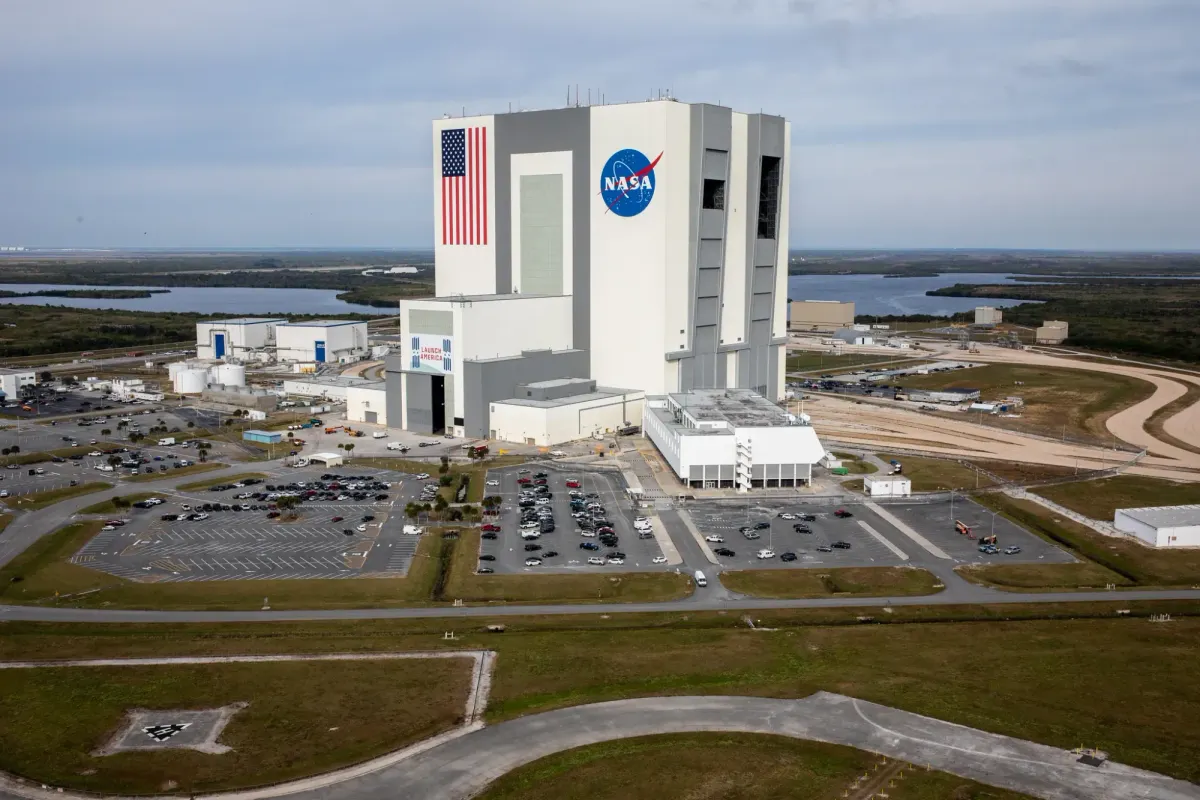
The National Aeronautics and Space Administration (NASA) is the U.S. government agency in charge of the country’s civilian space program. NASA leads efforts in human spaceflight, robotic missions, space and Earth science, aeronautics research, and new technologies for future exploration.
NASA was founded on October 1, 1958, during the early Space Race between the United States and the Soviet Union. It took over the National Advisory Committee for Aeronautics (NACA) and other military and scientific groups, quickly becoming the main hub for America’s civilian space activities.
For over sixty years, NASA has led major scientific and engineering achievements. The agency has sent astronauts to the Moon, kept people living in low Earth orbit, landed robots on other planets, used powerful telescopes to study the universe, researched Earth’s climate, and improved aviation and space technology.
Today, NASA works on many projects at once. These include sending people to the Moon, exploring Mars and the Solar System with robots, studying the universe from space, observing Earth, researching flight, and creating new technologies for future deep space missions.
What Does NASA Do?
NASA does much more than just send astronauts into space. The agency works in many areas, including science, engineering, exploration, and research.
Human Spaceflight
NASA builds and runs systems to send people into space and support them there. Its human spaceflight work includes missions in low Earth orbit, the Artemis program to return people to the Moon, and plans for exploring beyond the Earth-Moon area.
NASA also partners with private companies for transportation and other services in low Earth orbit. This shift means NASA is now more of a main customer and technology partner, rather than building and running every spacecraft itself.
Robotic spacecraft help NASA explore places that are too far away, risky, or difficult for people to visit directly.
NASA missions have explored the Moon, Mars, Venus, Mercury, Jupiter, Saturn, asteroids, comets, and the outer Solar System. Robotic spacecraft perform tasks ranging from geological surveys and atmospheric measurements to searches for evidence of past habitable environments.
Space Science
NASA runs and supports missions that study how the universe began, how it has changed, and how it works.
NASA’s science work covers astronomy, astrophysics, planetary science, heliophysics, Earth science, and cosmology. Telescopes like Hubble and James Webb let scientists see things from planets around other stars to the oldest galaxies in the universe.
Earth Science
NASA also studies Earth, the planet it was created to serve.
NASA uses satellites and aircraft to measure Earth’s air, oceans, land, ice, plants, and climate. These studies help scientists understand weather, climate change, natural disasters, water, and other Earth systems.
Aeronautics
The “A” in NASA stands for aeronautics. NASA took over NACA’s mission to research flight and still studies aviation today.
NASA creates and tests new technologies to make airplanes safer, quieter, more efficient, and better overall. Its research has also helped improve technology across the whole aerospace industry.
Space Technology
NASA invents and improves technologies needed for future space missions.
This work covers things like advanced engines, power systems, communications, robots, self-driving systems, spacesuits, life-support, new materials, manufacturing methods, and other technology needed for long-term space missions.
NASA History
Before NASA: NACA
NASA did not start from scratch.
The National Advisory Committee for Aeronautics (NACA), founded in 1915, came before NASA. NACA ran research labs and built up knowledge that helped American aviation grow.
After World War II, the U.S. put more resources into rockets, missiles, atmospheric research, and space science. As the Soviet Union became a rival, space exploration became a key part of the Cold War.
When the Soviet Union launched Sputnik 1 in October 1957, it proved they could put a satellite in orbit. This pushed the U.S. to speed up its own space program.
The U.S. created NASA with the National Aeronautics and Space Act of 1958. NASA started work on October 1, 1958, taking over NACA and other space research groups.
The Space Race
NASA’s first major challenge was competing with the Soviet Union in human spaceflight.
The Soviet Union achieved several early milestones, including launching the first artificial satellite, the first animal into orbit, and the first human into space. In response, the United States developed increasingly ambitious human spaceflight programs.
NASA’s early programs progressed from short-duration human flights to increasingly complex missions around Earth and ultimately to the Moon.
This approach set a pattern for NASA: each new mission builds technology, experience, and knowledge needed for the next, more advanced step.
NASA Programs
NASA’s history is marked by a series of programs that have slowly increased our ability to work beyond Earth.
Mercury Program
Timeframe: 1958–1963
Primary objective: Develop America’s capability for human spaceflight
Project Mercury was NASA’s first human spaceflight program.
The main goal was to find out if people could survive and work in space. The program started with test flights that got more complex, leading up to sending American astronauts into orbit.
Mercury culminated in a series of crewed orbital missions, establishing the basic technologies and procedures required for American human spaceflight.
The program also produced one of the defining moments of the early Space Race when John Glenn became the first American to orbit Earth in 1962.
Mercury showed the U.S. could send people into orbit and bring them back safely, but it also made clear there was still a lot to learn.
Gemini Program
Timeframe: 1961–1966
Primary objective: Develop the techniques required for lunar missions
Project Gemini acted as the link between Mercury and Apollo.
While Mercury demonstrated basic human spaceflight, Gemini focused on the more advanced operations required for a lunar mission. Astronauts conducted longer-duration flights, rendezvous and docking operations, orbital maneuvers, and extravehicular activities.
Gemini gave NASA important experience in running missions with people and spacecraft together in orbit.
The program showed that astronauts could stay in space for longer times and do the complex maneuvers needed for Apollo.
Apollo Program
Timeframe: 1961–1972
Primary objective: Land humans on the Moon and return them safely to Earth
The Apollo program was NASA’s mission to meet President John F. Kennedy’s goal of landing a person on the Moon before the end of the 1960s.
Apollo required an enormous technological ecosystem, including the Saturn V rocket, Apollo command and service modules, lunar modules, navigation systems, spacesuits, communications infrastructure, and a vast network of ground facilities.
Apollo 11 achieved the program’s central objective in July 1969, when Neil Armstrong and Buzz Aldrin became the first humans to walk on the Moon while Michael Collins remained in lunar orbit.
NASA conducted six successful crewed lunar landings between 1969 and 1972. Twelve astronauts ultimately walked on the lunar surface.
Apollo is still one of the greatest engineering achievements ever and made the Moon the first place beyond Earth visited by people.
Skylab
Timeframe: 1973–1979
Primary objective: Conduct long-duration human spaceflight and scientific research
Skylab was the first American space station.
Launched in 1973, Skylab let astronauts do experiments in microgravity, study how long space missions affect people, and observe Earth and the Sun.
Three crews lived aboard Skylab for progressively longer missions.
The program helped NASA learn about the challenges of living and working in space for long periods, which became important for later space stations and deep-space missions.
Space Shuttle Program
Timeframe: 1981–2011
Primary objective: Provide reusable transportation to and from low Earth orbit
The Space Shuttle was NASA’s main way to send people to space for thirty years.
Unlike earlier spacecraft, the Shuttle was partly reusable. Its orbiter could launch straight up, work in orbit, and land on a runway back on Earth.
The Shuttle fleet launched satellites, did science experiments, took astronauts to and from space, and helped build and maintain the International Space Station.
Five orbiters—Columbia, Challenger, Discovery, Atlantis, and Endeavour—flew operational missions. The program also suffered two catastrophic losses. Challenger was destroyed shortly after launch in 1986, killing all seven crew members, while Columbia broke apart during atmospheric reentry in 2003, also killing all seven astronauts aboard.
The Shuttle program ended in 2011 after flying 135 missions.
When the Shuttle retired, NASA no longer had its own spacecraft to carry astronauts to low Earth orbit. This led to the creation of the Commercial Crew program.
International Space Station
Timeframe: 1998–present
Primary objective: Establish a permanent international laboratory in low Earth orbit
The International Space Station (ISS) is a space lab built by the United States, Russia, Europe, Japan, and Canada working together.
Building the ISS started with the Zarya module in 1998. Over time, it became a large space complex with labs, living areas, solar panels, robots, and more.
People have lived on the ISS nonstop since November 2000.
NASA uses the station to conduct research into biology, physics, medicine, materials science, Earth observation, and technologies needed for future human exploration.
The ISS is also a major example of countries working together in human spaceflight.
Commercial Crew Program
Timeframe: 2010s–present
Primary objective: Develop commercially operated crew transportation to low Earth orbit
NASA’s Commercial Crew Program marked a major shift in how the agency approaches human spaceflight.
Instead of building and owning every part of the crew transport system, NASA teamed up with private companies to create spacecraft that can carry astronauts to and from the ISS.
SpaceX’s Crew Dragon became the first commercially developed crewed spacecraft to carry astronauts to orbit under the program in 2020.
Commercial Crew reduced NASA’s dependence on foreign crew transportation after the Space Shuttle retired and established a model in which privately developed space systems could support government missions.
This approach is now a key part of NASA’s plan to help build a commercial space economy in low Earth orbit.
Artemis Program
Timeframe: 2017–present
Primary objective: Return humans to the Moon and establish the foundation for sustained lunar exploration
Artemis is NASA’s current flagship human exploration program.
Unlike Apollo, which aimed for one big goal, Artemis is meant to keep people around and on the Moon for longer and to build up skills for future missions farther into the Solar System.
The program uses several spacecraft, launch systems, partnerships with companies, international teamwork, and new infrastructure on the Moon.
Major components include:
Space Launch System
The Space Launch System (SLS) is NASA’s big rocket, built to send the Orion spacecraft and other cargo beyond low Earth orbit.
SLS incorporates technologies derived from the Space Shuttle and Constellation programs while providing the launch capability NASA requires for its current crewed lunar architecture.
Orion
The Orion spacecraft is NASA’s vehicle for sending people into deep space.
It is built to carry astronauts beyond low Earth orbit, support them on deep-space trips, and bring them back safely to Earth.
Human Landing Systems
NASA is teaming up with private companies to build spacecraft that can take astronauts from lunar orbit down to the Moon’s surface.
This is a big change from Apollo, since NASA is now using private companies as part of its plan for sending people to the Moon.
Lunar Surface Exploration
The main goal of Artemis is to increase human activity on and near the Moon.
NASA’s Moon goals include science, new technology, resource use, and building capabilities that support more advanced exploration.
The agency’s current human-spaceflight organization places Artemis within the Human Spaceflight Mission Directorate, established during NASA’s 2026 organizational realignment. The directorate also oversees low Earth orbit activities, the Moon Base program, and commercial access to space.
Mars Exploration
Mars has been one of NASA’s most extensively explored planetary destinations.
NASA’s robotic Mars program has used orbiters, landers, and rovers to investigate the planet’s geology, atmosphere, climate, and potential habitability.
Major missions have included Viking, Mars Pathfinder, Spirit, Opportunity, Curiosity, InSight, Perseverance, and the Mars Reconnaissance Orbiter.
NASA’s Mars exploration strategy has increasingly emphasized the search for evidence that Mars may once have supported microbial life.
The Perseverance rover, which landed in Jezero Crater in 2021, is studying an ancient river delta and collecting rock samples intended for eventual return to Earth.
Mars is also central to NASA’s long-term human exploration ambitions. NASA is treating the Moon as a nearby proving ground for technologies and operational experience that could eventually support crewed missions to Mars.
NASA’s Space Telescopes
NASA has played a central role in space-based astronomy.
Hubble Space Telescope
Launched in 1990, the Hubble Space Telescope transformed astronomy by providing extremely detailed observations above Earth’s atmosphere.
Hubble has contributed to research involving galaxies, stars, nebulae, exoplanets, black holes, and the expansion of the universe.
Its observations have become some of the most recognizable scientific images ever produced.
James Webb Space Telescope
The James Webb Space Telescope (JWST) launched in December 2021 as Hubble's successor in several areas of infrared astronomy.
Webb was designed to study the formation of the first galaxies, the birth of stars and planetary systems, and the atmospheres of planets orbiting other stars.
Operating near the Sun-Earth L2 point, approximately 1.5 million kilometers from Earth, Webb uses a large segmented primary mirror and a multilayer sunshield to conduct extremely sensitive infrared observations.
Together, missions such as Hubble and Webb demonstrate one of NASA’s defining characteristics: building scientific instruments that can answer questions that could not be addressed from Earth.
NASA’s Robotic Exploration of the Solar System
NASA’s exploration portfolio extends far beyond Mars.
The agency has sent spacecraft to nearly every major class of object in the Solar System, including planets, moons, asteroids, and comets.
Notable missions include:
Voyager — explored the outer planets and continues traveling through interstellar space.
Cassini-Huygens — extensively studied Saturn and its moons, including Titan and Enceladus.
Juno — studies Jupiter’s atmosphere, interior, magnetic field, and massive storms.
New Horizons — conducted the first close flyby of Pluto and later explored the Kuiper Belt object Arrokoth.
OSIRIS-REx — collected samples from the near-Earth asteroid Bennu and returned them to Earth in 2023.
Lucy — is exploring Jupiter’s Trojan asteroids to study primitive remnants of the Solar System.
These missions allow scientists to reconstruct the Solar System's history and investigate environments that may preserve evidence of how planets formed.
NASA and Commercial Space
NASA’s relationship with the private space industry has changed substantially since the agency’s founding.
During the early Space Race, NASA largely commissioned and controlled the development of the spacecraft, rockets, and infrastructure required for its missions.
Today, NASA increasingly acts as a customer, partner, and technology developer alongside commercial companies.
Companies such as SpaceX, Boeing, Blue Origin, Northrop Grumman, and others have participated in NASA programs involving crew transportation, cargo delivery, lunar exploration, launch services, and other capabilities.
This shift is particularly significant in low Earth orbit, where NASA envisions a future in which government astronauts operate alongside privately funded commercial stations and other space businesses.
The underlying idea is that NASA can focus its resources on exploration and scientific objectives while commercial companies develop services that can eventually operate independently of government funding.
NASA and International Partnerships
NASA’s exploration efforts are closely tied to international space agencies and governments.
The International Space Station represents one of the most extensive examples of multinational cooperation in spaceflight.
NASA also works with organizations such as the European Space Agency (ESA), Japan Aerospace Exploration Agency (JAXA), the Canadian Space Agency (CSA), and numerous other international partners.
The Artemis program has expanded this model through the Artemis Accords, a framework for cooperation around peaceful and responsible exploration of the Moon and beyond.
International partnerships allow countries to combine scientific expertise, engineering capabilities, funding, infrastructure, and access to space.
NASA Centers and Facilities
NASA operates a distributed network of research centers, laboratories, testing facilities, and launch infrastructure throughout the United States.
Major NASA centers include:
Kennedy Space Center
Located in Florida, Kennedy Space Center is one of NASA’s primary launch facilities and serves as the principal launch site for many of the agency’s human spaceflight missions.
Johnson Space Center
Located in Houston, Texas, Johnson Space Center is the center of NASA’s human spaceflight operations and includes Mission Control.
Marshall Space Flight Center
Located in Huntsville, Alabama, Marshall has played a major role in NASA’s rocket development and propulsion programs, including the Saturn rockets and Space Launch System.
Jet Propulsion Laboratory
Located in Southern California and managed for NASA by the California Institute of Technology, JPL develops and operates many of NASA’s robotic planetary missions.
Goddard Space Flight Center
Located in Maryland, Goddard is heavily involved in Earth science, astrophysics, heliophysics, space science, and developing and operating scientific spacecraft.
Ames Research Center
Located in California, Ames conducts research involving aeronautics, advanced technology, astrobiology, planetary science, and other fields.
Langley Research Center
Located in Virginia, Langley conducts research in aeronautics, Earth science, atmospheric science, and space technology.
NASA’s broader center network allows the agency to distribute highly specialized engineering and scientific capabilities across the country. NASA currently identifies 10 field centers within its organizational structure.
How NASA Is Organized
NASA is an independent agency of the United States federal government.
Its headquarters is located in Washington, D.C., while its research centers, laboratories, and facilities are distributed throughout the United States.
NASA’s organizational structure changes over time as national priorities and mission requirements change.
As of 2026, NASA’s major mission organizations include the Human Spaceflight Mission Directorate, Research and Technology Mission Directorate, Science Mission Directorate, and Mission Support Directorate.
The 2026 reorganization combined NASA’s former Exploration Systems Development and Space Operations organizations into the Human Spaceflight Mission Directorate. It also combined aeronautics and space technology activities into the Research and Technology Mission Directorate.
NASA is currently led by Administrator Jared Isaacman, the agency’s 15th administrator.
NASA Today
NASA’s current activities span human exploration, scientific research, technology development, and commercial spaceflight.
The agency is pursuing an increasingly interconnected approach to space exploration.
In low Earth orbit, NASA is supporting the transition toward commercial space services and future commercial destinations.
Around the Moon, Artemis aims to develop the infrastructure and operational experience needed for sustained lunar exploration.
Across the Solar System, robotic missions continue investigating planets, moons, asteroids, and other bodies.
Meanwhile, NASA’s scientific missions continue observing Earth and the wider universe.
The agency’s 2026 organizational realignment placed particular emphasis on accelerating Artemis, developing lunar infrastructure, advancing nuclear space technology, expanding commercial activity in orbit, and continuing scientific discovery.
NASA’s Role in the Future of Space Exploration
NASA’s role in space is changing.
For most of its history, NASA was the main way Americans got into space. Now, the agency is part of a bigger system that includes private launch companies, spacecraft builders, international agencies, universities, research groups, and a growing space economy.
That does not make NASA less important. Instead, it changes what the agency can do.
NASA can increasingly use commercial transportation and services to accomplish activities in Earth orbit while directing public resources toward missions that remain too ambitious, expensive, risky, or scientifically specialized for the commercial market.
The long-term objective is not simply to repeat Apollo.
It is to develop the technologies, infrastructure, scientific knowledge, and operational experience necessary for humanity to become a more capable spacefaring civilization.
The Moon is the nearest major proving ground. Mars remains the most prominent long-term destination for human exploration. Robotic missions will continue expanding our understanding of the Solar System, while increasingly powerful observatories investigate the universe beyond it.
NASA’s future will therefore be defined not by a single destination, but by how effectively it connects these efforts into a broader progression of exploration.
Frequently Asked Questions About NASA
What does NASA stand for?
NASA stands for the National Aeronautics and Space Administration.
When was NASA founded?
NASA began operations on October 1, 1958, following the passage of the National Aeronautics and Space Act of 1958.
Why was NASA created?
NASA was created to coordinate and advance American civilian research and activities in aeronautics and space. It was created during the Cold War and the early Space Race with the Soviet Union.
Where is NASA headquartered?
NASA is headquartered in Washington, D.C., while its major research centers and facilities are located throughout the United States.
Who runs NASA?
The President of the United States appoints the NASA Administrator, who is confirmed by the Senate. As of 2026, Jared Isaacman is the Administrator.
Does NASA own SpaceX?
No. SpaceX is a private company and is independent of NASA.NASA contracts with SpaceX for various services, including crew transportation, cargo transportation, launch services, and lunar-related activities.
Does NASA still go to the Moon?
Yes. NASA’s Artemis program is its current human lunar exploration program.
Has NASA been to Mars?
NASA has sent numerous robotic spacecraft to Mars, including orbiters, landers, and rovers. Humans have not yet traveled to Mars.
How many people have walked on the Moon?
Twelve astronauts have walked on the lunar surface, all during NASA’s Apollo program between 1969 and 1972.
Does NASA only explore space?
No. NASA also conducts aeronautics research, Earth science, climate and atmospheric research, astrophysics, planetary science, heliophysics, and technology development.
NASA at a Glance
Full name: National Aeronautics and Space Administration
Type: U.S. federal government agency
Established: October 1, 1958
Headquarters: Washington, D.C.
Primary fields: Human spaceflight, space exploration, space science, Earth science, aeronautics, space technology
Current Administrator: Jared Isaacman
Major current human exploration program: Artemis
Major orbital laboratory: International Space Station
Major planetary focus: Moon and Mars
Major scientific missions: Hubble Space Telescope, James Webb Space Telescope, and numerous planetary and astrophysics missions
NASA remains one of the world’s most significant institutions for space exploration, scientific research, and aerospace technology. More than six decades after its creation, its work continues to define the boundary between what humanity can imagine doing in space and what it can actually accomplish.
Join the discussion
Commenting is available to paid members.
View membershipSign in