
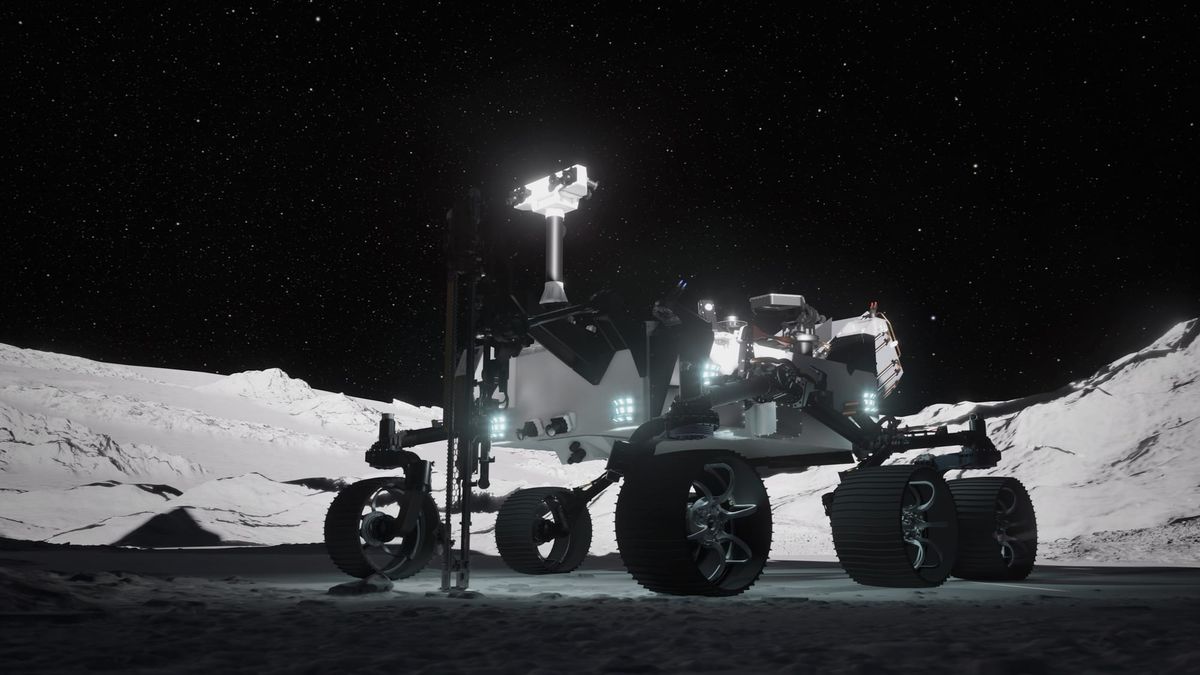
Having disclosed interest in sending existing rover hardware to the Moon in June, NASA announced on November 7th that the replica of the U.S.' two most recent Mars rovers will head to the Moon in late 2028.
To head to the Moon, the rover now named PROMISE (Polar Rover for Observation, Mapping, and In-Situ Exploration) will be equipped with unused spare hardware and suitable test items from the Curiosity and Perseverance rovers. Those are both operational on the Martian surface performing science, with Curiosity fourteen years into its two-year mission while Perseverance is in its fifth.
Previously, hardware bound for PROMISE has been used to troubleshoot issues with the two Mars rovers on Earth before commands are beamed to the red planet. At a press conference held the same day, NASA said that they have confidence in continuing to operate Curiosity and Perseverance safely using accumulated experience.
In addition to hardware from the recent Martian explorers, an unassigned radioisotope thermoelectric generator, which generates electricity via radioactive decay, is to be integrated with PROMISE to provide power. It will also allow the rover to operate during the lunar night or in permanently shadowed regions.
As for what PROMISE will get up to on the Moon, a new dedicated NASA webpage says that the rover will venture around the Moon's South Pole to characterize the surface regolith and just underground, while supporting efforts to prospect for possible resources. Doing so will be enabled by eight instruments:
- LAFORGE (Lunar Advanced Filter Observing Radiometer for Geologic Exploration): planned to measure local temperatures to assist in looking for lunar water ice and determining the composition of regolith.
- RAD (Radiation Assessment Detector): set to gather data about radiation levels around the Moon's south pole.
- LRA (Laser Retroreflector Array): designed to assist in measuring the Moon's distance from Earth as well as determining the location of the rover.
- Lunar Dashcam: a suite of cameras to image the terrain and surrounding environments to build 3D terrain maps.
- NSS (Neutron Spectrometer System): planned to assist with locating hydrogen below the lunar surface.
- NIRVSS (Near-Infrared Volatiles Spectrometer System): designed to determine what kind of ice may be present on the lunar surface as well as characterizing other minerals.
- MSOLO (Mass Spectrometer Observing Lunar Operations): set to analyze the chemical makeup of evaporating materials being drilled out from below the surface.
- TRIDENT (The Regolith and Ice Drill for Exploring New Terrain): a drill set to extract materials from up to one meter below the surface and deposit them on the surface for further analysis by the other instruments.
Those last four instruments are duplicates of those set to be flown aboard VIPER, a solar-powered lunar rover also heading for the South Pole region.
That rover also has the same task as PROMISE, allowing both to further scientific understanding of the environment of the lunar south pole region. VIPER is expected to operate on the surface for about one hundred days after being delivered in late 2027, while PROMISE should initially explore for eighteen months.
Before PROMISE can begin its lunar surface operations, it has to get there first. For that, NASA has selected Blue Origin's Blue Moon Mk1, manifesting it on its fifth vehicle, as it is the only lander in the U.S. commercial fleet able to accommodate its 1,000 kilogram mass. Interestingly, VIPER will fly on the second Blue Moon Mk1.
To get PROMISE to the surface, NASA is set to pay Blue Origin 94 million United States dollars, with an additional 140 million available based on 'performance'. A total cost for the new rover mission has not been stated, but NASA officials speaking on November 7th do not expect it to eclipse 400 million dollars. However, the Planetary Society estimates that PROMISE could cost as much as 723 million on the low end, or as much as 1.33 billion while not flying until the 2030s.
Join the discussion
Commenting is available to paid members.
View membershipSign in