
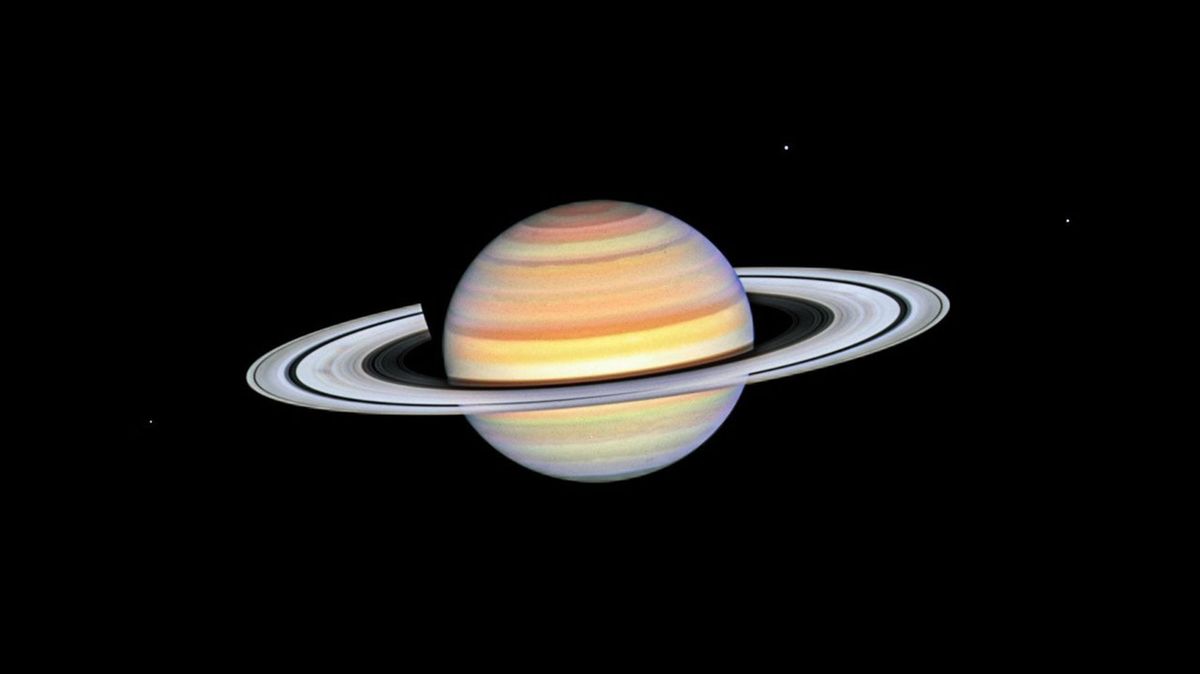
The planet Saturn is HUGE. It's over nine times wider than Earth and around 95 times more massive. The planet stretches about 74,900 miles (120,500 km) across at its equator and is roughly 9.5 Earths wide. By volume, about 764 Earths could theoretically fit inside it.
But even with all that size, Saturn is surprisingly light for an entire planet. Despite having more than 760 times Earth's volume, Saturn only has about 95 times its mass. In fact, the planet is less dense than water.
Saturn's average density is about 0.69 grams per cubic centimeter, while liquid water has a density of roughly 1 gram per cubic centimeter. That means if a body of water large enough to hold Saturn somehow existed, the entire planet would technically float.
Just how big is Saturn?
Saturn, however, isn't solid like a rubber duck floating in a tub. The above still applies, but the planet is made primarily of hydrogen and helium, with no true solid surface to stand on.
Saturn's size also gives it another unusual feature. The planet isn't actually a perfect sphere. It spins once roughly every 10.7 hours, causing its equator to bulge outward and its poles to flatten. Its equatorial diameter is thousands of miles wider than its pole-to-pole diameter, giving Saturn a slightly squashed appearance.
Then there are the rings. While Saturn itself is about 74,900 miles wide, its main ring system stretches roughly 175,000 miles (282,000 km) across. Despite their enormous size, the rings are incredibly thin compared with their width, measuring only tens of meters thick in many places.
Between its enormous size, low density and massive ring system, Saturn holds one particularly strange distinction: it remains the only planet in our Solar System with an average density low enough to technically float in water.
Join the discussion
Commenting is available to paid members.
View membershipSign in