
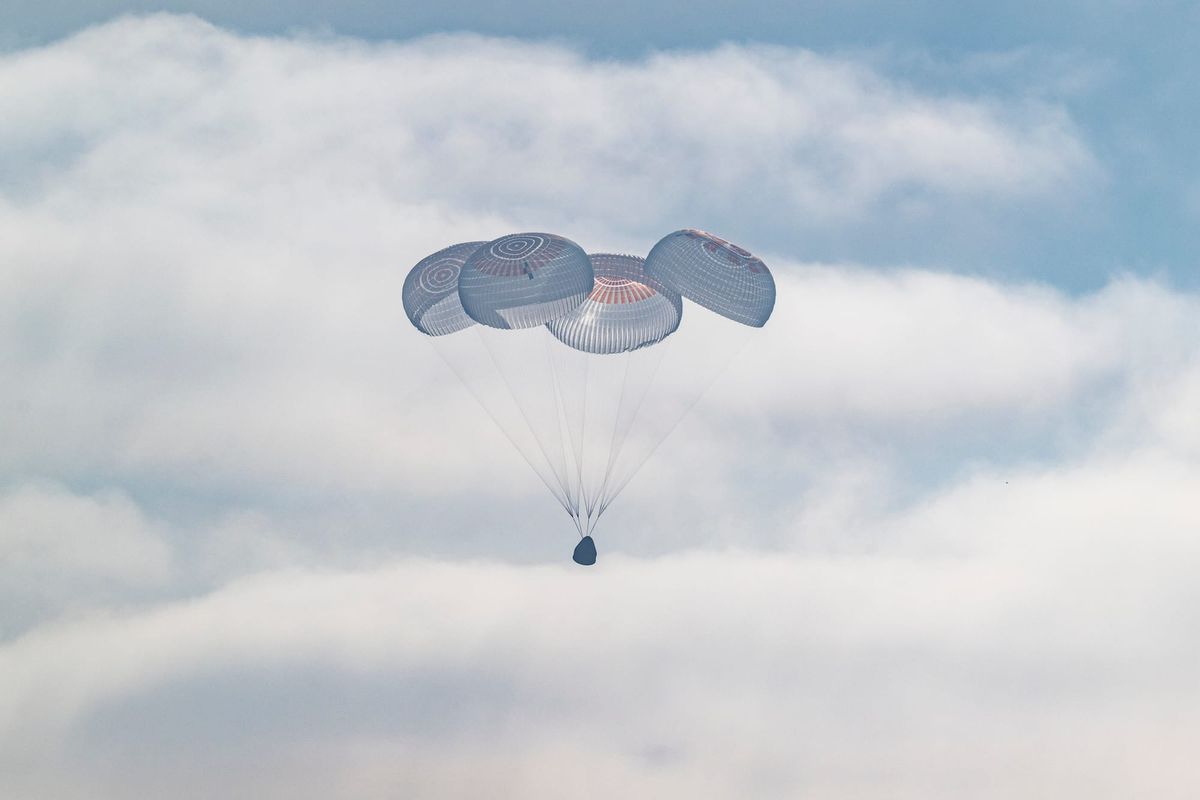
At 15:34 pm Universal Coordinated Time on October 8th, Crew Dragon 'Freedom' splashed down in the Pacific Ocean near California, bringing NASA astronauts Jessica Meir and Jack Hathaway, as well as France's Sophie Adenot and Russia's Andrey Fedyaev, concluding the Crew-12 mission.
Five hours earlier, the hatches between 'Freedom' and the station were closed to allow for final undocking preparations, which occurred at 13:05 pm. Over the course of two hours, Crew Dragon backed away from the space station, lowered its orbit, and performed a deorbit burn to return to Earth.
The four astronauts launched to the International Space Station back in February in response to a medical issue with Crew-11, and to minimize the time that the orbiting laboratory wasn't at its regular occupancy of seven people. They were only recently relieved of their duties following the arrival of Crew-13. Due to those missions, the four astronauts spent 237 days, just short of the eight-month mark by a few days, completing approximately 3,792 orbits.
Splashdown of Dragon confirmed! https://t.co/P2o7A3Gytf
— SpaceX (@SpaceX) October 8, 2026
While in space, the astronauts' day-to-day activities primarily consisted of supporting ongoing experiments, microgravity research, and hardware innovation. Items highlighted by NASA include efforts to better understand crystal structures to improve pharmaceuticals, ways to mitigate bone loss or restore that lost, how tissues develop in microgravity, trials of a new metal 3D printer, the multiplication of STEM cells for research purposes onboard, and quantum sciences.
In addition to work inside, six spacewalks were performed. The first, on March 18th, had hardware prepared by Jessica Meir and Christoper Williams (from Soyuz MS-28) ahead of the addition of a new solar array sometime in the future. On June 30th, the pair ventured outside again to repair the Canadarm2, used to move items and astronauts around. August 6th saw further preparations for a new solar array, this time by Meir and Anil Menon (from Soyuz MS-29).
Sophie Adenot began a trio of spacewalks on August 18th with the removal of a faulty communications antenna alongside Menon. A week later she was back outside, with Menon again, to connect a spare antenna to the spot where the faulty one was removed. Lastly, on September 1st, Adenot was joined by Meir for the space station's sixth all-woman spacewalk, which had a new retroreflector installed and a camera replaced.
In total, Crew-12 astronauts spent 40 hours and 31 minutes participating in spacewalks. Meir has now performed seven in her career, while Adenot has conducted her first three.
During their almost eight months onboard, the four astronauts supported the arrivals and departures of a handful of cargo spacecraft, carrying consumables and experiments. On the U.S. side of the station, that included Japan's HTV-X1, Northrop Grumman's Cygnus NG-24, and SpaceX's CRS-34 via Cargo Dragon V2. Meanwhile, the Russian segment saw Progress 92 through 96 visit.
Following a busy and lengthy mission aboard the International Space Station, NAA Administrator Jared Isaacman thanked the astronauts for their work, stating:
"Jessica, Jack, Sophie, and Andrey spent 237 days living and working in orbit, traveled more than 100 million miles, advanced important science, and returned safely home [...] Building the capability, experience, and confidence to do this repeatedly is exactly what will allow us to go farther, and I am grateful to Crew-12 and their families for their service to humanity’s greatest adventure."
Join the discussion
Commenting is available to paid members.
View membershipSign in