Rocket Lab Building Its First Geostationary Satellites for U.S. Military Use

Rocket Lab, operator of the sleek Electron rocket and manufacturer of many spacecraft parts and satellites that have ventured as far as the Moon, is now going somewhere the company has never gone before: geostationary space.
That first foray towards the orbital regime 35,786 kilometers up has come as the result of two contracts from the United States Space Force, both having settled on the company for different tasks.
The first, awarded in May, came directly from the space-focused military branch for the building of two satellites able to monitor and track other spacecraft in nearby orbits. Doing that is something the U.S. is eager to improve to allow military space officials to properly determine if another operator's or nation's satellite poses a 'threat'.
Electro-optical sensors enabling the capability to monitor surrounding orbits are coming from a Rocket Lab subsidiary via a previous contract. Those contracts have a combined value of 170.7 million United States Dollars.
A second award to build geostationary satellites has come quite recently, on August 17th, with Viasat tapping Rocket Lab as its prime contractor for the Protected Tactical SATCOM-Global program, a project of the U.S. Space Force. In that role, the company will provide effectively a ready-to-go spacecraft, except for Viasat's dual X/Ka-band secure communications payload.
That communications payload is funded by a U.S. Space Force award also from May, where Viasat was chosen alongside SES to build the 'Swarm 1' batch of small but resilient military communications spacecraft. The contract for it has a value of 437.6 million United States Dollars between the two chosen entities.
Regarding the rationale for selecting Rocket Lab as the prime contractor, Viasat's President of government business, Craig Miller, stated:
"By combining Viasat's cutting-edge communications payload technology with Rocket Lab's proven spacecraft platform, we are advancing a more agile and resilient [geostationary] architecture designed to support mission-critical communications hot spots in contested environments. We are excited to showcase how low cost, high performance dual-use technology can provide reliable connectivity for evolving missions in an increasingly contested tactical communications environment."
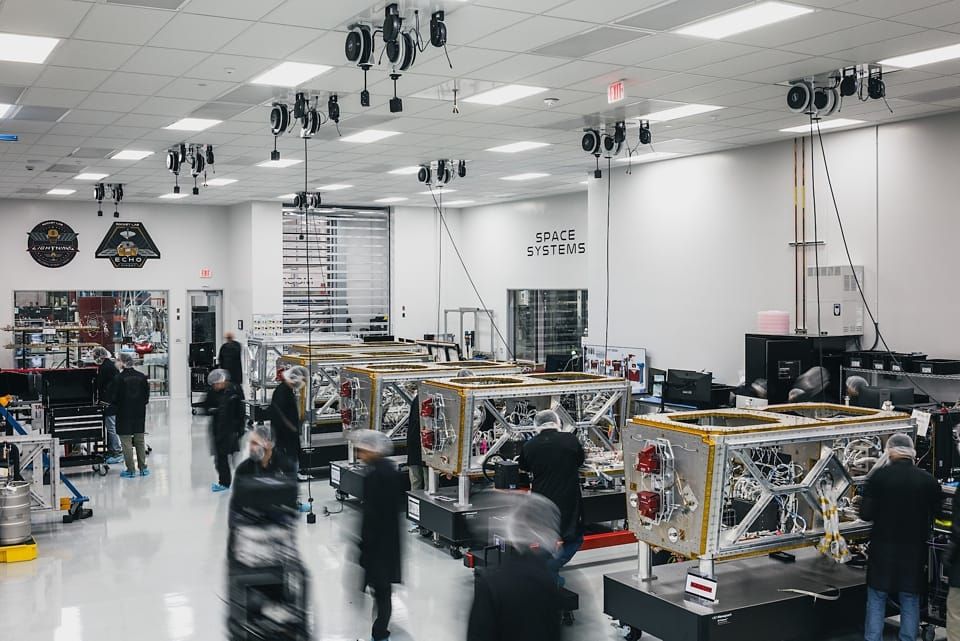
All three of the above satellites are set to use Rocket Lab's 'Lightning' spacecraft platform. That is stated to be designed for twelve years of operation in low Earth orbit for demanding sensing or communications applications, powered through three kilowatts generated via solar panels. The platform is boasted as being compatible to fly on multiple launch vehicles.
At least thirty-five 'Lightning' platforms have been ordered to date between Globalstar, to expand its internet-of-things constellation, and the U.S. Space Development Agency, for establishing an assured, resilient, low-latency military data and connectivity network.
As for when the three geostationary-bound 'Lightnings' will be deployed, only the one carrying Viasat's payload is known to have a target date, being sometime in 2029.