
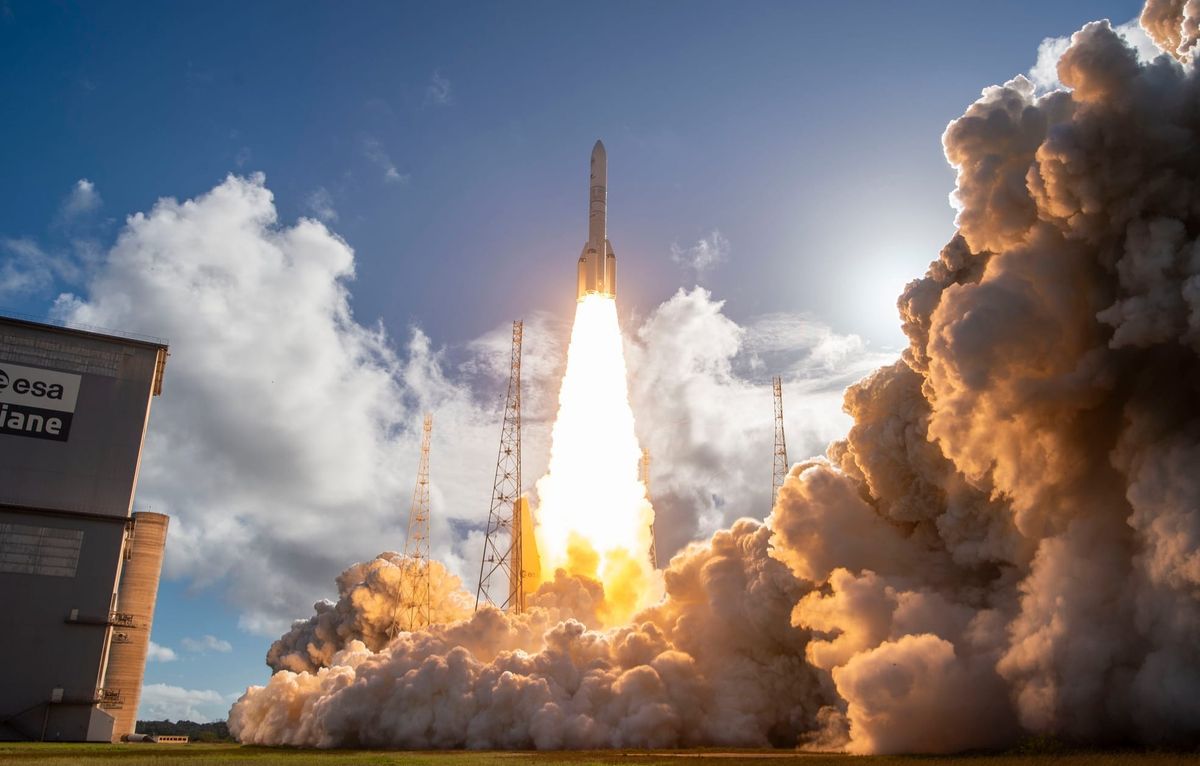
At 11:14 am Universal Coordinated Time today, November 24th, an Ariane 6 blasted off from the Guiana Space Centre heading for low Earth orbit, carrying 36 satellites for Amazon's Leo space-based internet constellation.
Four massive solid rocket boosters provided the majority of the rocket's liftoff thrust alongside the sole Vulcain 2.1 engine on the first-stage. Those boosters propelled the flight for about 143 seconds before being separated, while the single engine continued to power ascent for almost eight minutes. At the eight-minute mark, the second-stage was released and started its Vinci engine, continuing ascent into orbit until eighteen minutes after liftoff, as planned.
After the first hour in space, Ariane 6's second-stage ignited again to enter the targeted 460-kilometer deployment orbit. In that orbit, around 99 minutes after liftoff, the 36 Leo satellites were released over the course of twenty-five minutes, completing the constellation's seventeenth mission.
Following the deployment, Amazon now has 432 satellites in low Earth orbit for its space-based internet constellation. Over a quarter of those have been delivered by Ariane 6 through flights in February, April, and June.
Commenting on the company's previous and future missions aboard Ariane 6, Amazon Leo Vice President of Production Steve Metayer shared:
"Our Leo team works side by side with Arianespace on everything from satellite integration to launch day operations, and that shared expertise and trust is the driving force behind our cadence together this year. LE-04 is another strong result for that partnership, and we're looking forward to many more missions together as we prepare to roll out Amazon Leo to customers."
🚀 Four boosters. One powerful liftoff! Relive the moment Ariane 6 lifted off from Europe's Spaceport in French Guiana for its 10th flight! Powered by four P160C solid rocket boosters, Ariane 6 began its VA271/LE-04 mission carrying 36 Amazon Leo satellites into low Earth orbit. 🔥 Watch the liftoff again! Want more of VA271/LE-04 mission? Watch the live: https://t.co/JIbJtxrypY #LaunchingAmbitions #Ariane6 @AmazonLeo @ArianeGroup @esa @CNES @EuropeSpacePort
— Arianespace (@Arianespace) November 24, 2026
As of June 2026, Amazon is required by the U.S. Federal Communications Commission to have half of the Leo constellation's satellites, 1,616, in orbit by July 2028, and then have the full constellation of 3,232 satellites in space by the end of July 2029.
In deploying the seventeenth batch of Leo satellites, Amazon partly bounces back from a failure to launch its previous group atop of United Launch Alliance's Vulcan, which destroyed 40 satellites on November 15th. However, this launch had been hoped to have occurred earlier, sometime in early October, but Ariane 6 was grounded for a short while after an engine turbopump issue was found during production.
Adapting to the issue, the 36 satellites flown atop of Ariane 6 today arrived in French Guiana in August, stacked by mid-September, and were encapsulated at the start of this month. Stacking of the rocket's boosters, first-stage, and second-stage was completed by mid-November to allow the fairing full of Leo satellites to be brought on top. A readiness review of all hardware was performed on November 20th, opening the way for the successful liftoff.
While deploying Amazon's latest batch of internet satellites, Ariane 6 also reached the milestone of its tenth flight, something that has taken two years and four months to achieve since its debut in July 2024. In that time, the rocket has carried spy satellites, Europe's newest weather spacecraft, parts of a navigation system, and the earlier-mentioned Leo group deployments, which were used to introduce upgrades. Before the milestone, Ariane 6 last flew in August.
Speaking on the rocket's milestone flight and its future missions, Christophe Bruneau, Chief Executive Officer of ArianeGroup, stated:
"This tenth Ariane 6 mission is clear evidence of the industrial ramp-up now under way. This latest successful launch demonstrates ArianeGroup's ability to deliver the unrivalled reliability and performance of Ariane 6, Europe's heavy-lift launcher. More than ever, our focus is on consolidating this ramp-up to carry out next year's launches. This series of successful launches has been made possible by the extraordinary commitment of our teams and the entire industrial supply chain."
What is Ariane 6?
Ariane 6 is ArianeGroup's latest launch vehicle in the Ariane family of rockets. ArianeGroup has been manufacturing and marketing the Ariane launch vehicles on behalf of the European Space Agency since Ariane 4. Two versions of the Ariane 6 rocket are available, Ariane 62 and Ariane 64.
These two versions share the first and second stages. The first stage of Ariane 6 burns liquid hydrogen and liquid oxygen in a single Vulcain 2.1 engine, producing 139 tons of thrust. The second stage of Ariane 6 also burns liquid hydrogen and oxygen, but in a single Vinci engine that generates 18 tons of thrust.
Each of the solid rocket boosters burns a mixture of aluminum and hydroxyl-terminated polybutadiene to produce 474 tons of thrust each. This allows Ariane 62 to generate 1088 tons of thrust at liftoff, while Ariane 64 can generate 2036 tons of thrust.
Ariane 62
Ariane 62 is the cheaper of the two configurations because it opts to use two solid rocket boosters. The lift capacity of Ariane 62 is as follows: 10,350 kilograms to low Earth orbit, 7,200 kilograms to a sun-synchronous orbit, 4,500 kilograms to geostationary transfer orbit, or 3,500 kilograms to a lunar transfer orbit.
On the launch pad, Ariane 62 weighs approximately 530,000 kilograms with a first-stage, second-stage, and faring diameter of 5.4 meters. Ariane 62 stands 56 meters tall ahead of launch.
Ariane 64
Ariane 64 is the more capable of the two configurations due to its utilization of four solid rocket boosters. The lift Capacity of Ariane 64 is as follows: 22,000 kilograms to low Earth orbit, 15,500 kilograms to a sun-synchronous orbit, 11,500 kilograms to geostationary transfer orbit, 8,600 kilograms to a lunar transfer orbit, or 5,000 kilograms to geostationary orbit.
On the launch pad, Ariane 62 weighs approximately 860,000 kilograms with a first-stage, second-stage, and faring diameter of 5.4 meters, exactly the same as Ariane 62. Ariane 64 is eight meters taller than Ariane 62 and is 62 meters tall ahead of launch.
Join the discussion
Commenting is available to paid members.
View membershipSign in