
Since July, no new Amazon Leo satellites have been added to low Earth orbit. That has left the prospective space-based internet constellation flying 396 to trial customer services.
Those trials have been lightly spoken of by executives on social media, sharing snapshots of high-density and standard usage tests with consumer antennas in various undisclosed parts of the world ahead of an initial rollout later this year. Something the company has proudly directly spoken of is a test with the United States military, where speeds of 400 megabits per second were achieved.
The lack of launches has also allowed over one thousand cumulative satellites to be produced at Amazon's dedicated facility in Kirkland, Washington, and shipped for integration with various launch vehicles.
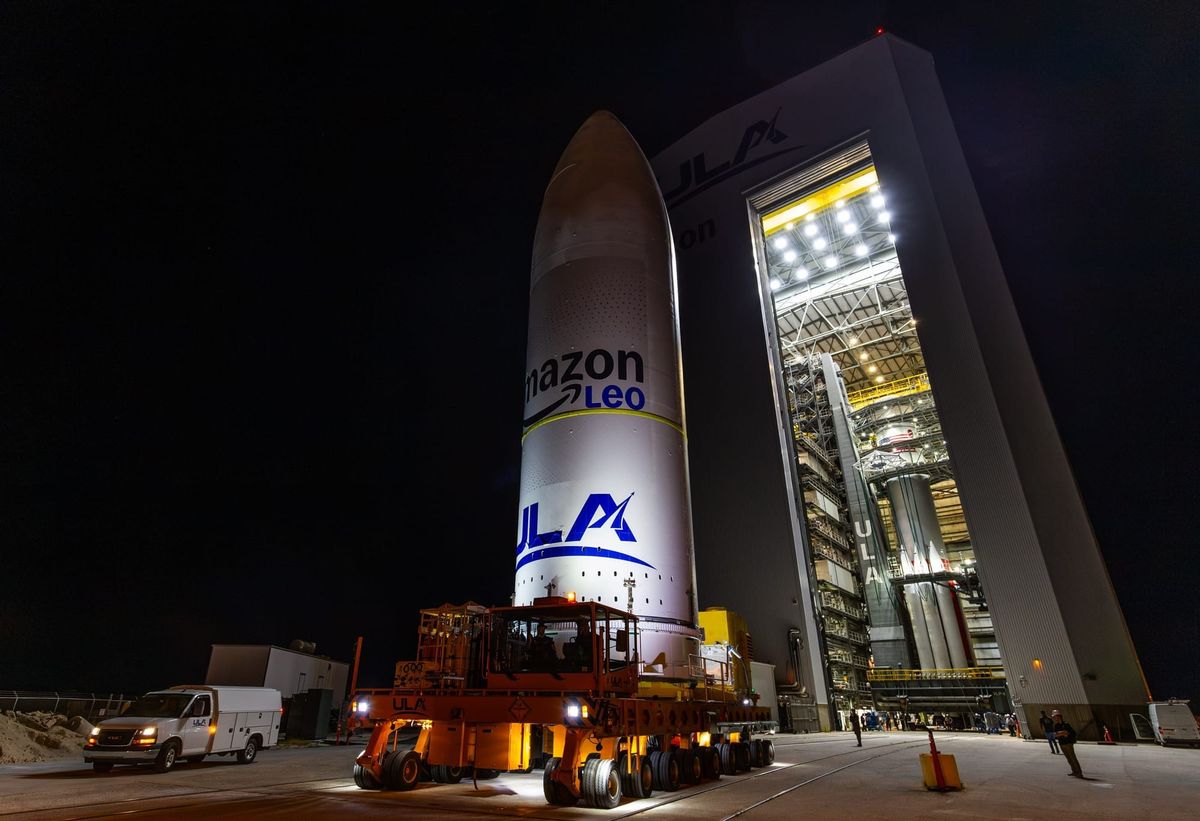
Now, almost four months after its last deployment, Amazon Leo is preparing to fly again. On October 26th, it was detailed that the first forty satellites to fly atop of United Launch Alliance's Vulcan rocket have been encapsulated and were on the move towards the launch pad in Florida. Two days later, they were announced to have been stacked with the vehicle.
To enable the deployment of forty satellites, which will become Amazon Leo's single largest group, Vulcan has been equipped with its voluminous 21.3-meter-long fairing for the first time. In addition, it's using six Northrop Grumman-made GEM-63XL solid rocket boosters while introducing a low Earth orbit-optimized Centaur-V upper stage to maximize performance.
The upcoming Vulcan mission will be its fifth overall as well as a return to flight. During its prior one in February, one of the GEM-63XL's experienced an 'observation' during ascent while still attached to the first-stage, spewing parts of rocket nozzle and debris while reducing performance. Thankfully, the rest of Vulcan made up for the losses. Since then, United Launch Alliance and Northrop Grumman have been inspecting what went wrong:
"[We] have identified several potential contributors which have been mitigated through design and process improvements to the nozzle. To support our customers, this upcoming launch will utilize the improved nozzle design, and additional testing and analysis will continue in parallel with the mission."
Vulcan could have potentially returned earlier in the year, had it not been for a major explosion involving Blue Origin's New Glenn during a static fire of seven BE-4 engines in May, which also power United Launch Alliance's rocket. It would take until August for the anomaly within the engines to be fixed and begin being implemented.
At present, Vulcan is expected to perform its first delivery for Amazon Leo no earlier than November 13th. That will be the first of thirty-eight launches currently on order.
Meanwhile, down at the Guiana Space Center in South America, thirty-six Leo satellites are currently being integrated for their fourth mission via Ariane 6. Once again to deploy Amazon satellites, the European rocket will make use of its most powerful configuration no earlier than November 23rd. The last time Ariane 6 performed a Leo mission was in mid-June.
Amazon had hoped that Ariane 6 would have been able to fly again sooner, but the rocket was grounded for a short while after an engine turbopump issue was found during production. Leo satellites are also not the rocket's only payload, as it has major commitments for its European backers and their projects.
Join the discussion
Commenting is available to paid members.
View membershipSign in